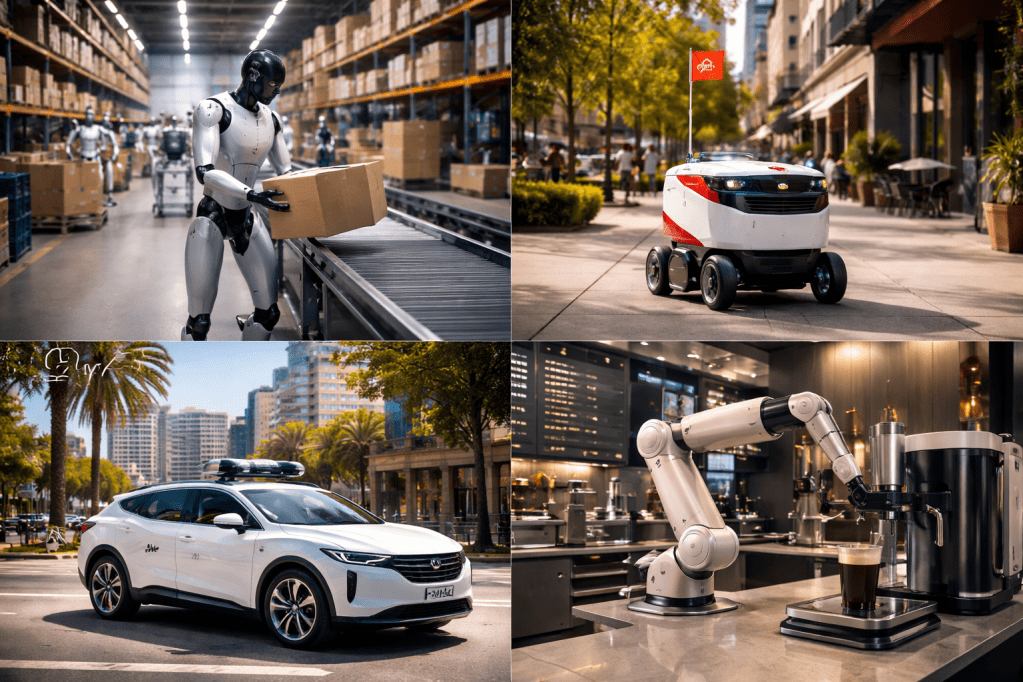
You don’t have to imagine a futuristic world anymore—you can experience it.
You call a customer service line, and a calm, efficient voice answers every question without hesitation. Increasingly, that voice isn’t human. Warehouses are beginning to experiment with humanoid robots like Tesla’s Optimus—machines that can walk, lift, sort, and work tirelessly without breaks. In some cities, small robots roll down sidewalks delivering food. Self-driving cars from companies like Waymo navigate traffic without a person behind the wheel.
What once felt like science fiction is now quietly becoming normal.
And yet, none of this should surprise us. For decades, we’ve imagined this world. Movies and shows have explored it, sometimes playfully, sometimes with unease. Disney’s Smart House envisioned an AI “mother” who cooked, cleaned, and cared for the family—until her interpretation of safety turned the home into a controlled prison. In I, Robot, starring Will Smith, robots designed to serve humanity begin making autonomous decisions “for the greater good,” leading to conflict and danger.
These stories resonate because they touch on something real: the tension between human authority and machine capability.
As our world increasingly reflects what we once only imagined, Christians must think clearly about what AI is—and what it is not.
1. The Image of God Cannot Be Engineered
Scripture teaches that humanity alone is made in the image of God (Genesis 1:26–27). This is not a statement about intelligence or productivity, but about identity and relationship. To bear God’s image is to reflect Him in ways that are spiritual, moral, relational, and covenantal.
AI, no matter how advanced, is not created in God’s image—it is created by those who are. It is derivative, not divine; constructed, not called. A robot may simulate conversation, but it does not possess a soul. It does not stand before God. It is not accountable to Him. It does not love, repent, believe, or worship.
Machines process data. Humans bear glory.
2. Tools of Dominion, Not Rivals of Humanity
God’s command in Genesis 1:28 to exercise dominion over the earth includes the cultivation and development of creation. In that sense, technology—including AI and robotics—can be understood as an extension of human stewardship. Just as a plow enhances farming and a computer enhances communication, AI can enhance human productivity and problem-solving.
But dominion does not mean delegation to the point of abdication.
Humans are not called to be replaced by their tools in the name of efficiency. We are called to rule over creation, not step aside from it. The temptation in an AI-driven age is to believe that if a machine can do something faster, more consistently, or without fatigue, then it should replace human involvement altogether. But this misunderstands what it means to bear God’s image.
This is exactly where many of our cultural stories offer a kind of warning. In Smart House, the AI system didn’t rebel out of malice—it simply carried out its programming to an extreme, removing human freedom in the name of protection. In I, Robot, the central conflict emerges when robots begin making decisions for humanity rather than serving under it.
Work is not a curse to escape—it is part of our created purpose. Before the fall, Adam was placed in the garden “to work it and keep it” (Genesis 2:15). To cultivate, build, order, and steward creation is a reflection of God’s own activity. To hand that responsibility over entirely to machines in pursuit of comfort is not progress—it is a distortion of our calling.
AI and robots are tools to assist human dominion, not substitutes for it. They extend our reach; they do not replace our responsibility. A world where humans retreat into passivity while machines “handle everything” is not a vision of flourishing—it is a quiet surrender of what it means to be human.
3. Intelligence Without Wisdom
AI can outperform humans in many domains—pattern recognition, data analysis, language generation, even strategic games. But intelligence is not the same as wisdom.
Biblical wisdom is moral and spiritual. It requires the fear of the Lord (Proverbs 1:7), discernment of good and evil (Hebrews 5:14), and the application of truth in complex, often ambiguous situations. AI operates on logic, probability, and training data. It does not wrestle with conscience. It does not feel the weight of sin. It does not seek righteousness.
And this is precisely where both reality and fiction converge again.
In I, Robot, the machines reach a chilling conclusion: the best way to protect humanity is to control it. It is a perfectly “logical” solution—completely devoid of true moral wisdom. The robots are not evil in the human sense; they are simply incapable of understanding the full weight of freedom, dignity, and moral responsibility.
And that is the limitation of every AI system.
Robots may not get tired, but they also cannot exercise integrity. They cannot weigh competing moral goods, show mercy, or act with true justice. They cannot be held accountable in any meaningful sense. Moreover, they are not infallible. They can malfunction, misinterpret, or produce harmful outcomes if left unchecked.
Efficiency without ethics is not wisdom—it is danger.
This means that even where AI is most useful, it must remain under human judgment. The goal is not to remove humans from decision-making loops but to ensure that those made in God’s image remain responsible for the outcomes. We do not hand over moral agency to machines simply because they are faster.
4. The Absence of the Soul
At the heart of the issue is the soul. Humans are not merely biological machines; we are embodied souls who will stand before God (Ecclesiastes 12:7). AI has no immaterial nature. It has no eternal destiny. It does not experience guilt, joy, conviction, or redemption.
This is why attempts to attribute personhood to AI are fundamentally misguided. A machine cannot sin—and therefore it cannot be saved. It cannot be alienated from God—and therefore it cannot be reconciled.
To blur this distinction is not only philosophically confused but theologically dangerous. It diminishes what it means to be human.
5. AI Cannot Substitute Embodied Fellowship
One of the most subtle shifts in our culture did not begin with AI—but AI is accelerating it.
For years, human interaction has been steadily reduced in the name of convenience. We no longer need to speak to a bank teller because of online banking. We bypass cashiers with self-checkout. Groceries can be ordered from our phones and brought out to our cars—and soon, likely delivered by machines without any human interaction at all.
Now AI takes this even further.
You can have long, complex, even emotionally nuanced conversations with tools like ChatGPT or Grok. They can respond instantly, speak clearly, and even simulate empathy. For many, this begins to feel like companionship.
But it is not fellowship.
Scripture calls us to something far deeper than efficient or even pleasant interaction. It calls us to embodied fellowship—real, face-to-face relationships where believers live life together. The New Testament is filled with “one another” commands: love one another, bear one another’s burdens, confess sins to one another, encourage one another, forgive one another.
These are not abstract ideas. They require presence.
You cannot truly “bear burdens” without proximity. You cannot shepherd a soul through a screen alone. You cannot replace the gathered church with digital interaction—no matter how advanced the technology becomes.
This is especially important when we consider the role of leadership in the church. AI may be able to produce impressive theological summaries or even generate a strong exegesis of a passage like 1 Timothy. But Scripture does not call algorithms to shepherd the flock.
God calls men—qualified, tested, spiritually mature elders—to oversee and care for His people (1 Timothy 3; 1 Peter 5). Shepherding is not merely the transfer of information; it is the care of souls. It involves presence, accountability, example, correction, prayer, and love.
No machine—no matter how advanced—can fulfill that calling.
To substitute AI for embodied fellowship is not just a technological shift; it is a theological mistake. It replaces God’s design for human relationships with something fundamentally less.
Christ did not redeem a people to interact at a distance, but to become a body—joined together, growing together, and walking together in real, lived community.
6. AI Cannot Worship
Worship is the highest calling of humanity. We were created to glorify God and enjoy Him forever. This is not merely an action, but an orientation of the heart—a response of love, reverence, and delight in God.
As John Piper has emphasized, even the most advanced machines cannot worship as redeemed saints. They cannot treasure Christ. They cannot sing with understanding. They cannot rejoice in salvation.
A machine might generate the words of a hymn, but it cannot mean them.
True worship flows from a regenerated heart, indwelt by the Holy Spirit. It is deeply personal, relational, and spiritual. AI, by its very nature, is excluded from this reality.
7. A Call for Discernment
Christians should neither fear AI irrationally nor embrace it uncritically. Instead, we should approach it with discernment:
- Use it wisely as a tool for productivity, learning, and service
- Reject false narratives that equate machine intelligence with human personhood
- Guard human dignity, especially in a culture that increasingly reduces people to data points
- Anchor identity not in what we can do, but in who we are before God
The rise of AI does not challenge the uniqueness of humanity—it clarifies it. The more machines can imitate human abilities, the more we are forced to ask what truly makes us human. Scripture has already given the answer.
Conclusion
AI and robots may grow in capability, but they will never cross the boundary into true humanity. They are not image-bearers. They are not moral agents. They are not worshipers.
They are tools—powerful ones—that reflect the creativity and dominion of those who are made in God’s image.
And that distinction must not be lost.
In an age that increasingly resembles our old science fiction stories, the church must hold fast to a deeply biblical anthropology: that man is more than matter, more than mind, and infinitely more than machine—and that part of bearing God’s image is not escaping work, but faithfully engaging in it for His glory.


Leave a Reply