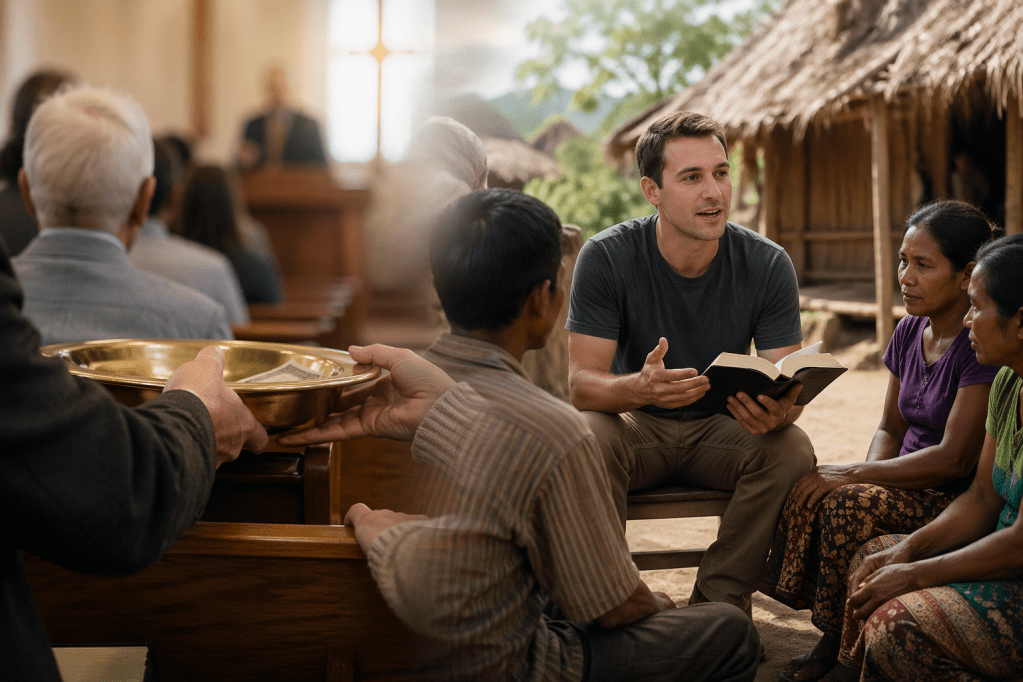
The cooperative spirit of the Southern Baptist Convention is often explained historically or pragmatically—as a strategy to accomplish more together than we could apart. But long before it was a strategy, it was Scripture. Long before it was formalized in structures like the Cooperative Program, it was embedded in the life of the early church.
If we want to understand why churches voluntarily unite to give financially for the advance of the gospel, we need to look closely at what is often called the Jerusalem Collection—a sustained, multi-church effort in the New Testament that reveals cooperation not as an innovation, but as part of the very DNA of the church.
The Beginning of a Pattern: Acts and the First Cooperative Effort
The earliest glimpse of this pattern appears in the Acts of the Apostles. In Acts 11:27–30, a prophetic warning is given that a severe famine will come upon the land. The church in Antioch responds immediately and decisively. Luke tells us that “the disciples determined, every one according to his ability, to send relief to the brothers living in Judea.”
This moment is more than an act of compassion—it is a theological and ecclesial blueprint. A local church, made up largely of Gentile believers, takes responsibility for meeting the needs of distant Jewish Christians. There is no command from Jerusalem demanding tribute, no centralized structure enforcing compliance. Instead, there is voluntary, proportionate giving—“every one according to his ability”—and a deliberate plan to send that support through trusted leaders.
Already, we see the essential components of cooperation: willingness, intentionality, accountability, and a shared sense of belonging to something larger than the local congregation.
A Defining Commitment: Paul and the Apostolic Vision
This instinct toward cooperation is not isolated. It becomes a defining feature of Paul’s apostolic ministry. In Epistle to the Galatians 2:10, Paul recounts his meeting with the leaders in Jerusalem. After affirming the unity of the gospel between Jewish and Gentile missions, they ask only one thing of him: “that we should remember the poor, the very thing I was eager to do.”
This is significant. The call to remember the poor—specifically the poor among the saints in Jerusalem—was not a side project. It was woven into the mission itself. Paul does not treat it as an obligation reluctantly accepted, but as something he was already eager to pursue. From this point forward, the Jerusalem Collection becomes a consistent thread running through his ministry.
Ordered and Corporate Giving: Instructions to Corinth
When Paul writes to the church in Corinth, he makes it clear that this effort is not isolated to one region or congregation. In 1 Corinthians 16:1–3, he writes, “Now concerning the collection for the saints: as I directed the churches of Galatia, so you also are to do.”
This single sentence opens a window into a coordinated, multi-church initiative. What Paul had already instructed in Galatia, he now instructs in Corinth. The churches, though geographically separated and independently governed, are participating in a shared mission.
Paul goes further, giving practical direction: “On the first day of every week, each of you is to put something aside and store it up, as he may prosper.” This is not spontaneous or occasional giving. It is regular, disciplined, and proportional. Each believer participates. Each church contributes. And the funds are to be entrusted to approved representatives who will carry the gift to Jerusalem.
What emerges here is not compulsion, but structure. Not centralization, but coordination. The churches are working together in an orderly, intentional way to accomplish a common goal.
The Heart of Giving: Grace and Fellowship in 2 Corinthians
In 2 Corinthians 8–9, Paul returns to the subject with greater depth, drawing back the curtain on the spiritual dynamics behind this cooperation. He points to the churches of Macedonia as an example, describing how “their abundance of joy and their extreme poverty have overflowed in a wealth of generosity.”
This is a remarkable statement. These churches are not giving out of surplus, but out of lack. And yet their giving is marked by joy, not reluctance. Paul is careful to emphasize that their participation is entirely voluntary. They gave “of their own accord,” even “begging us earnestly for the favor of taking part in the relief of the saints.”
The language Paul uses is deeply theological. He describes this offering as a form of koinonia—a sharing, a fellowship, a participation in the work of God. This is not merely financial support; it is spiritual partnership. The act of giving becomes a visible expression of unity in Christ.
Paul also guards the freedom of the churches. In 2 Corinthians 9:7, he writes, “Each one must give as he has decided in his heart, not reluctantly or under compulsion, for God loves a cheerful giver.” Cooperation, then, is not driven by pressure, but by grace. It is the overflow of a transformed heart.
A Theological Culmination: Unity in Romans
By the time Paul writes to the church in Rome, the collection is nearing completion. In Romans 15:25–27, he explains that he is on his way to Jerusalem “bringing aid to the saints.” He notes that “Macedonia and Achaia have been pleased to make some contribution for the poor among the saints at Jerusalem.”
But Paul does not leave this in the realm of logistics. He interprets it theologically. “They were pleased to do it,” he writes, “and indeed they owe it to them. For if the Gentiles have come to share in their spiritual blessings, they ought also to be of service to them in material blessings.”
Here, cooperation is grounded in the gospel itself. The Gentile churches have received the riches of salvation through the Jewish Messiah and the promises given to Israel. Their financial giving, then, is not merely generosity—it is gratitude. It is a tangible acknowledgment of their unity in Christ and their shared participation in God’s redemptive plan.
The Implications for Today
When we step back and consider these passages together—from Acts, Galatians, Corinthians, and Romans—a clear picture emerges. The early churches were not isolated, self-contained units. They were interdependent, relationally connected, and missionally aligned. They maintained their local autonomy, yet they gladly cooperated for the sake of the gospel.
This cooperation was voluntary, but it was also expected. It was joyful, but it was also structured. It was financial, but it was deeply spiritual.
This is the same impulse that animates the cooperative work of Southern Baptists today. When churches choose to give together for missions, theological education, disaster relief, and church planting, they are walking in a well-worn, biblical path. They are not surrendering their independence; they are expressing their unity.
Conclusion: Cooperation as a Gospel Instinct
The Jerusalem Collection shows us that cooperation is not a modern invention or merely a denominational distinctive. It is a reflection of the gospel itself. Just as believers are united to Christ and to one another, so they share their lives and resources for the good of the body and the advance of the mission.
In a world that prizes independence and self-sufficiency, the church bears witness to something better: a voluntary, joyful partnership rooted in grace.
From Biblical Cooperation to the Cooperative Program
If the Jerusalem Collection reveals that cooperation is part of the church’s original design, then the question becomes: what does that look like today?
For Southern Baptists, the most visible and enduring answer is the Cooperative Program (CP)—a unified giving strategy that channels the voluntary contributions of thousands of churches into a shared mission. Far from being a modern invention detached from Scripture, the CP is best understood as a practical outworking of the same biblical instincts we see in Acts and the Epistles: churches, freely and joyfully, pooling resources to advance the gospel beyond their individual reach.
A Brief History of the Cooperative Program
The Cooperative Program was established in 1925 during a pivotal moment in the life of the Southern Baptist Convention. At the time, Southern Baptists were funding missions and ministries through a patchwork of special offerings and direct appeals. This approach often led to competition between causes, inefficiency in fundraising, and inconsistent support for long-term mission work.
In response, Southern Baptist leaders proposed a different way forward: instead of multiple competing appeals, churches would give one unified offering through their state conventions, which would then be distributed to support a wide range of ministries.
This approach reflected several deeply biblical convictions:
- That cooperation is more effective than competition
- That giving should be intentional and systematic, not sporadic
- That mission work should be collectively owned, not dependent on individual personalities or organizations
In many ways, the Cooperative Program echoes Paul’s instructions in 1 Corinthians 16—regular, planned giving across multiple churches for a shared mission—only now applied on a much broader scale.
How the Cooperative Program Works
At its core, the Cooperative Program is beautifully simple:
- Each local church decides voluntarily what percentage of its undesignated tithes and offerings to give
- Those funds are sent to the church’s state convention
- The state retains a portion for local and regional ministry
- The remainder is forwarded to the national and international mission causes of the SBC
No church is coerced. No external authority dictates the amount. Each congregation gives as it has “decided in its heart” (2 Cor. 9:7), just as the New Testament pattern describes.
And yet, when combined, these gifts create a powerful force for gospel advancement.
What Cooperative Program Giving Supports
What, then, does this cooperation actually accomplish?
Much like the Jerusalem Collection met real needs among real people, CP giving fuels tangible gospel work across a wide spectrum of ministries.
1. Church Planting and Revitalization
Through the North American Mission Board (NAMB), Cooperative Program dollars help plant churches across North America—especially in underserved and unreached areas.
- New congregations are started in cities, suburbs, and rural communities
- Struggling churches receive support for revitalization
- Missionaries are deployed to engage diverse populations
This is a direct extension of the apostolic pattern: the gospel moving outward through the establishment of new local churches.
2. Collegiate and Next-Generation Ministry
CP giving also supports campus ministries that reach students during one of the most formative seasons of life.
- College students encounter the gospel
- Future leaders are discipled and trained
- Many are called into ministry and missions
Just as Paul invested in younger believers like Timothy, Cooperative Program giving helps raise up the next generation for gospel service.
3. International Missions
Through the International Mission Board (IMB), CP funds send and sustain thousands of missionaries around the world.
- Missionaries are fully supported so they can focus on gospel work
- Unreached people groups are engaged
- Churches are planted in hard-to-reach places
This is perhaps the clearest modern parallel to the Jerusalem Collection: churches pooling resources so that the gospel can go where it otherwise could not.
4. Theological Education
The Cooperative Program funds Southern Baptist seminaries, providing affordable, theologically grounded training for pastors and ministry leaders.
- Students are equipped to rightly handle the Word
- Churches are strengthened through sound doctrine
- Leaders are trained without crippling financial burden
This ensures that the gospel not only spreads widely, but is also preached faithfully.
5. Disaster Relief and Compassion Ministry
Through various SBC channels, CP giving enables rapid and effective responses to crises:
- Disaster relief teams provide food, shelter, and cleanup after hurricanes, floods, and wildfires
- Volunteers meet both physical and spiritual needs
- The gospel is shared in moments of deep vulnerability
In these efforts, we see echoes of Acts 11—believers responding to urgent needs with generosity and action.
6. Orphan Care and Mercy Ministries
Cooperative giving also supports initiatives related to:
- Adoption and foster care
- Crisis pregnancy support
- Care for the vulnerable and marginalized
These ministries reflect the biblical call to care for “the least of these,” demonstrating the compassion of Christ alongside the proclamation of His gospel.
Why This Matters
It is easy to view the Cooperative Program as a funding mechanism. But that would miss its deeper significance.
The CP is a theological statement.
It declares that:
- The mission of God is bigger than any one church
- The gospel compels us to share not only our message, but our resources
- Unity in Christ leads to partnership in mission
Just as the churches of Macedonia, Achaia, Galatia, and Corinth joined together to support the saints in Jerusalem, Southern Baptists today unite to send the gospel to neighborhoods, campuses, cities, and nations.
Conclusion: A Modern Expression of an Ancient Pattern
The Jerusalem Collection was not just about meeting a need—it was about expressing the unity of the church and advancing the mission of God.
The Cooperative Program carries that same vision forward.
It is not perfect, because it is carried out by imperfect people. But at its best, it reflects something profoundly biblical: churches, freely and faithfully, working together so that Christ is proclaimed where He is not yet known.
In that sense, every Cooperative Program gift—no matter the size—is part of a much larger story.
A story that began in the pages of the New Testament…
…and continues today, as churches unite for the sake of the gospel.