Category: Uncategorized

  • Pastoral Ministry is not a 9-5 Job

    Pastoral Ministry is not a 9-5 Job

    A new pastor arrives at a church with prayerful anticipation and a sense of holy calling. The search process had been long. The pulpit had been vacant. The congregation had asked for a shepherd who would preach the Word, love the people, and lead with faithfulness and conviction.

    At first, everything feels hopeful.

    Sermons are preached. Visitation begins. Relationships slowly form. The Word is opened with care, and the church begins to sense the stirrings of renewed direction. There is gratitude in the room, expectation in the air, and a shared hope that God is building something steady and faithful.

    But then, almost quietly at first, a different conversation begins to surface.

    “Where is his car during the day?”

    “He’s not in the office much.”

    “Our tithes and offerings pay his salary—what exactly is he doing all day?”

    The tone is not always hostile. Sometimes it is framed as stewardship. Sometimes as accountability. Sometimes as concern for order. But underneath it is a deeper assumption—that pastoral faithfulness is measured primarily by visibility, especially in the office during expected hours.

    And slowly, something subtle begins to form: suspicion replacing trust.

    Yet Scripture gives a very different vision of pastoral life.


    Shepherds Among the Flock, Not Employees in an Office

    The New Testament never describes pastors primarily as office workers, but as shepherds entrusted with souls.

    “Pay careful attention to yourselves and to all the flock, in which the Holy Spirit has made you overseers, to care for the church of God…” (Acts 20:28)

    The focus is not office presence—it is care for the flock.

    “They are keeping watch over your souls, as those who will have to give an account.” (Hebrews 13:17)

    The work is defined not by location but by responsibility: watching over souls before God.

    That kind of work cannot be reduced to business hours.


    Jesus and the Disruption of “Off Hours”

    The clearest picture of pastoral life is found in Jesus Himself.

    There are moments when Jesus intentionally withdraws.

    “He would withdraw to desolate places and pray.” (Luke 5:16)

    He steps away from the crowds. He seeks solitude. He rests. He communes with the Father. There is nothing rushed or reactive about it.

    But what happens next is crucial.

    The crowds do not respect His schedule.

    They follow Him.

    They find Him in the places He went to be alone.

    And instead of turning them away with frustration or saying, “This is not office hours,” Scripture says:

    “He had compassion on them…” (Matthew 14:14)

    “They were like sheep without a shepherd.” (Mark 6:34)

    Even when He had withdrawn, even when He was seeking rest, even when He was not “on the clock,” ministry interrupted Him—and He did not reject it.

    He taught them.

    He healed them.

    He fed them.

    This pattern appears again and again: divine interruption.

    Not chaos, but compassion.

    Not lack of boundaries, but love that is responsive rather than scheduled.


    When Ministry Does Not Fit the Schedule

    This is where pastoral ministry fundamentally differs from a 9–5 job.

    A corporate structure assumes predictable hours, defined output, and protected time blocks.

    But shepherding does not work that way.

    Ministry often arrives:

    • after office hours
    • during family dinners
    • late at night
    • early in the morning
    • in moments of personal exhaustion or intended rest

    A hospital emergency does not ask if the pastor is available.

    A marriage crisis does not wait for morning staff hours.

    A death does not schedule itself around calendars.

    A struggling believer does not only struggle during business hours.

    And so the question must be asked: what kind of expectation are we placing on pastoral ministry?

    Because if a church assumes the pastor is only “working” when visible in the office, then much of the most essential shepherding work will be misunderstood as absence.


    The Shepherd’s Burden Is Often Invisible

    Paul describes ministry this way:

    “I do not cease to admonish everyone with tears.” (Acts 20:31)

    “There is the daily pressure on me of my anxiety for all the churches.” (2 Corinthians 11:28)

    That is not a 9–5 description—it is a constant weight.

    Likewise:

    “Shepherd the flock of God that is among you…” (1 Peter 5:2)

    Among you. Present. Embedded in life. Responsive.

    Much of that work never appears on a schedule:

    • prayer that no one sees
    • counsel that no one hears
    • study that no one recognizes
    • burdens carried silently
    • interruptions that look like “absence” from the outside

    But heaven sees it differently.


    When Visibility Replaces Trust

    When a church begins to measure ministry primarily by office presence, a subtle shift occurs.

    The pastor becomes a service provider.

    The church becomes an evaluator.

    And trust is replaced with surveillance.

    But Scripture calls the church to something deeper:

    “Obey your leaders and submit to them, for they are keeping watch over your souls…” (Hebrews 13:17)

    That command assumes trust rooted in spiritual responsibility—not constant visibility.

    Without trust, suspicion fills every gap:

    • If he is not seen, he must not be working.
    • If he is not in the office, he must be absent.
    • If he is not visible, he must be idle.

    But shepherding is often most faithful when it is least visible.

    And more importantly, it is often most needed when it is least convenient.


    A Warning for the Life of the Church

    There is a sobering reality here.

    One day, every member of the flock will need a shepherd at a moment that does not fit a schedule.

    At midnight.
    In crisis.
    In grief.
    In unexpected loss.

    And in that moment, no one will ask:

    “Was he in the office today?”

    They will ask:

    “Will he come? Will he care? Will he shepherd us now?”

    But a culture that trains itself to question a shepherd’s unseen labor may find itself unprepared to receive his presence when it matters most.


    A Better Vision: Trust, Presence, and Faithful Shepherding

    A healthy church is not marked by blind trust or unaccountable leadership, but by mutual trust shaped by the gospel.

    The pastor labors publicly in preaching and teaching.

    He labors privately in prayer, counsel, study, and care.

    And the congregation recognizes that shepherding is not a job confined to hours, but a calling accountable to God.

    So the question is not ultimately:

    “Where is his car?”

    Or even:

    “Why isn’t he in the office?”

    But:

    • Is he faithfully watching over our souls?
    • Is he present when it matters most?
    • Do we trust the Lord who placed him here?

    Because pastoral ministry is not measured by office hours.

    It is measured by faithfulness to Christ and care for His people.

    And often, the most important moments of that care happen precisely when no one expected them—interrupting schedules, crossing boundaries, and reflecting the very compassion of Christ Himself.

  • Salt, Light, and the Danger of Blinding Brightness

    Salt, Light, and the Danger of Blinding Brightness

    Jesus’ words are familiar enough to lose their edge.

    “You are the salt of the earth… You are the light of the world” (Matthew 5:13–14).

    We quote them. We affirm them. We even build strategies around them. But somewhere along the way, many of us have quietly redefined what it means to be salt and light—not by Scripture, but by our instincts in an age of outrage.

    Ed Stetzer, in Christians in the Age of Outrage (Tyndale House, 2018), observes that we are living in a cultural moment marked by constant outrage, where the loudest voices are rewarded and the sharpest takes spread the fastest. Jamie Dunlop, in Loving the Church… Even When It Hurts (Crossway, 2019), reminds us that many of the people who most test our patience are not “out there,” but sitting right beside us in the pews.

    Put those together, and you start to see the problem.

    We are trying to be light—but we’ve confused illumination with intensity.

    When Light Stops Helping

    Light, by its nature, is meant to help people see.

    A lamp on a dark path doesn’t blind—it guides. It reveals where to step. It helps you move forward with confidence.

    But not all light helps.

    A two-million candlepower spotlight aimed straight into someone’s eyes doesn’t illuminate anything. It disorients. It overwhelms. It may be technically “bright,” but it is profoundly unhelpful.

    And if we’re honest, much of what passes for Christian “light” today feels less like a lamp for the path and more like a blinding floodlight.

    We win arguments but lose people.
    We speak truth but without proportion.
    We react quickly but rarely with patience.

    We are bright—but not helpful.

    Salt That Preserves, Not Burns

    The same is true of salt.

    Salt preserves. It enhances. It brings out what is good. In the ancient world, it slowed decay and made food usable.

    But salt, used carelessly, ruins a meal.

    No one sits down to eat a spoonful of it. No one enjoys food that has been overwhelmed by it. Salt is meant to be present, but not overpowering.

    Yet many of us have adopted a posture where being “salty” means being sharp, biting, and unfiltered—something Stetzer warns can easily mirror the outrage-driven tone of the culture rather than the character of Christ. We justify harshness as faithfulness, as if conviction requires abrasion.

    But biblical salt doesn’t destroy—it preserves.

    If our presence consistently corrodes relationships, inflames conflict, and drives people away, we should at least ask whether we’ve confused zeal with wisdom.

    The Outrage Temptation

    In an age of outrage, it is incredibly easy to drift into this—precisely the concern Stetzer raises as he calls Christians to resist becoming “outrage addicts.”

    Outrage feels like righteousness.
    Sharpness feels like clarity.
    Volume feels like courage.

    But Scripture consistently calls us to something deeper and more difficult:

    • “Let your speech always be gracious, seasoned with salt…” (Colossians 4:6)
    • “The anger of man does not produce the righteousness of God” (James 1:20)
    • “Speaking the truth in love…” (Ephesians 4:15)

    Notice the balance. Not truth instead of love. Not love instead of truth.

    Both. Always both.

    Loving the Ones Who Test Us

    Jamie Dunlop presses this even further. In Loving the Church… Even When It Hurts, he argues that the real test of our maturity is not how we engage our ideological opponents online, but how we love the brother or sister who frustrates us, misunderstands us, or sees things differently.

    It’s easy to shine a harsh light at a distance. It’s much harder to patiently walk alongside someone in the dark.

    It’s easy to be “right.” It’s harder to be edifying.

    In the church, especially, our calling is not merely to expose error, but to build up the body (Ephesians 4:12). That requires more than brightness. It requires wisdom, restraint, and a genuine commitment to the good of others—especially those we find difficult.

    A Better Kind of Light

    Jesus did not call us to be the loudest people in the room.

    He called us to be light.

    The kind of light that:

    • Helps people see clearly
    • Guides rather than overwhelms
    • Draws attention not to itself, but to what it reveals

    And He called us to be salt:

    • Preserving what is good
    • Slowing decay
    • Making the world more “tasteable,” not less

    That kind of presence is often quieter. More patient. Less reactive—precisely the kind of countercultural witness both Stetzer and Dunlop are urging in different ways.

    But it is far more powerful.

    A Needed Question

    Before we speak, post, or respond, we might ask:

    Is this helping someone see—or just proving that I can shine?
    Is this preserving—or just burning?
    Is this building up—or simply venting in religious language?

    Being salt and light is not about intensity.

    It’s about usefulness in the hands of God.

  • When the Structure becomes the Master

    From the Sabbath to Church Order

    Jesus once said something that cut straight through an entire religious system:

    “The Sabbath was made for man, not man for the Sabbath.” (Mark 2:27)

    That statement wasn’t a throwaway line—it was a direct confrontation of how something God designed for good had been distorted into a burden. The Sabbath was given as a gift. It was meant to bring rest, restoration, and a reorientation of life around God. But by the time of the Pharisees, it had become something else entirely.

    It had become a system to be managed, protected, and enforced.

    And in the process, the very people it was meant to serve were now serving it.

    When Good Gifts Become Crushing Systems

    The Pharisees didn’t reject the Sabbath—they were zealous for it. They built detailed interpretations, safeguards, and traditions to ensure it was honored. But somewhere along the way, the purpose was lost.

    Instead of asking, “How does the Sabbath serve the good of God’s people?” the question became, “How do we ensure the system is upheld?”

    So when Jesus’ disciples plucked grain because they were hungry, it was a problem.
    When Jesus healed a man with a withered hand, it was controversial.

    Not because these acts violated God’s heart—but because they disrupted the structure.

    The result? A tragic inversion:

    • The day meant to give rest became a source of anxiety
    • The command meant to bless became a standard to condemn
    • The structure meant to serve became a master to obey

    And into that distortion, Jesus speaks with clarity:
    “The Sabbath was made for man.”

    In other words, you’ve forgotten what this is for.

    Christ as Lord Over the Structure

    Jesus doesn’t merely reinterpret the Sabbath—He claims authority over it:

    “So the Son of Man is Lord even of the Sabbath.” (Mark 2:28)

    This is crucial. The problem wasn’t the existence of the Sabbath, but the loss of its proper place. The Sabbath was never meant to stand over people as an ultimate authority. It was always meant to sit under Christ, serving His purposes for His people.

    The Pharisees had effectively reversed that order. They treated the structure as ultimate, and in doing so, they resisted the very Lord the Sabbath pointed to.

    A Pattern That Repeats

    It’s tempting to look at the Pharisees and think, How could they miss it so badly? But the truth is, the same pattern is not hard to find.

    The more I’ve thought about it, the more I’ve seen how easily this same inversion happens in established churches—particularly when it comes to church polity and structure.

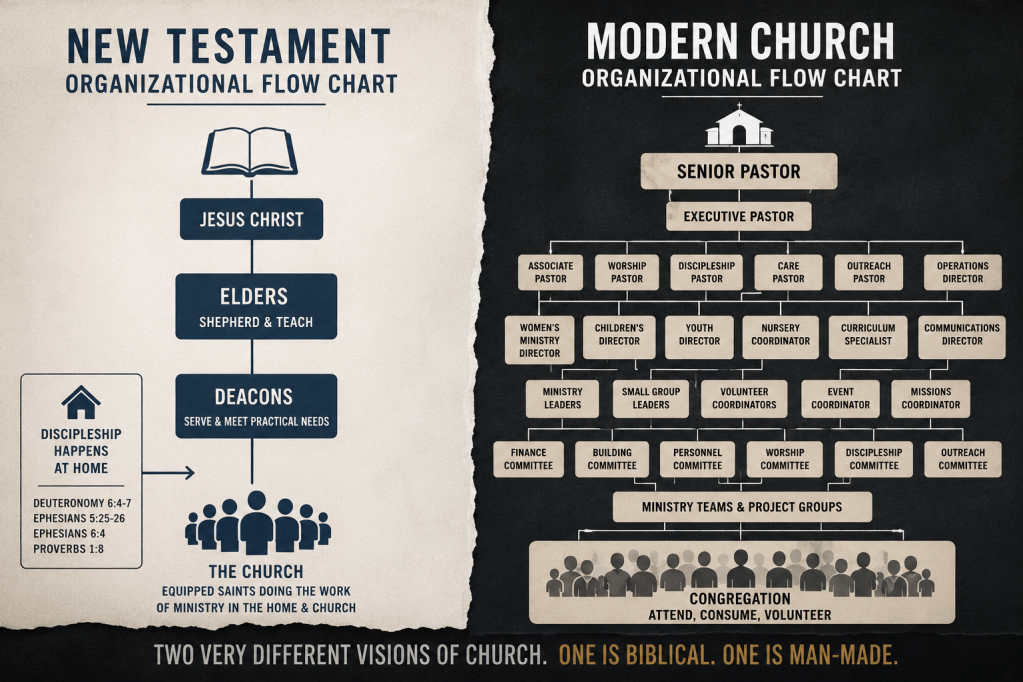
    The New Testament clearly gives us categories for church life:

    • Elders and deacons
    • Gathered worship
    • Church discipline
    • Orderly leadership

    These are not man-made inventions—they are biblical. But like the Sabbath, they were never meant to become ends in themselves.

    They were designed to serve the life and flourishing of the church.

    And yet, over time, something can subtly shift.

    When the Church Serves the Structure

    In many Baptist churches, this can take on very familiar—and often unquestioned—forms.

    Monthly business meetings, for example, may have originally been established to ensure transparency, accountability, and congregational involvement. Those are good and biblical instincts. But in practice, it’s not uncommon for churches to continue holding them simply because “it’s in the constitution.”

    So the church gathers, not because there is meaningful business to address, but because the structure demands it. Time is spent, energy is drained, and sometimes tension is created—not because the body is being built up, but because the system is being maintained.

    The same can be said of committees.

    At one point, committees may have been a way to involve more people in the life of the church—to give opportunities for service, to distribute responsibility, to ensure care for different areas of ministry. But over time, many churches find themselves scrambling to fill positions that no longer reflect real needs.

    Positions are filled not because there is meaningful work to be done, but because the chart says they must exist.

    So members are placed into roles they may not be gifted for, meetings are held with little purpose, and service becomes something people endure rather than something that gives life.

    All the while, the New Testament’s simple categories—elders who shepherd and deacons who serve—are often overshadowed by layers of structure that have accumulated over time.

    You can see it in other ways as well:

    • Ministry calendars that are packed not because they are fruitful, but because “this is what we’ve always done”
    • Voting processes that prioritize procedure over clarity and unity
    • Policies that make it difficult to respond wisely to real pastoral situations because “that’s not how we handle things”
    • Leadership energy spent maintaining systems rather than discipling people

    None of these things are necessarily wrong in themselves. In fact, many of them began with good intentions.

    But they illustrate the same shift:
    What once served the church can slowly become the thing the church serves.

    The Danger of Confusing Means and Ends

    This is where the real danger lies: confusing what is ultimate with what is instrumental.

    Church order is instrumental. It is a means. It is a tool.

    The church itself—the people of God, redeemed and being conformed to Christ—is the end.

    When that distinction blurs, we start protecting the tool as if it were the mission.

    And just like in Jesus’ day, the very systems designed to promote health can begin to hinder it.

    Not Less Order, But Rightly Ordered Order

    The answer is not to abandon structure altogether. Jesus didn’t abolish the Sabbath. The apostles didn’t reject church order.

    The answer is to restore structure to its proper place.

    A healthy church understands:

    • Christ is Lord of the church—not its systems
    • Scripture shapes our structures—but does not reduce life to them
    • Order exists for edification—not control
    • Leadership is for shepherding—not preserving an institution

    In other words, structure must remain a servant.

    The moment it becomes a master, we are no longer being more faithful—we are repeating the error Jesus confronted.

    Recovering the Heart of It

    What would it look like to recover this?

    It would mean asking different questions:

    • Not just, “Is this according to our polity?” but “Is this building up the body?”
    • Not just, “Are we maintaining order?” but “Is this helping people grow in Christ?”
    • Not just, “Are we protecting the system?” but “Are we shepherding souls?”

    It might even mean having the courage to say:

    • Do we need this meeting?
    • Does this committee actually serve the church?
    • Is this structure helping or hindering our mission?

    And where the answer is clear, making changes—not recklessly, but wisely and biblically.

    It would mean holding our structures with conviction—but also with humility, recognizing they are servants of something greater.

    A Final Word

    The Sabbath was a gift. Church order is also a gift.

    But gifts can be misused.

    When the church begins to exist for the preservation of its structures, rather than structures existing for the flourishing of the church, we have not become more biblical—we have become more brittle.

    Jesus is still Lord—not only of the Sabbath, but of His church.

    And every structure, no matter how well-intended or historically established, must remain under His authority, serving His purposes, and never replacing His rule.

  • Three Days and Three Nights…or a Day and a Half

    Three Days and Three Nights…or a Day and a Half

    Understanding the Timeline of Jesus’ Burial and Resurrection

    One of the most common questions surrounding the resurrection of Jesus is a seemingly simple one:

    If Jesus said He would be in the grave for “three days and three nights,” why does it look like He was only there for about a day and a half?

    According to the Gospel accounts, Jesus is buried late Friday, remains in the tomb on Saturday, and rises early Sunday morning. By modern standards, that’s not three full days and three full nights—it’s closer to 36 hours.

    So is this a contradiction?

    Not at all. The issue isn’t with the text—it’s with how we’re reading it.


    The Source of the Tension

    Jesus says in Matthew 12:40:

    “For just as Jonah was three days and three nights in the belly of the great fish, so will the Son of Man be three days and three nights in the heart of the earth.”

    Read through a modern lens, that sounds like a precise measurement:

    • Three full days
    • Three full nights
    • A literal 72-hour period

    But when we turn to the Gospels, we find something different:

    • Jesus dies and is buried on Friday afternoon
    • He remains in the tomb through Saturday
    • He rises early Sunday morning

    That’s:

    • Part of Friday
    • All of Saturday
    • Part of Sunday

    Which raises the question: how does that equal “three days and three nights”?


    Ancient People Didn’t Count Time Like We Do

    The answer lies in understanding how time was counted in the ancient Jewish world.

    We tend to think in precise, clock-based measurements. A “day” means 24 hours. Anything less is incomplete.

    But in the first century, time was often counted inclusively, meaning:

    Any part of a day could be counted as a whole day.

    This wasn’t unusual or sloppy—it was normal.

    So:

    • A few hours on Friday = Day 1
    • Saturday = Day 2
    • A few hours on Sunday = Day 3

    That is “three days” in the way people commonly spoke.


    “Three Days and Three Nights” Was an Idiom

    The phrase Jesus uses—“three days and three nights”—was not a technical expression requiring exact duration. It was a common Jewish idiom referring to a period that spanned three days, even if only partially.

    We see this kind of language elsewhere in Scripture.

    In Esther 4:16, Esther tells the Jews to fast for “three days, night and day.” Yet in the very next chapter (Esther 5:1), she goes to the king on the third day, not after three full days have passed.

    Similarly, in 1 Samuel 30, a servant speaks of “three days and three nights,” but also refers to the same period as “three days ago.”

    These examples show that:

    “Three days and three nights” did not require three complete 24-hour cycles.

    It was a flexible expression, not a mathematical formula.


    The Gospels Use Multiple Expressions Interchangeably

    Another clue comes from how the New Testament itself describes the resurrection timeline.

    Jesus repeatedly says:

    • He will rise “on the third day” (Luke 24:7)
    • He will rise “after three days” (Mark 8:31)

    These phrases are used interchangeably with “three days and three nights.”

    If the Gospel writers saw these as contradictory, we would expect clarification—but instead, they present them side by side without concern.

    Why?

    Because in their world, they meant the same thing.


    The Point of Jonah Isn’t the Stopwatch

    When Jesus references Jonah, He isn’t primarily making a chronological argument—He’s making a theological one.

    Jonah’s time in the fish represents:

    • Descent into judgment
    • Separation from the land of the living
    • A dramatic deliverance

    Jesus is saying: just as Jonah emerged, so will He.

    The emphasis is on the pattern, not the precise number of hours.


    Why Modern Readers Struggle

    The difficulty arises because we instinctively read ancient texts with modern expectations.

    We assume:

    • Precision where there was flexibility
    • Literal symmetry where there was idiom
    • Exact measurements where there was common speech

    It’s similar to how we use expressions today:

    • “I’ve been waiting forever”
    • “I told you a thousand times”

    No one hears those and demands numerical accuracy. We understand the intent.

    In the same way, Jesus’ original audience would not have been confused by His statement. They understood exactly what He meant.


    The Timeline, Properly Understood

    When read in its original context, the timeline is straightforward:

    • Friday (Day 1): Jesus is crucified and buried before sunset
    • Saturday (Day 2): Jesus remains in the tomb
    • Sunday (Day 3): Jesus rises early

    This is fully consistent with Jewish reckoning and fulfills His prediction perfectly.


    A Final Reflection

    Interestingly, attempts to force a literal 72-hour timeline often create more problems than they solve—leading to alternative theories like a Wednesday crucifixion that don’t align as well with the Gospel accounts.

    But the real issue isn’t the Bible—it’s the lens we bring to it.

    Jesus’ words were true, not because they satisfy modern precision, but because they were spoken in the language, idioms, and worldview of His time.

    And the central claim remains untouched:

    He was truly dead.
    He was truly buried.
    And on the third day—just as He said—
    He rose.

  • From Acts to Timothy: How the Church Matures

    It started, as it often does, with a meeting that ran too long at Redemption Hill Church.

    What was supposed to be a straightforward discussion about next year’s budget had slowly turned into something else. The room wasn’t loud, but it was heavy—the kind of silence where everyone knows more is being said beneath the surface than on it.

    Pastor Daniel sat at the end of the table, hands folded, trying to keep the conversation moving. Across from him was Mark Ellison, a longtime member whose family had been at Redemption Hill for over twenty years. Mark didn’t raise his voice—he didn’t have to.

    “I just think,” Mark said, leaning back in his chair, “we need to be wise about where we’re putting resources. We’ve always prioritized ministries that actually bear fruit.”

    Everyone in the room knew what he meant.

    Jared, one of the younger members who had only been at the church a few years, shifted forward. “But who decides what counts as fruit?” he asked. “It feels like some of these decisions are already made before we even get in this room.”

    A few heads turned. No one spoke.

    Finally, one of the elders, Tom, cleared his throat. “Jared, I think we need to be careful here. There’s a reason God appoints leaders. Not every decision needs to be… debated at length.”

    Jared nodded slowly, but the tension didn’t ease. “I’m not asking for control,” he said. “Just clarity.”

    From the corner, Lisa—who oversaw one of the ministries that had recently lost funding—spoke up quietly. “It would just be helpful to know why some things are being cut and others aren’t.”

    Mark sighed, not irritated, just settled. “Not everything can be a priority,” he said. “That’s just reality.”

    But by then, the meeting had already shifted. This wasn’t about numbers anymore. It was about trust. About influence. About who actually shaped the direction of the church.

    And everyone felt it.


    In the weeks that followed, the real conversations didn’t happen in meetings.

    They happened in parking lots after Sunday service.

    In living rooms over late-night conversations.

    In group texts that started with, “I don’t want to stir anything up, but…”

    Jared met with a few others from the church. “I’m not trying to divide anything,” he said, “but it feels like there are two churches here—one that makes decisions and one that just lives with them.”

    Across town, Mark sat at his kitchen table with a couple of longtime members. “We’ve seen this before,” he said. “You get a few people who want to change everything overnight. That’s how churches lose their footing.”

    Lisa, meanwhile, quietly stepped back from her ministry. No announcement. No conflict. Just… absence.

    By the next members’ meeting, the tension was no longer subtle.

    Someone finally said the word no one had wanted to say out loud:

    “Are we heading toward a split?”

    The room went still.

    Pastor Daniel leaned forward, his voice careful. “I hope not,” he said. “But we need to be honest about where we are.”

    And then, from the back of the room, a voice broke in—earnest, almost pleading:

    “This is exactly why the church needs to get back to the simplicity of Acts 2.”

    A few people nodded.

    “No politics. No power struggles. Just the Word, prayer, fellowship… caring for each other. That’s what the church is supposed to be.”

    It sounded right.

    It sounded spiritual.

    It sounded like the answer.

    But it also raised a question that no one in the room was asking yet:

    Was Acts 2 ever meant to carry the full weight of a church over time?

    Or are we longing for a moment in Scripture that was never designed to stand alone?


    Acts Is a Beginning, Not a Mature Model

    Acts 2 describes a newly formed community in the immediate aftermath of Pentecost. The Spirit has been poured out. Thousands have been converted. The apostles are physically present. The church is unified, energized, and—at least in that moment—uncomplicated.

    But it doesn’t stay that way.

    Very quickly, cracks begin to show:

    • In Acts 5, hypocrisy enters through Ananias and Sapphira.
    • In Acts 6, conflict arises over the neglect of widows.
    • In Acts 15, doctrinal controversy threatens the unity of the church.

    The “simplicity” of Acts 2 doesn’t disappear because something went wrong—it disappears because real people are involved. Sinners saved by grace still bring sin into the life of the church. Growth introduces complexity. Diversity introduces tension. Time introduces drift.

    And what does the church do?

    It doesn’t try to recreate Acts 2. It begins to organize, appoint, clarify, and guard.


    The Reality Check: The Churches of the New Testament

    If Acts shows us the birth of the church, the Epistles show us its adolescence—and it’s not pretty.

    Take Corinth, for example. This is not a church lacking spiritual gifts or enthusiasm. And yet:

    • Members are suing one another in secular courts (1 Cor. 6).
    • Sexual immorality is being tolerated—even celebrated (1 Cor. 5).
    • The Lord’s Supper is being abused, turning a sacred meal into division and selfishness (1 Cor. 11).
    • Worship gatherings are marked by chaos rather than edification (1 Cor. 14).

    This isn’t a church that just needs to “get back to Acts 2.” This is a church that needs correction, structure, and clear apostolic authority.

    Or consider Galatia:

    Paul doesn’t commend them—he confronts them. Strongly.

    • False teachers have infiltrated the church.
    • The gospel itself is being distorted.
    • Believers are being led away from grace into legalism.

    Paul’s response is not to simplify things. It is to draw hard doctrinal lines: “If anyone preaches another gospel…let him be accursed” (Gal. 1:8).

    Then there’s Ephesus:

    Even in a relatively healthy church, unity is fragile.

    • Jew and Gentile tensions threaten to divide the body (Eph. 2).
    • Maturity is not assumed—it must be cultivated (Eph. 4).
    • The church must be equipped so it is not “tossed to and fro by every wind of doctrine.”

    Across the New Testament, a pattern emerges: churches are not drifting because they’ve become too structured—they are struggling because they are made up of sinners who need clarity, leadership, and formation.


    The New Testament Moves Toward Structure, Not Away From It

    By the time we reach the Pastoral Epistles—1 Timothy and Titus—we’re no longer looking at a brand-new movement. We’re looking at churches that have existed long enough to face serious challenges:

    • False teachers are distorting the gospel (1 Tim. 1:3–7; Titus 1:10–11).
    • Leadership is necessary and must be qualified (1 Tim. 3; Titus 1).
    • Widows need structured, ongoing care (1 Tim. 5).
    • Church order is not optional—it is essential.

    Paul doesn’t tell Timothy and Titus to “get back to the simplicity of Acts 2.” He tells them to establish elders, appoint deacons, rebuke false teaching, and bring order to the household of God.

    In other words, the church doesn’t become less structured as it matures—it becomes more so.


    Guardrails Are Not the Enemy of the Spirit

    There is often an assumption behind the “back to Acts 2” mindset: structure stifles the Spirit, while simplicity invites Him.

    But the New Testament presents a different picture.

    The same Spirit who was poured out at Pentecost is the one who:

    • Inspires the qualifications for elders and deacons
    • Commands the guarding of sound doctrine
    • Establishes patterns for discipline, care, and leadership

    Structure in the church is not a retreat from spiritual vitality—it is the means by which spiritual vitality is preserved.

    Guardrails are not opposed to life; they protect it.


    The Church Is Not an Event—It’s a Household

    Acts 2 feels like a moment. The Pastoral Epistles describe a household.

    Paul explicitly calls the church “the household of God” (1 Tim. 3:15). Households require order. They require leadership. They require care for the vulnerable. They require instruction, correction, and stability over time.

    You can’t run a household on a perpetual “Pentecost moment.” It requires ongoing faithfulness.


    The Real Danger of Romanticizing Acts 2

    When we idealize Acts 2 as the model to return to, we can unintentionally:

    • Downplay the necessity of qualified leadership
    • Resist accountability and doctrinal clarity
    • Neglect long-term care structures (like widows and the needy)
    • Confuse emotional vibrancy with spiritual health

    Worse, we can begin to see the very instructions God gives in the Pastoral Epistles as less spiritual than the early days of Acts.

    But that’s exactly backward.


    Don’t Rewind—Mature

    The goal isn’t to go back to Acts 2. The goal is to become a church that is:

    • Rooted in apostolic doctrine
    • Led by qualified, godly elders
    • Served by faithful deacons
    • Committed to sound teaching
    • Structured to care for its people
    • Equipped to guard the gospel over time

    Acts 2 shows us what the Spirit begins.
    1 Timothy and Titus show us what the Spirit sustains.


    A Better Vision

    Yes, we should long for the devotion, generosity, and gospel power of Acts 2.

    But we should also embrace the wisdom, order, and durability of the Pastoral Epistles.

    Because the same God who poured out His Spirit in Acts 2 is the God who, through Paul, told the church how to endure.

    Not as a moment.

    But as a faithful, ordered, truth-guarding people—generation after generation.

  • The Resurrection: Reliable, Relevant, and Transformative

    The Resurrection: Reliable, Relevant, and Transformative

    From a small town in Galilee over two thousand years ago, a movement began under the leadership of Jesus of Nazareth. That movement has since spread to every continent and now counts billions of followers worldwide. Yet despite its global influence, one question remains at the heart of Christian faith: Did Jesus truly rise from the dead?

    The resurrection of Jesus Christ is not only the central event in history but also the cornerstone of Christian belief. In our day, skeptics question both its reality and its relevance. A careful examination of Scripture, however, reveals why the resurrection is historically credible, spiritually transformative, and calls for a response.


    1. The Reliability of the Resurrection

    Several lines of evidence from Scripture support the resurrection’s reliability:

    Multiple Eyewitness Accounts
    Paul emphasizes in 1 Corinthians 15:3–8 that Jesus was seen alive by many after his death:
    “He appeared to Cephas, then to the twelve. After that, he appeared to more than five hundred brothers and sisters at the same time… Then he appeared to James, then to all the apostles.”
    Paul stresses that many witnesses were alive at the time of his writing, inviting verification.

    The Role of Women as First Witnesses
    All four Gospel writers report women as the first witnesses to the empty tomb (Matthew 28:1–10; Mark 16:1–8; Luke 24:1–12; John 20:1–18). In first-century Jewish culture, women’s testimony was often discounted. The consistent inclusion of women as first witnesses strongly suggests these accounts were preserved accurately, rather than fabricated.

    The Transformation of Skeptics
    Those who initially doubted or opposed Jesus became bold witnesses. Peter, who denied Jesus three times, preached openly (Acts 2). Paul, a former persecutor of Christians, became a devoted apostle after encountering the risen Christ (Acts 9). Their radical transformations point to an extraordinary reality: something truly remarkable happened.

    Empty Tomb Confirmed by Authorities
    Even the Gospel writers note that the tomb was heavily guarded (Matthew 27:62–66) and sealed. Opponents suggested the disciples stole the body, but no evidence supports that claim. The presence of Roman guards makes such a theft highly implausible.

    Responding to Skeptical Theories

    • Wrong Tomb Theory: If the women had gone to the wrong tomb, opponents could have simply produced the body from the correct tomb. No such body appeared.
    • Stolen Body Theory: The disciples remained in Jerusalem under threat, boldly proclaiming the resurrection. Their courage undermines the idea of theft.
    • Swoon Theory: The claim that Jesus didn’t die contradicts historical records (John 19:33). Even if he somehow survived crucifixion, he could not have rolled away the stone, evaded Roman guards, or convinced anyone that he had risen.

    2. The Relevance of the Resurrection

    The resurrection is not just a historical fact—it is the foundation of Christian faith and the source of life-changing hope.

    Faith is Futile Without the Resurrection
    1 Corinthians 15:14–17 makes the stakes clear:
    “And if Christ has not been raised, our preaching is useless and so is your faith… and you are still in your sins.”
    The resurrection validates every claim of Jesus’ identity, purpose, and work. Without it, forgiveness and new life would be impossible.

    Raised for Our Justification
    Romans 4:25 teaches that Jesus “was delivered over to death for our sins and was raised to life for our justification.” The resurrection is God’s declaration that sin has been fully paid for and that we are legally reconciled to Him.

    Victory Over Sin and Death
    Romans 6:4–5 explains that believers share in Christ’s victory:
    “We were therefore buried with him through baptism into death in order that, just as Christ was raised from the dead through the glory of the Father, we too may live a new life.”

    Empowered for Godly Living
    Ephesians 1:19–20 describes the same power that raised Jesus from the dead as available to believers:
    “…his incomparably great power for us who believe. That power is the same as the mighty strength he exerted when he raised Christ from the dead and seated him at his right hand in the heavenly realms.”

    Knowing Christ is alive reshapes how we respond to suffering, serve others, and pursue holiness. The resurrection is not merely a past event to admire—it is an ongoing reality that transforms daily life.


    3. The Response to the Resurrection

    The resurrection is meant to elicit a response—not passive admiration.

    Peter’s Pentecost Sermon
    On the day of Pentecost, Peter boldly proclaimed the resurrection:
    “God has raised this Jesus to life, and we are all witnesses of it… Repent and be baptized, every one of you, in the name of Jesus Christ for the forgiveness of your sins” (Acts 2:32–38).
    The resurrection calls every person to faith, repentance, and obedience. It is not merely a historical claim but a personal invitation to experience new life in Christ.

    Ongoing Transformation
    Believers who respond to the resurrection are empowered to live holy, hope-filled lives. They join the same movement that began in Galilee, which continues today through billions of transformed lives across the globe.


    Conclusion

    The resurrection of Jesus is reliable, affirmed by multiple witnesses, consistent accounts, and historical verification. It is relevant, securing forgiveness, new life, and the hope of resurrection for all who believe. And it demands a response, calling people to repentance, faith, and life in Christ.

    As 1 Corinthians 15 and Romans 4 remind us, the resurrection is the bedrock of Christian hope. To doubt it is to question the very foundation of our faith; to embrace it is to enter into the fullness of life, now and forever.

  • The Voice in Your Ear vs. The Shepherd at Your Bedside

    We live in an age where the most influential pastors in a person’s life often aren’t the ones who know their name.

    They’re the voices in our earbuds.
    The clips in our feeds.
    The polished sermons downloaded on demand.

    We can access the best communicators in the world within seconds. And many of them are faithful, gifted, and worth learning from. But something subtle—and deeply dangerous—has happened in the process: we have begun to confuse influence with authority, and access with accountability.

    And in doing so, we have quietly displaced the very men God has actually called to shepherd us.


    When Life Breaks, You Don’t Call a Podcast

    When tragedy hits, you don’t reach for a celebrity preacher.

    When you’re sitting in a hospital room, waiting for news you never wanted to hear…
    When your marriage is unraveling and the silence between you is louder than your arguments…
    When you’re burying someone you love…

    You don’t email a podcast host and expect them to show up.

    They won’t be there to pray with you.
    They won’t sit in the waiting room.
    They won’t come to your home when everything feels like it’s falling apart.
    They won’t stand over your casket one day and preach the hope of the resurrection to those you leave behind.

    But your local pastor will.

    Not because he’s more gifted. Not because he’s more well-known. But because he is yours, and you are his to shepherd.


    The Men Who Watch Over Your Soul

    Scripture does not speak vaguely about pastoral care. It speaks personally.

    Your pastors are not distant voices. They are men who “keep watch over your souls as those who will give an account” (Hebrews 13:17).

    That’s not true of the preacher you listen to on your commute.
    That’s not true of the theologian you follow online.
    That’s not true of the conference speaker whose books line your shelf.

    They may instruct you. They may encourage you. They may even shape your thinking in meaningful ways.

    But they will not stand before God and give an account for you.

    Your elders will.

    They know your life. Your struggles. Your patterns. Your blind spots. Your family. Your growth. Your drift. Your repentance.

    And because of that, they are not merely content producers in your spiritual life—they are shepherds.


    From Shepherd to Employee

    Yet many churches have subtly redefined the role.

    Pastors are treated less like elders and more like employees. Evaluated not by faithfulness, but by preference. Retained as long as they meet expectations. Quietly resisted—or actively opposed—when they don’t.

    We’ve created a consumer culture in the church:

    • If the preaching doesn’t resonate, we disengage.
    • If leadership decisions frustrate us, we criticize.
    • If correction comes, we question authority.
    • If discomfort arises, we consider leaving—or removing the pastor altogether.

    All while continuing to sit under the teaching of distant voices we will never meet.

    It’s a strange inversion: we grant functional authority to those who have no responsibility for us, while resisting the actual authority of those God has placed over us.


    Authority You Can’t Mute

    A podcast can be paused.
    A sermon can be skipped.
    A voice can be unfollowed.

    But a faithful pastor cannot shepherd you that way—and you cannot faithfully be shepherded if you treat him that way.

    Real pastoral authority is not domineering or self-serving. Scripture is clear: elders are not to lord it over the flock, but to serve as examples (1 Peter 5:3). But neither is their authority optional.

    It is relational.
    It is present.
    It is costly.

    It requires knowing and being known. Leading and being followed. Speaking truth and being heard—even when it confronts, corrects, or calls you to something you wouldn’t choose on your own.


    Relearning Honor

    If we are going to recover a healthy church, we must recover a right view of our pastors.

    Not as celebrities.
    Not as content creators.
    Not as hired hands we manage and evaluate.

    But as elders.

    Men appointed to shepherd a specific flock. Men who will labor in prayer, in teaching, in counsel, in correction, and in care. Men who will rejoice with you, weep with you, and walk with you through the long obedience of the Christian life.

    And yes—men who will one day stand before God and answer for how they shepherded you.

    That should sober them.
    And it should humble us.


    A Simple Question

    When you think about the voices shaping your spiritual life, ask yourself:

    Who will be there when it costs something?

    Not when it’s convenient. Not when it’s scalable. Not when it’s a platform.

    But when it’s messy. Personal. Painful. Real.

    That’s your pastor.

    And that’s why he should not just have your attention—but your trust, your respect, and your willingness to be led.

    Because in the end, the most important voice in your life isn’t the one with the largest audience.

    It’s the one who knows your soul.

  • Called to Shepherd, Not to Apply: Rethinking How We Raise Up Pastors

    Jake loved his church.

    He wasn’t on staff. He didn’t have a title. But he was there when people needed him. He taught faithfully. He discipled younger men. He showed up in hospital rooms and living rooms and hard conversations.

    People began to notice.

    “I think Jake might be called to ministry.”

    Eventually, Jake believed it too.

    So he did what everyone told him to do.

    He left.

    He went to seminary. He sat under professors who didn’t know his life, didn’t know his church, and didn’t know the people he had already begun to shepherd. He learned, he studied, he graduated.

    Then he built a résumé.

    He sent it out to churches he had never visited—churches that had never seen him handle conflict, never watched him disciple a struggling believer, never observed his life over time.

    One of them called.

    After a series of interviews, they offered him the position of pastor.

    Jake accepted.

    At first, things went well. He preached faithfully. He worked hard. He cast vision. But slowly, something began to feel off.

    Every decision seemed to run through a group of deacons who functioned less like servants and more like a board of directors. Budgets, priorities, even aspects of ministry direction were filtered through them.

    Jake wasn’t leading as an elder—he was reporting as an employee.

    When tensions arose, they weren’t handled as shepherding issues within a body. They felt like workplace conflicts. Evaluations happened. Concerns were raised. Expectations were clarified.

    And eventually, the relationship fractured.

    Jake resigned.

    Within months, he was updating his résumé again—searching for the next opportunity, the next church, the next “fit.”

    And the church?

    They began the process all over again.

    And no one thought this was strange.

    When the Church Becomes a Corporation

    We’ve created a system that would have been foreign to the New Testament.

    A man senses a call, leaves his church to be trained elsewhere, and then enters a kind of ministry marketplace—applying, interviewing, negotiating—until he is hired by a church that barely knows him.

    Once there, he often functions not as a recognized elder among a known people, but as a professional brought in to perform a role.

    And in many cases, the structure reinforces it.

    Deacons—who in Scripture are called to serve—can drift into functioning like a governing board. The pastor—who is called to shepherd and oversee—can be subtly recast as a kind of employee accountable to that board.

    It’s not always explicit. No one says it out loud.

    But it shows up in how decisions are made, how authority is structured, and how easily a pastor can be replaced.

    The Assumption We Never Question

    Underneath all of this is an assumption we rarely examine:

    That a “call to ministry” is a call to become the senior pastor somewhere else.

    But that category doesn’t come from Scripture.

    The New Testament speaks of elders—plural—who shepherd a local church together (Acts 14:23, Titus 1:5). It does not present a lone “senior pastor” as the goal of a man’s calling.

    So what if Jake’s calling was not to leave?

    What if his calling was to shepherd the flock of God among him?

    What if the recognition of his gifting by his church was not the first step away from that body—but deeper intoresponsibility within it?

    One of the most overlooked paths in our current system is this:

    A man is called… and he stays.

    He is raised up as an elder in the very church where his life is already known. He shepherds the people who have seen his character. He leads alongside other elders, not above them. He doesn’t need a new platform—he embraces a present responsibility.

    But in many of our contexts, that option is barely visible.

    We’ve unintentionally trained men to think that faithfulness means leaving.

    Shepherds Don’t Job Hop

    If a pastor is functionally an employee, then leaving for another church can feel no different than taking a new position somewhere else.

    But shepherding isn’t a career ladder.

    It’s a calling to people.

    Peter says, “shepherd the flock of God that is among you” (1 Peter 5:2).

    Not the one hundreds of miles away.

    Not the one you interviewed for.

    The one among you—people who know your life, who have seen your faithfulness, who can affirm your calling because they’ve witnessed it over time.

    The Root Problem: Disconnected Formation

    We have separated the raising up of pastors from the life of the local church.

    Instead of being trained, tested, and affirmed within a body, men are often formed at a distance and then inserted into a church as outsiders.

    That creates a fragile foundation from the start.

    The church doesn’t truly know the man.

    The man doesn’t truly know the church.

    And when pressure comes—and it always does—there is not enough relational depth to hold things together.

    A Better Pattern: Raised Up and Sent Out

    The New Testament offers a better way.

    A man senses a call and brings it to his elders. They test it. They observe his life. They give him opportunities to teach, to lead, to shepherd.

    Over time, he is not just educated—he is known.

    And then one of two things happens:

    He is recognized as an elder in that church, continuing to shepherd the very people among whom he was formed.

    Or—

    He is sent out by that church to plant, revitalize, or strengthen another work.

    In Acts 13, the church at Antioch sets apart Paul and Barnabas and sends them out. They go not as independent ministers seeking opportunity, but as men recognized and commissioned by a local body.

    Not hired.

    Sent.

    Restoring the Right Roles

    Recovering this vision also restores clarity to the offices of the church.

    Elders lead, shepherd, and oversee.

    Deacons serve, support, and meet tangible needs.

    When those roles are blurred, the church suffers. When they are restored, the church flourishes.

    Pastors are no longer treated like entry-level employees trying to prove themselves to a board.

    They are recognized as shepherds—among a people, alongside other elders, under Christ.

    The Way Forward

    Recovering this will require a shift in how we think about calling.

    Not every called man needs to go somewhere else.

    Some need to stay.

    Some need to shepherd the flock already among them.

    And some need to be sent—but sent by a church that knows them, affirms them, and remains connected to them.

    That means slowing down. Investing deeply. Raising up men instead of importing them.

    It means resisting the instinct to turn pastors into employees and churches into hiring organizations.

    Because the goal is not to fill positions.

    It is to faithfully shepherd the flock of God.

    Not far away.

    But among you.

  • Unity in the Church: Remembering What Christ Has Done

    Unity in the Church: Remembering What Christ Has Done

    Walk down the main street of almost any town, and you’ll see it: a row of churches, each claiming to follow Christ—but each telling a very different story about what that means. One proudly declares itself Reformed, emphasizing the Five Solas and doctrines of grace, preaching a careful, methodical theology of God’s sovereignty. Next door, another brims with energy, speaking in tongues, emphasizing the gifts of the Spirit, and calling the congregation to expect miracles and prophecy in every service. A few blocks away, yet another church is consumed with the end times, pouring over dates, headlines, and signs in the sky, warning believers to be prepared for the coming tribulation.

    On the surface, it may look like diversity—variety in worship styles, theology, and emphasis. But underneath, the reality is often far less beautiful: suspicion, judgment, and competition. The differences that should enrich the body of Christ instead become dividing walls.

    Into this fractured landscape, Paul’s words in Ephesians 2 speak with timeless power: the dividing wall between Jew and Gentile has been broken down. Former enemies are now reconciled, not by compromise, but by the finished work of Christ on the cross. Our unity is grounded in something far deeper than personal preferences or theological nuances.

    And yet, unity requires effort. In Ephesians 4, Paul calls the church to “make every effort to maintain the unity of the Spirit in the bond of peace,” anchored in “one faith, one Lord, one baptism.” Differences in gifts, personality, and approach are real, but they must never overshadow the gospel that makes us one.


    The Modern Challenge

    In today’s fractured church landscape, it’s easy to forget what binds us together. Churches that emphasize different doctrines or worship styles often speak past one another, inadvertently elevating secondary debates above the primary mission of the gospel. One church meticulously studies God’s sovereignty, another exuberantly exercises spiritual gifts, while a third dissects headlines for end-times signs. Individually, each pursuit has value—but collectively, when these emphases overshadow the gospel itself, the witness of the church suffers.

    Paul’s letters repeatedly show a remarkable clarity on what is of first importance. In 1 Corinthians 15, for example, he insists that the resurrection is non-negotiable: if Christ has not been raised, our faith is futile. Likewise, even in letters filled with detailed teaching on conduct, doctrine, and church life, Paul consistently points his readers back to the central truths of the gospel. The resurrection, justification by faith, and the reconciliation brought by Christ’s death and resurrection are the essentials—everything else, while important, is subordinate.


    Pursuing Unity Today

    So, how can churches pursue unity in this environment without surrendering doctrinal conviction? The pathway is both simple in principle and challenging in practice: focus on the essentials, honor differences, and prioritize the mission.

    1. Anchor in the Gospel – Like the Jew and Gentile reconciled in Ephesians 2, the church today must root its unity in Christ’s finished work. Salvation, the resurrection, and the lordship of Christ form the foundation of our fellowship. Differences in secondary doctrines or worship style must never overshadow this anchor.
    2. Celebrate Differences in Gifts – Paul reminds us in Ephesians 4 that the Spirit gives diverse gifts to build up the body. Unity does not require uniformity. The Reformed preacher, the charismatic teacher, and the eschatology enthusiast all contribute to the body’s maturity—if we focus on the gifts rather than the differences.
    3. Prioritize the Mission – The ultimate test of unity is not doctrinal agreement on every point, but faithful obedience to Christ’s command: make disciples of all nations, teaching them to observe all that He has commanded(Matthew 28:19–20). Churches that measure success by spiritual fruit—lives transformed, souls won, disciples trained—naturally gravitate toward what matters most.
    4. Practice Humility and Peace – Maintaining unity requires intentional humility. We must enter conversations ready to listen, willing to defer on secondary matters, and slow to judge. Paul calls this “making every effort to maintain the unity of the Spirit in the bond of peace” (Ephesians 4:3). It is a daily discipline, not a one-time declaration.
    5. Focus on “First Things First” – Like Paul, we must constantly remind ourselves of what is essential. Doctrinal instruction, governance, and worship style have their place, but they serve the gospel, not the other way around. Churches that keep first things first are best positioned to live out both unity and mission.

    Conclusion: Living Out the Unity Christ Bought

    Unity in the church is not about erasing differences or pretending disagreements don’t exist. It is about letting the gospel define our relationships, so that even amid differences in gifts, doctrine, and style, the church can reflect the reconciling work of Christ.

    If the churches in that small town—the Reformed, the charismatic, the eschatology-focused—could place the gospel at the center of their lives and ministries, they would model what Paul describes: diverse, yet one; different, yet united; passionate about Christ, yet humble toward one another.

    Christ died to make us one. Our task is to pursue that unity with diligence, focus on what is of first importance, and channel our energy toward winning souls and making disciples. When we do, our differences enrich the body rather than divide it, and the world sees the power of Christ’s love lived out in a fractured but reconciling church.

  • “Wealth Without Wisdom: Proverbs 22:16 and the False Promise of Prosperity”

    “Wealth Without Wisdom: Proverbs 22:16 and the False Promise of Prosperity”

    “Whoever oppresses the poor to increase his own wealth, or gives to the rich, will only come to poverty.” — Proverbs 22:16

    The Prosperity Promise—and the Proverb That Exposes It

    The prosperity gospel offers a simple formula: give, believe, and God will make you wealthy. It turns faith into a mechanism for financial gain and generosity into a strategy for return on investment.

    But Proverbs 22:16 quietly dismantles that vision.

    Rather than presenting wealth as the automatic result of spiritual activity, this proverb exposes how wealth is often pursued wrongly—and how those pursuits end not in blessing, but in loss.

    Oppressing the Poor: When Religion Exploits the Vulnerable

    “Whoever oppresses the poor to increase his own wealth…”

    This is more than ancient injustice; it is a timeless warning. The poor are not to be used as a means of gain.

    Yet the prosperity gospel can mirror this pattern when it pressures those with the least to give the most—promising financial breakthrough if they sow sacrificially. In doing so, it risks turning the suffering of the poor into a revenue stream.

    Proverbs calls that what it is: oppression, even when dressed in spiritual language.

    Giving to the Rich: The Illusion of Strategic Generosity

    “…or gives to the rich, will only come to poverty.”

    This exposes another subtle error—giving not out of love, but out of ambition. It is generosity aimed upward, hoping to gain favor, access, or reflected blessing.

    In prosperity thinking, this often becomes “sowing into” already wealthy leaders or ministries in hopes of sharing in their success. Giving becomes transactional, almost superstitious.

    But Proverbs warns: this path does not lead to increase. It leads to emptiness.

    The Missing Piece: How Proverbs Actually Says Wealth Comes

    If the prosperity gospel is wrong, what does Proverbs say instead?

    Over and over again, Proverbs gives a consistent, grounded answer: wealth—when it comes at all—comes through diligence, patience, and ordinary work.

    • “A slack hand causes poverty, but the hand of the diligent makes rich.” (Proverbs 10:4)
    • “The plans of the diligent lead surely to abundance, but everyone who is hasty comes only to poverty.” (Proverbs 21:5)
    • “Whoever works his land will have plenty of bread, but he who follows worthless pursuits lacks sense.” (Proverbs 12:11)
    • “The soul of the sluggard craves and gets nothing, while the soul of the diligent is richly supplied.” (Proverbs 13:4)

    There is no hint here of financial return through giving formulas or faith declarations. The path is slower, less glamorous, and far more grounded:

    Work. Plan. Be diligent. Avoid shortcuts.

    This doesn’t guarantee riches—but it does reflect God’s ordinary design for provision.

    The Danger of Shortcuts

    The prosperity gospel thrives on immediacy. Sow today, reap tomorrow. Give now, receive a hundredfold.

    But Proverbs repeatedly warns against that mindset:

    • “Wealth gained hastily will dwindle, but whoever gathers little by little will increase it.” (Proverbs 13:11)

    This is perhaps one of the clearest contradictions of prosperity teaching in the entire Bible.

    True increase, when it comes, is gradual, not explosive. It is built, not declared. It grows “little by little,” not through spiritualized shortcuts.

    A Different Definition of Blessing

    At its core, the prosperity gospel misdefines blessing.

    Proverbs redefines it:

    • Better to be righteous than rich (Proverbs 16:8)
    • Better to have little with the fear of the Lord (Proverbs 15:16)
    • A good name is greater than great riches (Proverbs 22:1)

    Blessing is not measured by accumulation, but by character, wisdom, and the fear of the Lord.

    The Ironic End: Poverty

    Proverbs 22:16 closes with a sobering irony: those who chase wealth through exploitation or manipulation will end in poverty.

    This includes:

    • Those who take advantage of the poor
    • Those who give for self-advancement
    • And, by extension, those who try to bypass God’s design for provision

    The prosperity gospel promises abundance, but it often produces disillusionment—if not financial poverty, then certainly spiritual poverty.

    Conclusion

    Proverbs offers a far more realistic—and far more faithful—vision of life:

    • Wealth is not the measure of God’s favor
    • Giving is not a strategy for personal gain
    • And provision ordinarily comes through diligence, not declarations

    Proverbs 22:16 calls us to reject every system that exploits, manipulates, or shortcuts God’s design.

    Instead, it invites us into a wiser path—one marked by integrity, steady labor, contentment, and trust in the Lord.

    Not flashy. Not immediate. But true.