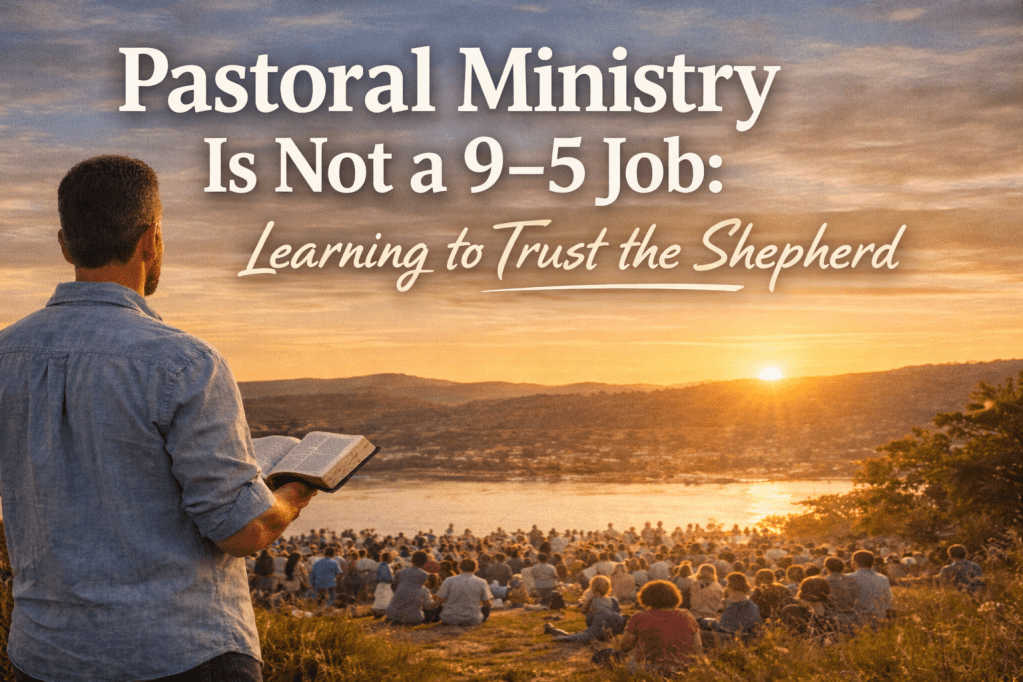
A new pastor arrives at a church with prayerful anticipation and a sense of holy calling. The search process had been long. The pulpit had been vacant. The congregation had asked for a shepherd who would preach the Word, love the people, and lead with faithfulness and conviction.
At first, everything feels hopeful.
Sermons are preached. Visitation begins. Relationships slowly form. The Word is opened with care, and the church begins to sense the stirrings of renewed direction. There is gratitude in the room, expectation in the air, and a shared hope that God is building something steady and faithful.
But then, almost quietly at first, a different conversation begins to surface.
“Where is his car during the day?”
“He’s not in the office much.”
“Our tithes and offerings pay his salary—what exactly is he doing all day?”
The tone is not always hostile. Sometimes it is framed as stewardship. Sometimes as accountability. Sometimes as concern for order. But underneath it is a deeper assumption—that pastoral faithfulness is measured primarily by visibility, especially in the office during expected hours.
And slowly, something subtle begins to form: suspicion replacing trust.
Yet Scripture gives a very different vision of pastoral life.
Shepherds Among the Flock, Not Employees in an Office
The New Testament never describes pastors primarily as office workers, but as shepherds entrusted with souls.
“Pay careful attention to yourselves and to all the flock, in which the Holy Spirit has made you overseers, to care for the church of God…” (Acts 20:28)
The focus is not office presence—it is care for the flock.
“They are keeping watch over your souls, as those who will have to give an account.” (Hebrews 13:17)
The work is defined not by location but by responsibility: watching over souls before God.
That kind of work cannot be reduced to business hours.
Jesus and the Disruption of “Off Hours”
The clearest picture of pastoral life is found in Jesus Himself.
There are moments when Jesus intentionally withdraws.
“He would withdraw to desolate places and pray.” (Luke 5:16)
He steps away from the crowds. He seeks solitude. He rests. He communes with the Father. There is nothing rushed or reactive about it.
But what happens next is crucial.
The crowds do not respect His schedule.
They follow Him.
They find Him in the places He went to be alone.
And instead of turning them away with frustration or saying, “This is not office hours,” Scripture says:
“He had compassion on them…” (Matthew 14:14)
“They were like sheep without a shepherd.” (Mark 6:34)
Even when He had withdrawn, even when He was seeking rest, even when He was not “on the clock,” ministry interrupted Him—and He did not reject it.
He taught them.
He healed them.
He fed them.
This pattern appears again and again: divine interruption.
Not chaos, but compassion.
Not lack of boundaries, but love that is responsive rather than scheduled.
When Ministry Does Not Fit the Schedule
This is where pastoral ministry fundamentally differs from a 9–5 job.
A corporate structure assumes predictable hours, defined output, and protected time blocks.
But shepherding does not work that way.
Ministry often arrives:
- after office hours
- during family dinners
- late at night
- early in the morning
- in moments of personal exhaustion or intended rest
A hospital emergency does not ask if the pastor is available.
A marriage crisis does not wait for morning staff hours.
A death does not schedule itself around calendars.
A struggling believer does not only struggle during business hours.
And so the question must be asked: what kind of expectation are we placing on pastoral ministry?
Because if a church assumes the pastor is only “working” when visible in the office, then much of the most essential shepherding work will be misunderstood as absence.
The Shepherd’s Burden Is Often Invisible
Paul describes ministry this way:
“I do not cease to admonish everyone with tears.” (Acts 20:31)
“There is the daily pressure on me of my anxiety for all the churches.” (2 Corinthians 11:28)
That is not a 9–5 description—it is a constant weight.
Likewise:
“Shepherd the flock of God that is among you…” (1 Peter 5:2)
Among you. Present. Embedded in life. Responsive.
Much of that work never appears on a schedule:
- prayer that no one sees
- counsel that no one hears
- study that no one recognizes
- burdens carried silently
- interruptions that look like “absence” from the outside
But heaven sees it differently.
When Visibility Replaces Trust
When a church begins to measure ministry primarily by office presence, a subtle shift occurs.
The pastor becomes a service provider.
The church becomes an evaluator.
And trust is replaced with surveillance.
But Scripture calls the church to something deeper:
“Obey your leaders and submit to them, for they are keeping watch over your souls…” (Hebrews 13:17)
That command assumes trust rooted in spiritual responsibility—not constant visibility.
Without trust, suspicion fills every gap:
- If he is not seen, he must not be working.
- If he is not in the office, he must be absent.
- If he is not visible, he must be idle.
But shepherding is often most faithful when it is least visible.
And more importantly, it is often most needed when it is least convenient.
A Warning for the Life of the Church
There is a sobering reality here.
One day, every member of the flock will need a shepherd at a moment that does not fit a schedule.
At midnight.
In crisis.
In grief.
In unexpected loss.
And in that moment, no one will ask:
“Was he in the office today?”
They will ask:
“Will he come? Will he care? Will he shepherd us now?”
But a culture that trains itself to question a shepherd’s unseen labor may find itself unprepared to receive his presence when it matters most.
A Better Vision: Trust, Presence, and Faithful Shepherding
A healthy church is not marked by blind trust or unaccountable leadership, but by mutual trust shaped by the gospel.
The pastor labors publicly in preaching and teaching.
He labors privately in prayer, counsel, study, and care.
And the congregation recognizes that shepherding is not a job confined to hours, but a calling accountable to God.
So the question is not ultimately:
“Where is his car?”
Or even:
“Why isn’t he in the office?”
But:
- Is he faithfully watching over our souls?
- Is he present when it matters most?
- Do we trust the Lord who placed him here?
Because pastoral ministry is not measured by office hours.
It is measured by faithfulness to Christ and care for His people.
And often, the most important moments of that care happen precisely when no one expected them—interrupting schedules, crossing boundaries, and reflecting the very compassion of Christ Himself.
 Doctrine and Mission
Leave a comment