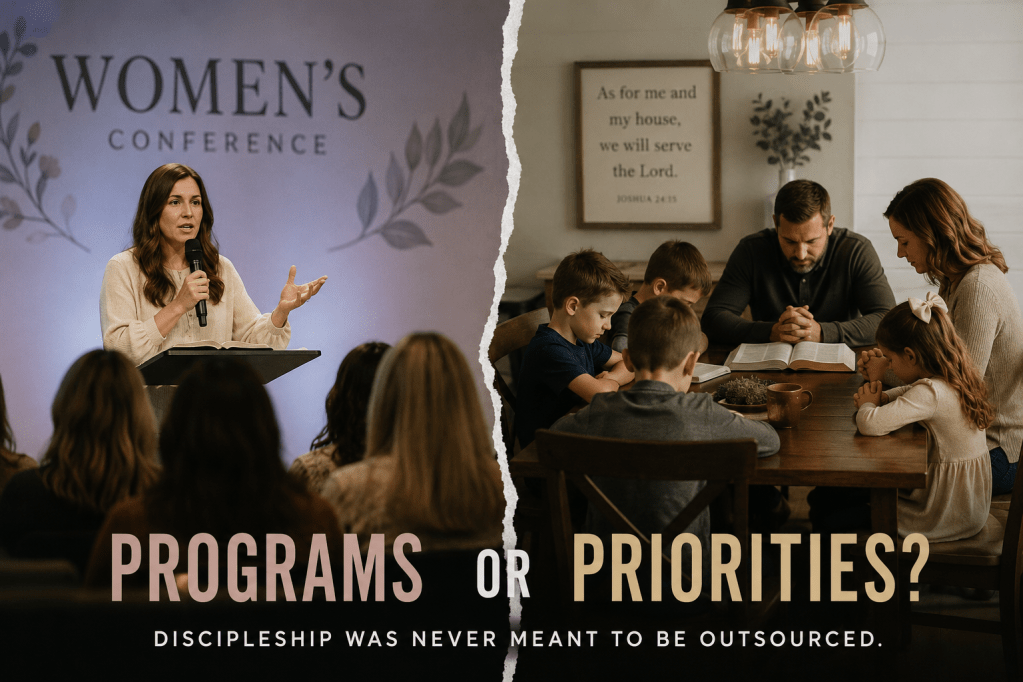
Why this Question is Asking the Wrong Question.
One of the common debates in modern evangelicalism is this: If only qualified men can serve as pastors, what leadership roles can women hold in the church?
Can women lead women’s ministry?
Can women direct children’s ministry?
Can women preach to women?
Can women oversee discipleship programs?
But perhaps we are beginning with the wrong question entirely.
The issue is not merely who is qualified to lead these ministries. The deeper question is this:
Are these ministries, as we commonly structure them today, even biblical categories to begin with?
Much of the modern church assumes the existence of ministries and leadership offices the New Testament never establishes. We create organizational structures, departments, and staff positions, then afterward ask who is biblically qualified to lead them. But the apostles did not organize the church this way.
The church at Antioch did not have a women’s ministry director.
The church at Corinth did not have a children’s ministry coordinator.
The church at Ephesus did not employ a family pastor overseeing segmented age-based discipleship programs.
In many cases, we have created ministries Scripture never assigns to the institutional church and then debate who should run them.
The New Testament Emphasis: The Household
The New Testament consistently places the primary burden of discipleship not on specialized church programs, but on the Christian household.
This is especially clear regarding women and children.
Who Is Responsible for the Discipleship of Women?
The modern church often assumes women require a formal church ministry structure for discipleship. But when we examine the New Testament, the primary responsibility for the spiritual care and growth of a married woman is placed upon her husband.
In Ephesians 5, husbands are commanded:
“Husbands, love your wives, as Christ loved the church and gave himself up for her, that he might sanctify her… having cleansed her by the washing of water with the word” (Ephesians 5:25–26).
The husband is not merely a provider or protector. He is called to participate in the spiritual sanctification of his wife. He is to wash her with the Word. He is to lead his home spiritually.
Likewise, in 1 Corinthians 14, when questions regarding teaching and order in the church arise, Paul says:
“If there is anything they desire to learn, let them ask their husbands at home.”
Whether one agrees with every interpretive detail of that passage or not, the principle is unmistakable: the apostolic assumption was that husbands would be spiritually engaged enough to instruct their wives.
The modern church often functions in the exact opposite way. We assume men will remain spiritually passive while the church creates women’s ministry systems to compensate for male failure.
Instead of asking, “Which women should lead the women’s ministry?” perhaps we should ask:
Why are Christian husbands not being trained to disciple their wives?
The solution to weak discipleship among women is not first the creation of more church programs. It is the recovery of spiritually mature men who know Scripture, lead their homes, pray with their wives, and shepherd their families.
Certainly, older women are called to teach younger women in Titus 2. But even there, Paul does not describe a formal church department with staff structures and ministry branding. He describes godly life-on-life discipleship within the covenant community.
The emphasis is relational, familial, and organic—not institutionalized and programmatic.
Who Is Responsible for the Discipleship of Children?
The same pattern appears with children.
Modern churches frequently treat children’s discipleship as something outsourced to professionals. Churches hire children’s pastors, children’s directors, curriculum specialists, and age-segmented ministry teams. Parents then often assume the church bears the primary responsibility for their children’s spiritual growth.
But Scripture never places that burden primarily upon the institutional church.
It places it upon parents.
Paul commands fathers in Ephesians 6:4:
“Fathers, do not provoke your children to anger, but bring them up in the discipline and instruction of the Lord.”
The responsibility is explicit. Fathers are charged with the spiritual upbringing of their children.
Deuteronomy 6 is even more comprehensive:
“These words that I command you today shall be on your heart. You shall teach them diligently to your children…”
When?
“When you sit in your house, and when you walk by the way, and when you lie down, and when you rise.”
Biblical discipleship was never envisioned primarily as a once-a-week classroom experience administered by church specialists. It was woven into the fabric of ordinary family life.
Parents were to speak of God continually. Instruction was integrated into the rhythms of the home.
The modern church has often unintentionally displaced parents by professionalizing what God assigned to mothers and fathers.
We have trained children’s ministry experts while neglecting to train fathers to open their Bibles at the dinner table. We have built sophisticated ministry systems while parents remain intimidated by basic family worship.
Instead of asking:
“Who should lead the children’s ministry?”
Perhaps we should ask:
“Why are parents not being equipped to disciple their own children?”
The Church’s Role Is Equipping, Not Replacing
None of this means the church has no role in discipleship. Far from it.
Pastors are called to equip the saints for the work of ministry (Ephesians 4:11–12). The church teaches sound doctrine, protects the flock, administers the ordinances, practices discipline, and nurtures believers in the faith.
But the church must not replace the God-ordained responsibilities of the home.
The institutional church is strongest not when it becomes the primary discipler of wives and children, but when it equips husbands, fathers, and mothers to fulfill their biblical responsibilities faithfully.
A healthy church does not create dependence upon ministry professionals. It cultivates mature Christian households.
This means churches should devote enormous energy toward:
- Training men to lead spiritually.
- Teaching husbands how to disciple their wives.
- Equipping fathers for family worship.
- Helping parents teach Scripture naturally in everyday life.
- Cultivating older women who mentor younger women personally.
- Strengthening families instead of replacing them with programs.
The answer to spiritual immaturity is not endless specialization. It is recovering the biblical order God already established.
And this restoration does something else modern churches often overlook: it naturally creates qualified elders.
One of the qualifications for an elder is that he be “able to teach” (1 Timothy 3:2). Yet many churches search for men who can teach publicly while neglecting the biblical proving ground where pastoral leadership is first demonstrated: the home.
Paul explicitly connects leadership in the home with leadership in the church:
“For if someone does not know how to manage his own household, how will he care for God’s church?” (1 Timothy 3:5).
The New Testament pattern assumes that the men teaching and shepherding the church are already faithfully teaching and shepherding at home.
The husband washing his wife with the Word.
The father instructing his children in the Lord.
The man leading family worship, prayer, and discipleship consistently over time.
These are not secondary matters. They are the training ground for eldership.
When churches abandon the household as the center of ordinary discipleship, they should not be surprised when they struggle to find qualified elders. We have often attempted to create pastors through seminaries, staff structures, and ministry programs while neglecting the very context Scripture emphasizes most heavily: faithful leadership in the home.
Restoring the biblical pattern naturally creates a healthy pipeline of future elders.
Men who are already teaching Scripture to their wives and children become men capable of teaching the church. Men already shepherding their households become men prepared to help shepherd the flock of God.
In this model, the church is not competing with the home. The church is equipping the home.
Pastors equip husbands and fathers. Husbands and fathers disciple their families. Mature households then produce mature men who are qualified to serve as elders who equip the saints for the work of ministry.
The result is a church culture where discipleship is not centralized in programs, but multiplied through faithful homes.
Recovering the Ordinary Means of Faithfulness
Many modern ministry structures arose with good intentions. Churches saw real needs and attempted to address them. Some women have been greatly encouraged through women’s Bible studies. Some children have learned Scripture through church classes.
But good intentions do not automatically establish biblical priorities.
The question is not whether a program can produce some good. The question is whether the church is unintentionally shifting God-given responsibilities away from the home and onto institutional structures He never commanded.
When churches normalize the idea that women require a designated ministry department to be discipled, or that children require professionals for spiritual formation, we may actually weaken the very people God commanded to lead.
The biblical model is slower, simpler, and far more ordinary.
Fathers opening the Bible with their children.
Husbands praying with their wives.
Mothers teaching diligently throughout daily life.
Older women mentoring younger women personally.
Pastors equipping households through faithful preaching and teaching.
This does not look impressive by modern organizational standards. It cannot always be branded, scaled, or marketed.
But it looks much closer to the New Testament.
The Real Crisis
The real crisis in many churches is not the absence of women ministry directors or children’s pastors.
The real crisis is the absence of spiritually mature men.
We have built ministries to compensate for male passivity rather than confronting it directly.
Instead of creating endless structures to work around absent spiritual leadership, the church should recover the biblical vision of husbands and fathers who know God’s Word, love their families, and lead them faithfully.
The goal is not to diminish women or children. The goal is to restore the household to its biblical place as the primary center of discipleship.
The church does not need more unbiblical offices to solve spiritual weakness.
It needs faithful pastors equipping faithful husbands, faithful wives, faithful fathers, faithful mothers, and faithful households for the glory of God.