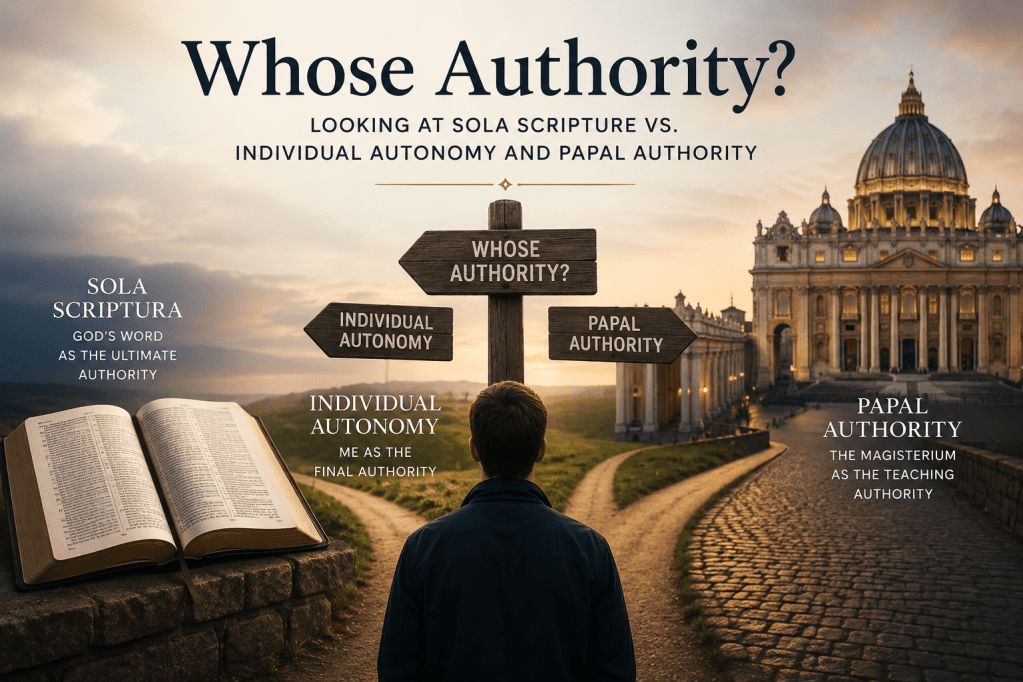
A Case for Sola Scriptura vs. Expressive Individualism and Papal Authority
In our home there is a daily, almost ordinary battle over authority. As parents, we are the God-ordained authority over our daughter, responsible before Him to guide, correct, and protect her. And yet, like every child made in God’s image, our 10-year-old is not naturally inclined to embrace that structure without resistance. She does not usually reject everything outright, but she resists something more subtle and more fundamental: the idea of being told what to do.
“Clean your room.” “Go outside and play.” “Come back in and clean up.” These are simple, good, and loving instructions. And yet they often meet an internal pushback—not always open rebellion, but a desire underneath it all to be her own authority. She wants, in her own small way, to be self-governing. Not necessarily to do evil, but to not be ruled.
That impulse is not unique to children. It is, in fact, deeply human.
Being made in the image of God means we were created for dominion. Genesis 1:26–28 teaches that God gave Adam and Eve real authority over creation. They were to “rule” and “subdue” the earth, but always as representatives under God’s greater authority. Their dominion was real, but derivative. They were kings under the true King, exercising authority that was borrowed, not absolute.
The tragedy of the fall is not that they wanted influence, but that they wanted autonomy. They rejected delegated dominion in favor of independent dominion. Instead of ruling under God’s Word, they sought to define good and evil for themselves. In other words, they wanted authority without submission. And the moment that desire took root, sin, disorder, and death entered the world. Humanity has been living out the consequences ever since.
We still see that same impulse everywhere today, only in more sophisticated forms. Modern culture often assumes that the individual is the highest authority. Truth is frequently treated as internal rather than external. Feelings become decisive. Identity is self-defined. Even when external voices speak—science, history, parents, or tradition—the individual is told that none of them can ultimately define reality for you. “You determine who you are.” “You define your truth.”
This is autonomy elevated to a worldview.
But the same underlying issue also appears in religious contexts, though in different expressions. One version of this is “choose-your-own-adventure” theology, where Scripture is treated as raw material to be shaped by personal preference. Doctrine becomes fluid. Truth bends toward what feels right, what is culturally acceptable, or what is emotionally comfortable. In that framework, the individual effectively becomes the final interpreter, and Scripture loses its binding authority.
On the opposite end is another attempt to solve the same problem: the transfer of ultimate authority away from the individual and into an institution. In Roman Catholicism, authority is located in the magisterium—the Pope and church councils. The ordinary believer is not encouraged to interpret Scripture independently, because it is considered unsafe or unreliable. Instead, the Church is presented as the final interpretive authority: trust the Church, trust the Pope, trust the official teaching office.
In both cases, however, the same foundational problem remains: where does ultimate authority reside? Is it the individual? Or is it an institution made up of fallible human beings?
Because Scripture is consistent on one point that both extremes struggle with: every human authority is fallible. Individuals err. Churches err. Councils err. And history—both biblical and post-biblical—confirms this repeatedly. Even the most respected leaders and systems are capable of distortion when placed above the Word of God.
That is why the Reformers recovered and defended the principle of Sola Scriptura: Scripture alone is the final and infallible authority for the Christian. Not Scripture isolated from the church, as though believers are meant to be independent agents disconnected from the body of Christ. But Scripture above the church, above tradition, above councils, and above every human authority.
Scripture itself testifies to this authority. Paul writes, “All Scripture is inspired by God and profitable for teaching, for reproof, for correction, for training in righteousness” (2 Timothy 3:16). Jesus prays to the Father, “Sanctify them in the truth; Your word is truth” (John 17:17). And the Bereans are commended precisely because they did not blindly accept apostolic teaching, but “examined the Scriptures daily to see whether these things were so” (Acts 17:11).
Even apostolic preaching was tested against the written Word.
At the same time, Sola Scriptura does not mean “solo Scriptura”—as though the Christian life is lived in isolation, with every person functioning as their own final theological authority. God has never intended His people to live that way. He has given pastors, elders, and teachers to shepherd His church (Ephesians 4:11–13). Their role is real, necessary, and good. They are gifts of Christ to His body.
Likewise, historic creeds and confessions are not enemies of Scripture but servants of it. They are summaries forged in the fires of controversy, designed to clarify biblical truth, protect the church from error, and provide unity in essential doctrine. When used rightly, they function like guardrails—helping the church stay on the path of faithful interpretation.
But they remain subordinate. A creed has authority only insofar as it reflects Scripture faithfully. A pastor has authority only insofar as he proclaims God’s Word accurately. The church is not over the Word; it is under the Word. It does not create truth; it receives it.
So the Christian life avoids two opposite errors. On one side is the illusion of absolute personal autonomy—where the individual becomes the final authority. On the other is the surrender of conscience to fallible human institutions. Both ultimately displace the voice of God.
True biblical Christianity submits neither to self nor to man, but to God speaking in His Word.
In the end, the question of authority is not abstract or merely theological—it is deeply personal, and it surfaces in everyday life. In parenting. In culture. In the church. In our own hearts. We all resist being governed. We all feel the pull toward autonomy.
But the gospel does not call us to autonomy. It calls us to submission—to a better authority, a rightful King, and a perfect Word that does not err.
We are not meant to be our own authority. We are meant to live joyfully, humbly, and securely under the authority of Christ, revealed in Scripture, and faithfully applied in the life of His church.


Leave a Reply