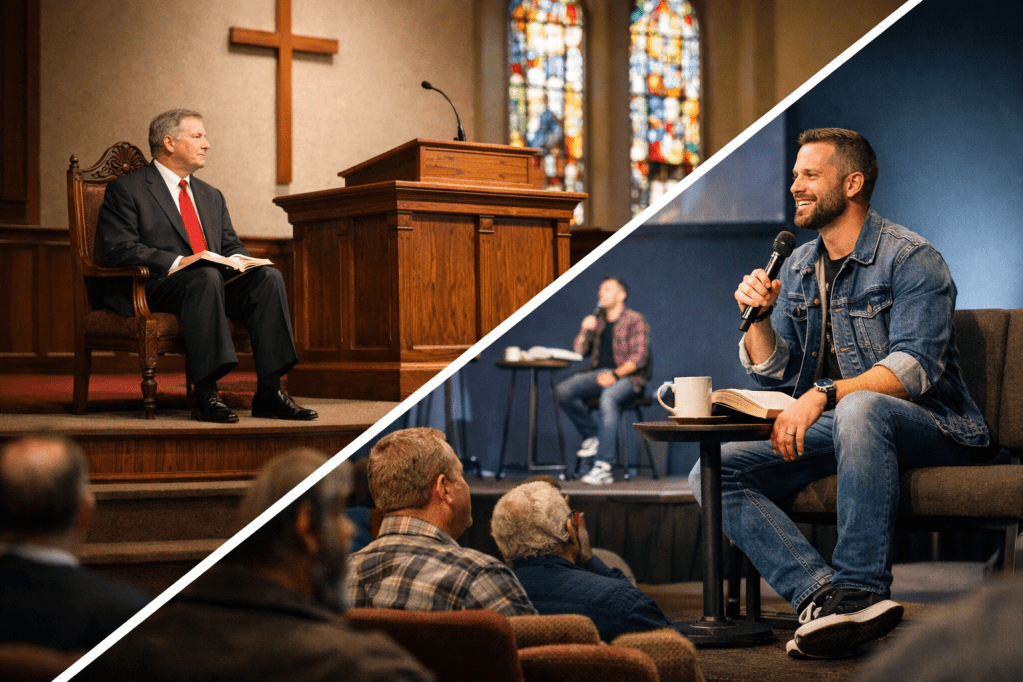
Jake loved his church.
He wasn’t on staff. He didn’t have a title. But he was there when people needed him. He taught faithfully. He discipled younger men. He showed up in hospital rooms and living rooms and hard conversations.
People began to notice.
“I think Jake might be called to ministry.”
Eventually, Jake believed it too.
So he did what everyone told him to do.
He left.
He went to seminary. He sat under professors who didn’t know his life, didn’t know his church, and didn’t know the people he had already begun to shepherd. He learned, he studied, he graduated.
Then he built a résumé.
He sent it out to churches he had never visited—churches that had never seen him handle conflict, never watched him disciple a struggling believer, never observed his life over time.
One of them called.
After a series of interviews, they offered him the position of pastor.
Jake accepted.
At first, things went well. He preached faithfully. He worked hard. He cast vision. But slowly, something began to feel off.
Every decision seemed to run through a group of deacons who functioned less like servants and more like a board of directors. Budgets, priorities, even aspects of ministry direction were filtered through them.
Jake wasn’t leading as an elder—he was reporting as an employee.
When tensions arose, they weren’t handled as shepherding issues within a body. They felt like workplace conflicts. Evaluations happened. Concerns were raised. Expectations were clarified.
And eventually, the relationship fractured.
Jake resigned.
Within months, he was updating his résumé again—searching for the next opportunity, the next church, the next “fit.”
And the church?
They began the process all over again.
And no one thought this was strange.
When the Church Becomes a Corporation
We’ve created a system that would have been foreign to the New Testament.
A man senses a call, leaves his church to be trained elsewhere, and then enters a kind of ministry marketplace—applying, interviewing, negotiating—until he is hired by a church that barely knows him.
Once there, he often functions not as a recognized elder among a known people, but as a professional brought in to perform a role.
And in many cases, the structure reinforces it.
Deacons—who in Scripture are called to serve—can drift into functioning like a governing board. The pastor—who is called to shepherd and oversee—can be subtly recast as a kind of employee accountable to that board.
It’s not always explicit. No one says it out loud.
But it shows up in how decisions are made, how authority is structured, and how easily a pastor can be replaced.
The Assumption We Never Question
Underneath all of this is an assumption we rarely examine:
That a “call to ministry” is a call to become the senior pastor somewhere else.
But that category doesn’t come from Scripture.
The New Testament speaks of elders—plural—who shepherd a local church together (Acts 14:23, Titus 1:5). It does not present a lone “senior pastor” as the goal of a man’s calling.
So what if Jake’s calling was not to leave?
What if his calling was to shepherd the flock of God among him?
What if the recognition of his gifting by his church was not the first step away from that body—but deeper intoresponsibility within it?
One of the most overlooked paths in our current system is this:
A man is called… and he stays.
He is raised up as an elder in the very church where his life is already known. He shepherds the people who have seen his character. He leads alongside other elders, not above them. He doesn’t need a new platform—he embraces a present responsibility.
But in many of our contexts, that option is barely visible.
We’ve unintentionally trained men to think that faithfulness means leaving.
Shepherds Don’t Job Hop
If a pastor is functionally an employee, then leaving for another church can feel no different than taking a new position somewhere else.
But shepherding isn’t a career ladder.
It’s a calling to people.
Peter says, “shepherd the flock of God that is among you” (1 Peter 5:2).
Not the one hundreds of miles away.
Not the one you interviewed for.
The one among you—people who know your life, who have seen your faithfulness, who can affirm your calling because they’ve witnessed it over time.
The Root Problem: Disconnected Formation
We have separated the raising up of pastors from the life of the local church.
Instead of being trained, tested, and affirmed within a body, men are often formed at a distance and then inserted into a church as outsiders.
That creates a fragile foundation from the start.
The church doesn’t truly know the man.
The man doesn’t truly know the church.
And when pressure comes—and it always does—there is not enough relational depth to hold things together.
A Better Pattern: Raised Up and Sent Out
The New Testament offers a better way.
A man senses a call and brings it to his elders. They test it. They observe his life. They give him opportunities to teach, to lead, to shepherd.
Over time, he is not just educated—he is known.
And then one of two things happens:
He is recognized as an elder in that church, continuing to shepherd the very people among whom he was formed.
Or—
He is sent out by that church to plant, revitalize, or strengthen another work.
In Acts 13, the church at Antioch sets apart Paul and Barnabas and sends them out. They go not as independent ministers seeking opportunity, but as men recognized and commissioned by a local body.
Not hired.
Sent.
Restoring the Right Roles
Recovering this vision also restores clarity to the offices of the church.
Elders lead, shepherd, and oversee.
Deacons serve, support, and meet tangible needs.
When those roles are blurred, the church suffers. When they are restored, the church flourishes.
Pastors are no longer treated like entry-level employees trying to prove themselves to a board.
They are recognized as shepherds—among a people, alongside other elders, under Christ.
The Way Forward
Recovering this will require a shift in how we think about calling.
Not every called man needs to go somewhere else.
Some need to stay.
Some need to shepherd the flock already among them.
And some need to be sent—but sent by a church that knows them, affirms them, and remains connected to them.
That means slowing down. Investing deeply. Raising up men instead of importing them.
It means resisting the instinct to turn pastors into employees and churches into hiring organizations.
Because the goal is not to fill positions.
It is to faithfully shepherd the flock of God.
Not far away.
But among you.