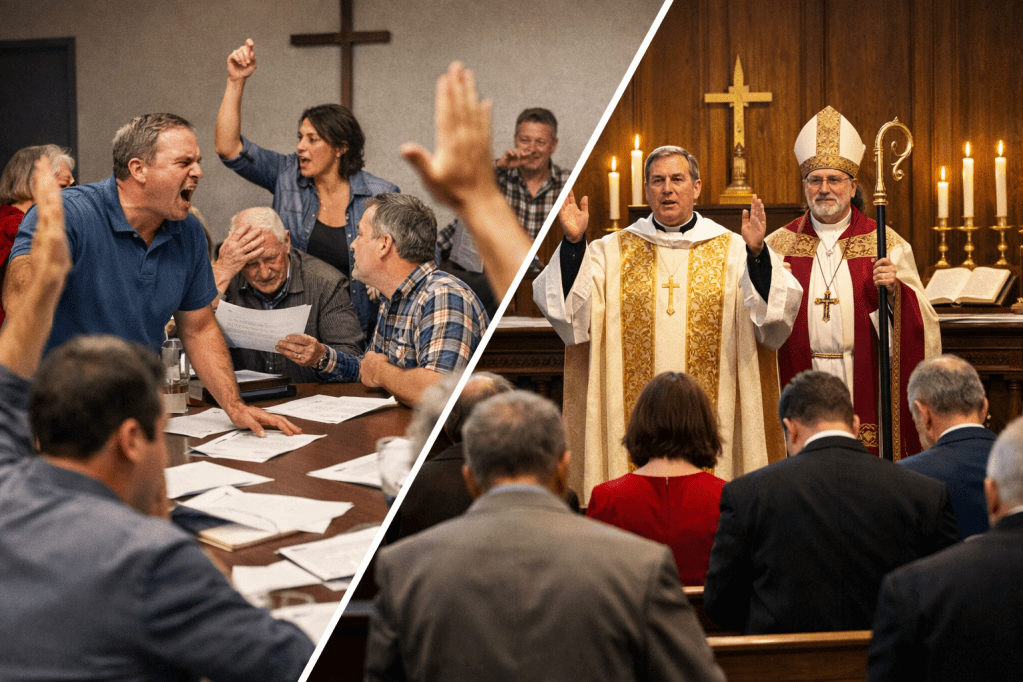
In recent years, it has become increasingly common to hear stories of Baptists who find themselves drawn toward Anglicanism. Often the attraction is framed in terms of liturgy, tradition, or beauty. But beneath those surface explanations lies a deeper issue: authority and ecclesiology.
Many Baptists are not primarily searching for incense and prayer books. They are searching for order. They are searching for leadership. And sometimes they are searching for relief from dysfunctional congregationalism.
Unfortunately, some Baptist churches have unintentionally turned their polity into something resembling a town council meeting rather than a biblical congregation.
But the solution is not to abandon Baptist ecclesiology. The solution is to recover it.
The Problem: Congregationalism Without Leadership
Historically, Baptists have affirmed congregational polity. This means that the final earthly authority in the church resides in the congregation itself. Major matters—such as receiving members, appointing leaders, and practicing church discipline—are entrusted to the body.
This principle was never meant to create constant democracy.
Yet in many churches today, business meetings can become exercises in parliamentary maneuvering:
- Members debating minor operational details
- Committees controlling ministry direction
- Pastors treated like hired staff
- Decisions driven by the loudest personalities in the room
Instead of spiritual discernment, meetings sometimes resemble a civic hearing.
When that happens, the congregation is no longer exercising biblical authority. It is exercising raw influence.
And influence often flows not to the wisest voices but to the loudest ones.
Why Anglicanism Begins to Look Attractive
Against that backdrop, the ordered structure of Anglicanism can appear refreshing.
Anglican churches operate with episcopal polity, where bishops oversee clergy and provide hierarchical leadership. Authority flows downward through established offices rather than emerging through congregational deliberation.
For Baptists exhausted by chaotic governance, this can feel stabilizing.
Instead of endless debates, there is structure.
Instead of congregational factions, there is clerical authority.
To someone who has experienced unhealthy congregationalism, episcopal systems can seem like the obvious answer.
But the problem was never congregationalism itself.
The problem was the abandonment of biblical leadership within it.
What Baptist Ecclesiology Was Meant to Be
Early Baptists never envisioned congregational life as a perpetual democracy.
Congregational authority existed to protect the gospel, not to manage the church like a corporation. Pastors were not mere facilitators of meetings. They were shepherds charged with spiritual oversight.
The New Testament consistently portrays church leaders as those who teach, guide, and govern under Christ’s authority.
The congregation holds final responsibility, but pastors exercise real leadership.
When these roles function properly, congregational authority becomes a safeguard, not a substitute for leadership.
Recovering Pastoral Authority
Many Baptist churches today need not a new ecclesiology, but a renewed confidence in pastoral leadership.
Pastors should not function as corporate managers who simply implement whatever the congregation votes. They are called to shepherd, teach, and guide the church.
Healthy churches recognize this authority without drifting into clericalism.
The pastor leads.
The elders shepherd.
The congregation affirms and guards the faith.
When that balance is lost, congregational meetings become arenas for power struggles rather than moments of corporate discernment.
What Member Meetings Are Actually For
Church meetings should not resemble municipal governance.
They exist for a few essential purposes:
- Receiving and restoring members
- Practicing church discipline
- Affirming leaders
- Celebrating what God is doing in the church
They are not designed to decide carpet colors, debate scheduling decisions, or adjudicate personal preferences.
When meetings are limited to their proper scope, they become meaningful expressions of the church’s shared responsibility under Christ.
The Loudest Voices Are Not the Church
One of the greatest dangers in unhealthy congregationalism is the rise of informal power structures.
When pastoral authority is weakened, leadership does not disappear. It simply shifts.
It shifts to:
- long-tenured members
- dominant personalities
- influential families
In such environments, the church is not governed by Scripture but by social dynamics.
And ironically, this produces far less accountability than healthy pastoral leadership would.
The Answer Is Not Elsewhere
It is understandable why some Baptists look to traditions like Anglicanism for solutions. When congregational life becomes chaotic, ordered hierarchy looks appealing.
But abandoning congregationalism is not the answer.
The Baptist vision—when properly practiced—combines pastoral leadership with congregational responsibility. It protects both the authority of shepherds and the accountability of the church.
Rather than seeking stability elsewhere, Baptists should rediscover the wisdom within their own tradition.
Congregationalism does not require chaos.
Pastoral authority does not require hierarchy.
And church meetings do not need to resemble town halls.
When pastors lead faithfully and congregations follow wisely, the church reflects the order Christ intended.
And when that happens, there is far less temptation to look for solutions outside the house.
 Doctrine and Mission
Leave a comment