Tag: southern baptist convention

  • If Only Men Can Be Pastors, Can Women Lead Women’s and Children’s Ministries?

    If Only Men Can Be Pastors, Can Women Lead Women’s and Children’s Ministries?

    Why this Question is Asking the Wrong Question.

    One of the common debates in modern evangelicalism is this: If only qualified men can serve as pastors, what leadership roles can women hold in the church?

    Can women lead women’s ministry?
    Can women direct children’s ministry?
    Can women preach to women?
    Can women oversee discipleship programs?

    But perhaps we are beginning with the wrong question entirely.

    The issue is not merely who is qualified to lead these ministries. The deeper question is this:

    Are these ministries, as we commonly structure them today, even biblical categories to begin with?

    Much of the modern church assumes the existence of ministries and leadership offices the New Testament never establishes. We create organizational structures, departments, and staff positions, then afterward ask who is biblically qualified to lead them. But the apostles did not organize the church this way.

    The church at Antioch did not have a women’s ministry director.
    The church at Corinth did not have a children’s ministry coordinator.
    The church at Ephesus did not employ a family pastor overseeing segmented age-based discipleship programs.

    In many cases, we have created ministries Scripture never assigns to the institutional church and then debate who should run them.

    The New Testament Emphasis: The Household

    The New Testament consistently places the primary burden of discipleship not on specialized church programs, but on the Christian household.

    This is especially clear regarding women and children.

    Who Is Responsible for the Discipleship of Women?

    The modern church often assumes women require a formal church ministry structure for discipleship. But when we examine the New Testament, the primary responsibility for the spiritual care and growth of a married woman is placed upon her husband.

    In Ephesians 5, husbands are commanded:

    “Husbands, love your wives, as Christ loved the church and gave himself up for her, that he might sanctify her… having cleansed her by the washing of water with the word” (Ephesians 5:25–26).

    The husband is not merely a provider or protector. He is called to participate in the spiritual sanctification of his wife. He is to wash her with the Word. He is to lead his home spiritually.

    Likewise, in 1 Corinthians 14, when questions regarding teaching and order in the church arise, Paul says:

    “If there is anything they desire to learn, let them ask their husbands at home.”

    Whether one agrees with every interpretive detail of that passage or not, the principle is unmistakable: the apostolic assumption was that husbands would be spiritually engaged enough to instruct their wives.

    The modern church often functions in the exact opposite way. We assume men will remain spiritually passive while the church creates women’s ministry systems to compensate for male failure.

    Instead of asking, “Which women should lead the women’s ministry?” perhaps we should ask:

    Why are Christian husbands not being trained to disciple their wives?

    The solution to weak discipleship among women is not first the creation of more church programs. It is the recovery of spiritually mature men who know Scripture, lead their homes, pray with their wives, and shepherd their families.

    Certainly, older women are called to teach younger women in Titus 2. But even there, Paul does not describe a formal church department with staff structures and ministry branding. He describes godly life-on-life discipleship within the covenant community.

    The emphasis is relational, familial, and organic—not institutionalized and programmatic.

    Who Is Responsible for the Discipleship of Children?

    The same pattern appears with children.

    Modern churches frequently treat children’s discipleship as something outsourced to professionals. Churches hire children’s pastors, children’s directors, curriculum specialists, and age-segmented ministry teams. Parents then often assume the church bears the primary responsibility for their children’s spiritual growth.

    But Scripture never places that burden primarily upon the institutional church.

    It places it upon parents.

    Paul commands fathers in Ephesians 6:4:

    “Fathers, do not provoke your children to anger, but bring them up in the discipline and instruction of the Lord.”

    The responsibility is explicit. Fathers are charged with the spiritual upbringing of their children.

    Deuteronomy 6 is even more comprehensive:

    “These words that I command you today shall be on your heart. You shall teach them diligently to your children…”

    When?
    “When you sit in your house, and when you walk by the way, and when you lie down, and when you rise.”

    Biblical discipleship was never envisioned primarily as a once-a-week classroom experience administered by church specialists. It was woven into the fabric of ordinary family life.

    Parents were to speak of God continually. Instruction was integrated into the rhythms of the home.

    The modern church has often unintentionally displaced parents by professionalizing what God assigned to mothers and fathers.

    We have trained children’s ministry experts while neglecting to train fathers to open their Bibles at the dinner table. We have built sophisticated ministry systems while parents remain intimidated by basic family worship.

    Instead of asking:

    “Who should lead the children’s ministry?”

    Perhaps we should ask:

    “Why are parents not being equipped to disciple their own children?”

    The Church’s Role Is Equipping, Not Replacing

    None of this means the church has no role in discipleship. Far from it.

    Pastors are called to equip the saints for the work of ministry (Ephesians 4:11–12). The church teaches sound doctrine, protects the flock, administers the ordinances, practices discipline, and nurtures believers in the faith.

    But the church must not replace the God-ordained responsibilities of the home.

    The institutional church is strongest not when it becomes the primary discipler of wives and children, but when it equips husbands, fathers, and mothers to fulfill their biblical responsibilities faithfully.

    A healthy church does not create dependence upon ministry professionals. It cultivates mature Christian households.

    This means churches should devote enormous energy toward:

    • Training men to lead spiritually.
    • Teaching husbands how to disciple their wives.
    • Equipping fathers for family worship.
    • Helping parents teach Scripture naturally in everyday life.
    • Cultivating older women who mentor younger women personally.
    • Strengthening families instead of replacing them with programs.

    The answer to spiritual immaturity is not endless specialization. It is recovering the biblical order God already established.

    And this restoration does something else modern churches often overlook: it naturally creates qualified elders.

    One of the qualifications for an elder is that he be “able to teach” (1 Timothy 3:2). Yet many churches search for men who can teach publicly while neglecting the biblical proving ground where pastoral leadership is first demonstrated: the home.

    Paul explicitly connects leadership in the home with leadership in the church:

    “For if someone does not know how to manage his own household, how will he care for God’s church?” (1 Timothy 3:5).

    The New Testament pattern assumes that the men teaching and shepherding the church are already faithfully teaching and shepherding at home.

    The husband washing his wife with the Word.
    The father instructing his children in the Lord.
    The man leading family worship, prayer, and discipleship consistently over time.

    These are not secondary matters. They are the training ground for eldership.

    When churches abandon the household as the center of ordinary discipleship, they should not be surprised when they struggle to find qualified elders. We have often attempted to create pastors through seminaries, staff structures, and ministry programs while neglecting the very context Scripture emphasizes most heavily: faithful leadership in the home.

    Restoring the biblical pattern naturally creates a healthy pipeline of future elders.

    Men who are already teaching Scripture to their wives and children become men capable of teaching the church. Men already shepherding their households become men prepared to help shepherd the flock of God.

    In this model, the church is not competing with the home. The church is equipping the home.

    Pastors equip husbands and fathers. Husbands and fathers disciple their families. Mature households then produce mature men who are qualified to serve as elders who equip the saints for the work of ministry.

    The result is a church culture where discipleship is not centralized in programs, but multiplied through faithful homes.

    Recovering the Ordinary Means of Faithfulness

    Many modern ministry structures arose with good intentions. Churches saw real needs and attempted to address them. Some women have been greatly encouraged through women’s Bible studies. Some children have learned Scripture through church classes.

    But good intentions do not automatically establish biblical priorities.

    The question is not whether a program can produce some good. The question is whether the church is unintentionally shifting God-given responsibilities away from the home and onto institutional structures He never commanded.

    When churches normalize the idea that women require a designated ministry department to be discipled, or that children require professionals for spiritual formation, we may actually weaken the very people God commanded to lead.

    The biblical model is slower, simpler, and far more ordinary.

    Fathers opening the Bible with their children.
    Husbands praying with their wives.
    Mothers teaching diligently throughout daily life.
    Older women mentoring younger women personally.
    Pastors equipping households through faithful preaching and teaching.

    This does not look impressive by modern organizational standards. It cannot always be branded, scaled, or marketed.

    But it looks much closer to the New Testament.

    The Real Crisis

    The real crisis in many churches is not the absence of women ministry directors or children’s pastors.

    The real crisis is the absence of spiritually mature men.

    We have built ministries to compensate for male passivity rather than confronting it directly.

    Instead of creating endless structures to work around absent spiritual leadership, the church should recover the biblical vision of husbands and fathers who know God’s Word, love their families, and lead them faithfully.

    The goal is not to diminish women or children. The goal is to restore the household to its biblical place as the primary center of discipleship.

    The church does not need more unbiblical offices to solve spiritual weakness.

    It needs faithful pastors equipping faithful husbands, faithful wives, faithful fathers, faithful mothers, and faithful households for the glory of God.

  • When Churches Prefer Control Over Shepherding: A Call for Tested Pastors and Biblical Maturity

    When Churches Prefer Control Over Shepherding: A Call for Tested Pastors and Biblical Maturity

    There is a troubling pattern emerging in some churches—one that is often unspoken but plainly visible. Rather than seeking faithful, seasoned shepherds, some congregations repeatedly install very young pastors, not because they are the most qualified, but because they are the most manageable.

    This is not a new problem. But it is one that strikes at the very heart of what Christ intends for His church.

    The Subtle Temptation: A Pastor You Can Manage

    It would be unfair to say every young pastor is chosen for the wrong reasons. God has used many men in their twenties in powerful ways. Yet there are cases where the pattern becomes too consistent to ignore: a church cycles through inexperienced men, often bypassing older, proven shepherds.

    Why?

    Because a younger, less-tested pastor is often easier to influence, easier to redirect, and—if we are honest—easier to control.

    But this reveals a deeper issue. The problem is not ultimately age. It is authority.

    Some churches do not want a shepherd they must follow. They want a figurehead they can guide.

    And that is a dangerous inversion of God’s design.

    Christ’s Design: Shepherds Who Lead, Churches That Follow

    Scripture consistently presents pastors as shepherds who lead, not representatives who merely reflect congregational preferences.

    In passages like Hebrews 13:17, believers are commanded to “obey your leaders and submit to them, for they are keeping watch over your souls.” Likewise, elders are described in 1 Peter 5 as those who “shepherd the flock of God… exercising oversight.”

    This does not mean pastors are authoritarian. Far from it. Biblical leadership is marked by humility, gentleness, and accountability.

    But it does mean this:
    A church is not called to control its shepherd, but to be shepherded by him.

    When a church consistently avoids strong, mature leadership in favor of pliability, it is not protecting itself—it is resisting God’s appointed means of care.

    The Biblical Weight of Being “Tested”

    One of the clearest qualifications for church leadership is that a man be tested and proven.

    In 1 Timothy 3, Paul warns against appointing a “recent convert,” lest he become conceited and fall into condemnation. While this passage is often applied narrowly to spiritual maturity, the principle is broader:
    Men entrusted with spiritual oversight must have a track record of faithfulness.

    They must have:

    • Endured suffering
    • Navigated conflict
    • Shepherded real people through real sin and sorrow
    • Demonstrated stability over time

    This kind of formation does not happen quickly.

    It is forged in the ordinary, often hidden work of ministry—years of being corrected, refined, and sharpened under the leadership of other faithful pastors.

    A Word to Young Men: Do Not Rush the Process

    For men in their twenties who feel called to ministry, the exhortation is not “step back,” but “slow down.”

    There is a world of difference between:

    • Having gifting, and
    • Being ready to shepherd a flock

    Young men need:

    • Time under wise elders
    • Space to make mistakes without catastrophic consequences
    • Opportunities to teach, serve, and grow without bearing the full weight of pastoral responsibility

    To pursue the pastorate prematurely is not a mark of zeal—it can be a failure to grasp the gravity of the office.

    The desire to lead must be matched by the willingness to be led.

    A Word to Churches: Seek Shepherds, Not Projects

    Churches must ask themselves a hard question:

    Do we want a pastor we can shape, or a shepherd who will shape us?

    The answer will determine not only the health of the leadership, but the spiritual trajectory of the entire congregation.

    Faithful churches should look for men who are:

    • Above reproach over time
    • Proven in doctrine and life
    • Respected by those who know them best
    • Seasoned enough to lead without being swayed by every internal pressure

    This does not mean age alone qualifies a man. But it does mean that experience matters, and testing matters.

    A church that consistently avoids such men may not be protecting itself—it may be avoiding accountability.

    The Cost of Getting This Wrong

    When churches prioritize control over qualification, several things happen:

    • Leadership becomes weak or inconsistent
    • The congregation remains immature
    • Conflict is mishandled or avoided
    • The church slowly reshapes itself around preferences instead of truth

    In the end, both pastor and people suffer.

    The young man is placed in a role he is not yet ready to bear.
    The church is deprived of the mature care it desperately needs.

    A Better Way Forward

    The solution is not to exclude young men from ministry, nor to idolize age.

    It is to return to a biblical vision:

    • Young men are trained, tested, and sent—not rushed.
    • Churches seek proven shepherds—not controllable leaders.
    • Pastors lead with humility—and congregations follow with trust.

    This is slower. It is less convenient. It requires patience on all sides.

    But it is God’s way.

    And in the long run, it produces something far better than control:

    It produces healthy churches, faithful pastors, and a testimony that reflects the wisdom of Christ Himself.

  • The DNA of Cooperation: The Jerusalem Collection and the Biblical Case for Southern Baptist Partnership

    The DNA of Cooperation: The Jerusalem Collection and the Biblical Case for Southern Baptist Partnership

    The cooperative spirit of the Southern Baptist Convention is often explained historically or pragmatically—as a strategy to accomplish more together than we could apart. But long before it was a strategy, it was Scripture. Long before it was formalized in structures like the Cooperative Program, it was embedded in the life of the early church.

    If we want to understand why churches voluntarily unite to give financially for the advance of the gospel, we need to look closely at what is often called the Jerusalem Collection—a sustained, multi-church effort in the New Testament that reveals cooperation not as an innovation, but as part of the very DNA of the church.


    The Beginning of a Pattern: Acts and the First Cooperative Effort

    The earliest glimpse of this pattern appears in the Acts of the Apostles. In Acts 11:27–30, a prophetic warning is given that a severe famine will come upon the land. The church in Antioch responds immediately and decisively. Luke tells us that “the disciples determined, every one according to his ability, to send relief to the brothers living in Judea.”

    This moment is more than an act of compassion—it is a theological and ecclesial blueprint. A local church, made up largely of Gentile believers, takes responsibility for meeting the needs of distant Jewish Christians. There is no command from Jerusalem demanding tribute, no centralized structure enforcing compliance. Instead, there is voluntary, proportionate giving—“every one according to his ability”—and a deliberate plan to send that support through trusted leaders.

    Already, we see the essential components of cooperation: willingness, intentionality, accountability, and a shared sense of belonging to something larger than the local congregation.


    A Defining Commitment: Paul and the Apostolic Vision

    This instinct toward cooperation is not isolated. It becomes a defining feature of Paul’s apostolic ministry. In Epistle to the Galatians 2:10, Paul recounts his meeting with the leaders in Jerusalem. After affirming the unity of the gospel between Jewish and Gentile missions, they ask only one thing of him: “that we should remember the poor, the very thing I was eager to do.”

    This is significant. The call to remember the poor—specifically the poor among the saints in Jerusalem—was not a side project. It was woven into the mission itself. Paul does not treat it as an obligation reluctantly accepted, but as something he was already eager to pursue. From this point forward, the Jerusalem Collection becomes a consistent thread running through his ministry.


    Ordered and Corporate Giving: Instructions to Corinth

    When Paul writes to the church in Corinth, he makes it clear that this effort is not isolated to one region or congregation. In 1 Corinthians 16:1–3, he writes, “Now concerning the collection for the saints: as I directed the churches of Galatia, so you also are to do.”

    This single sentence opens a window into a coordinated, multi-church initiative. What Paul had already instructed in Galatia, he now instructs in Corinth. The churches, though geographically separated and independently governed, are participating in a shared mission.

    Paul goes further, giving practical direction: “On the first day of every week, each of you is to put something aside and store it up, as he may prosper.” This is not spontaneous or occasional giving. It is regular, disciplined, and proportional. Each believer participates. Each church contributes. And the funds are to be entrusted to approved representatives who will carry the gift to Jerusalem.

    What emerges here is not compulsion, but structure. Not centralization, but coordination. The churches are working together in an orderly, intentional way to accomplish a common goal.


    The Heart of Giving: Grace and Fellowship in 2 Corinthians

    In 2 Corinthians 8–9, Paul returns to the subject with greater depth, drawing back the curtain on the spiritual dynamics behind this cooperation. He points to the churches of Macedonia as an example, describing how “their abundance of joy and their extreme poverty have overflowed in a wealth of generosity.”

    This is a remarkable statement. These churches are not giving out of surplus, but out of lack. And yet their giving is marked by joy, not reluctance. Paul is careful to emphasize that their participation is entirely voluntary. They gave “of their own accord,” even “begging us earnestly for the favor of taking part in the relief of the saints.”

    The language Paul uses is deeply theological. He describes this offering as a form of koinonia—a sharing, a fellowship, a participation in the work of God. This is not merely financial support; it is spiritual partnership. The act of giving becomes a visible expression of unity in Christ.

    Paul also guards the freedom of the churches. In 2 Corinthians 9:7, he writes, “Each one must give as he has decided in his heart, not reluctantly or under compulsion, for God loves a cheerful giver.” Cooperation, then, is not driven by pressure, but by grace. It is the overflow of a transformed heart.


    A Theological Culmination: Unity in Romans

    By the time Paul writes to the church in Rome, the collection is nearing completion. In Romans 15:25–27, he explains that he is on his way to Jerusalem “bringing aid to the saints.” He notes that “Macedonia and Achaia have been pleased to make some contribution for the poor among the saints at Jerusalem.”

    But Paul does not leave this in the realm of logistics. He interprets it theologically. “They were pleased to do it,” he writes, “and indeed they owe it to them. For if the Gentiles have come to share in their spiritual blessings, they ought also to be of service to them in material blessings.”

    Here, cooperation is grounded in the gospel itself. The Gentile churches have received the riches of salvation through the Jewish Messiah and the promises given to Israel. Their financial giving, then, is not merely generosity—it is gratitude. It is a tangible acknowledgment of their unity in Christ and their shared participation in God’s redemptive plan.


    The Implications for Today

    When we step back and consider these passages together—from Acts, Galatians, Corinthians, and Romans—a clear picture emerges. The early churches were not isolated, self-contained units. They were interdependent, relationally connected, and missionally aligned. They maintained their local autonomy, yet they gladly cooperated for the sake of the gospel.

    This cooperation was voluntary, but it was also expected. It was joyful, but it was also structured. It was financial, but it was deeply spiritual.

    This is the same impulse that animates the cooperative work of Southern Baptists today. When churches choose to give together for missions, theological education, disaster relief, and church planting, they are walking in a well-worn, biblical path. They are not surrendering their independence; they are expressing their unity.


    Conclusion: Cooperation as a Gospel Instinct

    The Jerusalem Collection shows us that cooperation is not a modern invention or merely a denominational distinctive. It is a reflection of the gospel itself. Just as believers are united to Christ and to one another, so they share their lives and resources for the good of the body and the advance of the mission.

    In a world that prizes independence and self-sufficiency, the church bears witness to something better: a voluntary, joyful partnership rooted in grace.

    From Biblical Cooperation to the Cooperative Program

    If the Jerusalem Collection reveals that cooperation is part of the church’s original design, then the question becomes: what does that look like today?

    For Southern Baptists, the most visible and enduring answer is the Cooperative Program (CP)—a unified giving strategy that channels the voluntary contributions of thousands of churches into a shared mission. Far from being a modern invention detached from Scripture, the CP is best understood as a practical outworking of the same biblical instincts we see in Acts and the Epistles: churches, freely and joyfully, pooling resources to advance the gospel beyond their individual reach.


    A Brief History of the Cooperative Program

    The Cooperative Program was established in 1925 during a pivotal moment in the life of the Southern Baptist Convention. At the time, Southern Baptists were funding missions and ministries through a patchwork of special offerings and direct appeals. This approach often led to competition between causes, inefficiency in fundraising, and inconsistent support for long-term mission work.

    In response, Southern Baptist leaders proposed a different way forward: instead of multiple competing appeals, churches would give one unified offering through their state conventions, which would then be distributed to support a wide range of ministries.

    This approach reflected several deeply biblical convictions:

    • That cooperation is more effective than competition
    • That giving should be intentional and systematic, not sporadic
    • That mission work should be collectively owned, not dependent on individual personalities or organizations

    In many ways, the Cooperative Program echoes Paul’s instructions in 1 Corinthians 16—regular, planned giving across multiple churches for a shared mission—only now applied on a much broader scale.


    How the Cooperative Program Works

    At its core, the Cooperative Program is beautifully simple:

    • Each local church decides voluntarily what percentage of its undesignated tithes and offerings to give
    • Those funds are sent to the church’s state convention
    • The state retains a portion for local and regional ministry
    • The remainder is forwarded to the national and international mission causes of the SBC

    No church is coerced. No external authority dictates the amount. Each congregation gives as it has “decided in its heart” (2 Cor. 9:7), just as the New Testament pattern describes.

    And yet, when combined, these gifts create a powerful force for gospel advancement.


    What Cooperative Program Giving Supports

    What, then, does this cooperation actually accomplish?

    Much like the Jerusalem Collection met real needs among real people, CP giving fuels tangible gospel work across a wide spectrum of ministries.

    1. Church Planting and Revitalization

    Through the North American Mission Board (NAMB), Cooperative Program dollars help plant churches across North America—especially in underserved and unreached areas.

    • New congregations are started in cities, suburbs, and rural communities
    • Struggling churches receive support for revitalization
    • Missionaries are deployed to engage diverse populations

    This is a direct extension of the apostolic pattern: the gospel moving outward through the establishment of new local churches.


    2. Collegiate and Next-Generation Ministry

    CP giving also supports campus ministries that reach students during one of the most formative seasons of life.

    • College students encounter the gospel
    • Future leaders are discipled and trained
    • Many are called into ministry and missions

    Just as Paul invested in younger believers like Timothy, Cooperative Program giving helps raise up the next generation for gospel service.


    3. International Missions

    Through the International Mission Board (IMB), CP funds send and sustain thousands of missionaries around the world.

    • Missionaries are fully supported so they can focus on gospel work
    • Unreached people groups are engaged
    • Churches are planted in hard-to-reach places

    This is perhaps the clearest modern parallel to the Jerusalem Collection: churches pooling resources so that the gospel can go where it otherwise could not.


    4. Theological Education

    The Cooperative Program funds Southern Baptist seminaries, providing affordable, theologically grounded training for pastors and ministry leaders.

    • Students are equipped to rightly handle the Word
    • Churches are strengthened through sound doctrine
    • Leaders are trained without crippling financial burden

    This ensures that the gospel not only spreads widely, but is also preached faithfully.


    5. Disaster Relief and Compassion Ministry

    Through various SBC channels, CP giving enables rapid and effective responses to crises:

    • Disaster relief teams provide food, shelter, and cleanup after hurricanes, floods, and wildfires
    • Volunteers meet both physical and spiritual needs
    • The gospel is shared in moments of deep vulnerability

    In these efforts, we see echoes of Acts 11—believers responding to urgent needs with generosity and action.


    6. Orphan Care and Mercy Ministries

    Cooperative giving also supports initiatives related to:

    • Adoption and foster care
    • Crisis pregnancy support
    • Care for the vulnerable and marginalized

    These ministries reflect the biblical call to care for “the least of these,” demonstrating the compassion of Christ alongside the proclamation of His gospel.


    Why This Matters

    It is easy to view the Cooperative Program as a funding mechanism. But that would miss its deeper significance.

    The CP is a theological statement.

    It declares that:

    • The mission of God is bigger than any one church
    • The gospel compels us to share not only our message, but our resources
    • Unity in Christ leads to partnership in mission

    Just as the churches of Macedonia, Achaia, Galatia, and Corinth joined together to support the saints in Jerusalem, Southern Baptists today unite to send the gospel to neighborhoods, campuses, cities, and nations.


    Conclusion: A Modern Expression of an Ancient Pattern

    The Jerusalem Collection was not just about meeting a need—it was about expressing the unity of the church and advancing the mission of God.

    The Cooperative Program carries that same vision forward.

    It is not perfect, because it is carried out by imperfect people. But at its best, it reflects something profoundly biblical: churches, freely and faithfully, working together so that Christ is proclaimed where He is not yet known.

    In that sense, every Cooperative Program gift—no matter the size—is part of a much larger story.

    A story that began in the pages of the New Testament…

    …and continues today, as churches unite for the sake of the gospel.

  • Why Movements Fracture: From MAGA to the Local Church

    Why Movements Fracture: From MAGA to the Local Church

    Introduction: The Inevitable Drift

    Movements rarely die all at once. They fracture.

    What begins as a unified cause—clear, compelling, and energizing—slowly splinters into competing factions. Voices that once stood shoulder to shoulder begin to turn on one another. What was once central becomes contested. What was once secondary becomes ultimate.

    You can see it in politics. You can see it in the church. And if we’re honest, you can see it in our own hearts.


    A Political Parable in Real Time

    The modern “America First” movement rallied around Donald Trump with a sense of shared purpose—border security, economic nationalism, and resistance to elite institutions.

    But unity around a figure is not the same as unity around a fully developed worldview.

    Now, fractures are visible:

    • Tucker Carlson emphasizes non-intervention and skepticism of foreign entanglements
    • Candace Owens has taken increasingly provocative and polarizing positions
    • Others remain firmly aligned with Trump’s policies and leadership

    What happened?

    The movement didn’t suddenly lose its passion—it lost its shared center of gravity. Once that center is tested (especially by real-world decisions like war, policy, or governance), underlying differences surface.

    And when those differences surface in a media-driven age, they don’t quietly diverge—they publicly collide.


    The Church Is Not Immune

    We would like to think the church is above this. It isn’t.

    Consider the rise and influence of Together for the Gospel Conference. It brought together pastors and leaders across denominational lines to stand on a shared conviction: the gospel is of first importance.

    For a time, that center held.

    But then came new pressures—particularly around social justice, race, and cultural engagement. What had been a coalition united by the gospel began to fracture over how the gospel applies to society.

    • Some emphasized justice as an implication of the gospel
    • Others warned against importing secular ideologies into the church

    And just like that, the coalition strained. Not because the gospel changed—but because agreement on the gospel did not guarantee agreement on everything else.


    From Denominations to Deacon Meetings

    This same dynamic is visible in the Southern Baptist Convention today. Internal debates—over leadership, abuse response, doctrinal boundaries, and cultural engagement—have exposed deep fault lines.

    But what’s most concerning is not what happens at the top.

    It’s what trickles down.

    Because eventually, that same spirit shows up in local churches:

    • Secondary issues become identity markers
    • Preferences become principles
    • Disagreements become divisions

    And unity begins to erode—not over the gospel, but over everything surrounding it.


    When Tertiary Issues Become Ultimate

    I saw this firsthand.

    A disagreement over parenting philosophy.
    A conviction about corporate worship—specifically, not allowing soloists.

    These are not insignificant topics. They matter. They require biblical wisdom.

    But they are not the gospel.

    And yet, they became lines of division. Not thoughtful disagreement—but relational fracture. Not charitable dialogue—but opposition.

    What causes that?

    It’s the same dynamic you see on the national stage:

    • Convictions untethered from proportion
    • Preferences elevated to doctrine
    • Disagreements treated as threats

    In other words, when we lose a clear sense of theological triage, everything starts to feel like a first-order issue.


    The Deeper Issue: Disordered Loves

    At the root of every fractured movement is not just disagreement—it’s disordered loves.

    We begin to love:

    • Being right more than being unified
    • Influence more than truth
    • Winning more than understanding

    And once that happens, division is inevitable.

    Even good convictions—rightly held—can become destructive when they are wrongly weighted.


    Recovering What Matters Most

    If movements fracture when they lose their center, then the solution is not the absence of conviction—but the recovery of proper order.

    The church must recover:

    1. The Centrality of the Gospel

    Not just in statement, but in function.

    The gospel must not only unite us doctrinally—it must govern how we treat one another.


    2. Theological Triage

    We must learn again to distinguish:

    • First-order doctrines (the gospel itself)
    • Second-order doctrines (that shape church life)
    • Third-order issues (where disagreement should not divide fellowship)

    Without this, everything becomes a hill to die on.


    3. Charity in Disagreement

    Conviction and charity are not enemies.

    You can hold a strong view on parenting, worship, or culture—and still refuse to divide the body over it.


    Conclusion: A More Excellent Way

    Fracturing may be inevitable in human movements—but it is not inevitable in a faithful church.

    Because the church is not ultimately held together by shared preferences, cultural alignment, or even ministry philosophy.

    It is held together by Christ.

    And where Christ is central, secondary things can remain secondary.

    But where Christ is displaced—even subtly—everything else begins to compete for first place.

    And when everything is ultimate, unity becomes impossible.

  • Called to Shepherd, Not to Apply: Rethinking How We Raise Up Pastors

    Jake loved his church.

    He wasn’t on staff. He didn’t have a title. But he was there when people needed him. He taught faithfully. He discipled younger men. He showed up in hospital rooms and living rooms and hard conversations.

    People began to notice.

    “I think Jake might be called to ministry.”

    Eventually, Jake believed it too.

    So he did what everyone told him to do.

    He left.

    He went to seminary. He sat under professors who didn’t know his life, didn’t know his church, and didn’t know the people he had already begun to shepherd. He learned, he studied, he graduated.

    Then he built a résumé.

    He sent it out to churches he had never visited—churches that had never seen him handle conflict, never watched him disciple a struggling believer, never observed his life over time.

    One of them called.

    After a series of interviews, they offered him the position of pastor.

    Jake accepted.

    At first, things went well. He preached faithfully. He worked hard. He cast vision. But slowly, something began to feel off.

    Every decision seemed to run through a group of deacons who functioned less like servants and more like a board of directors. Budgets, priorities, even aspects of ministry direction were filtered through them.

    Jake wasn’t leading as an elder—he was reporting as an employee.

    When tensions arose, they weren’t handled as shepherding issues within a body. They felt like workplace conflicts. Evaluations happened. Concerns were raised. Expectations were clarified.

    And eventually, the relationship fractured.

    Jake resigned.

    Within months, he was updating his résumé again—searching for the next opportunity, the next church, the next “fit.”

    And the church?

    They began the process all over again.

    And no one thought this was strange.

    When the Church Becomes a Corporation

    We’ve created a system that would have been foreign to the New Testament.

    A man senses a call, leaves his church to be trained elsewhere, and then enters a kind of ministry marketplace—applying, interviewing, negotiating—until he is hired by a church that barely knows him.

    Once there, he often functions not as a recognized elder among a known people, but as a professional brought in to perform a role.

    And in many cases, the structure reinforces it.

    Deacons—who in Scripture are called to serve—can drift into functioning like a governing board. The pastor—who is called to shepherd and oversee—can be subtly recast as a kind of employee accountable to that board.

    It’s not always explicit. No one says it out loud.

    But it shows up in how decisions are made, how authority is structured, and how easily a pastor can be replaced.

    The Assumption We Never Question

    Underneath all of this is an assumption we rarely examine:

    That a “call to ministry” is a call to become the senior pastor somewhere else.

    But that category doesn’t come from Scripture.

    The New Testament speaks of elders—plural—who shepherd a local church together (Acts 14:23, Titus 1:5). It does not present a lone “senior pastor” as the goal of a man’s calling.

    So what if Jake’s calling was not to leave?

    What if his calling was to shepherd the flock of God among him?

    What if the recognition of his gifting by his church was not the first step away from that body—but deeper intoresponsibility within it?

    One of the most overlooked paths in our current system is this:

    A man is called… and he stays.

    He is raised up as an elder in the very church where his life is already known. He shepherds the people who have seen his character. He leads alongside other elders, not above them. He doesn’t need a new platform—he embraces a present responsibility.

    But in many of our contexts, that option is barely visible.

    We’ve unintentionally trained men to think that faithfulness means leaving.

    Shepherds Don’t Job Hop

    If a pastor is functionally an employee, then leaving for another church can feel no different than taking a new position somewhere else.

    But shepherding isn’t a career ladder.

    It’s a calling to people.

    Peter says, “shepherd the flock of God that is among you” (1 Peter 5:2).

    Not the one hundreds of miles away.

    Not the one you interviewed for.

    The one among you—people who know your life, who have seen your faithfulness, who can affirm your calling because they’ve witnessed it over time.

    The Root Problem: Disconnected Formation

    We have separated the raising up of pastors from the life of the local church.

    Instead of being trained, tested, and affirmed within a body, men are often formed at a distance and then inserted into a church as outsiders.

    That creates a fragile foundation from the start.

    The church doesn’t truly know the man.

    The man doesn’t truly know the church.

    And when pressure comes—and it always does—there is not enough relational depth to hold things together.

    A Better Pattern: Raised Up and Sent Out

    The New Testament offers a better way.

    A man senses a call and brings it to his elders. They test it. They observe his life. They give him opportunities to teach, to lead, to shepherd.

    Over time, he is not just educated—he is known.

    And then one of two things happens:

    He is recognized as an elder in that church, continuing to shepherd the very people among whom he was formed.

    Or—

    He is sent out by that church to plant, revitalize, or strengthen another work.

    In Acts 13, the church at Antioch sets apart Paul and Barnabas and sends them out. They go not as independent ministers seeking opportunity, but as men recognized and commissioned by a local body.

    Not hired.

    Sent.

    Restoring the Right Roles

    Recovering this vision also restores clarity to the offices of the church.

    Elders lead, shepherd, and oversee.

    Deacons serve, support, and meet tangible needs.

    When those roles are blurred, the church suffers. When they are restored, the church flourishes.

    Pastors are no longer treated like entry-level employees trying to prove themselves to a board.

    They are recognized as shepherds—among a people, alongside other elders, under Christ.

    The Way Forward

    Recovering this will require a shift in how we think about calling.

    Not every called man needs to go somewhere else.

    Some need to stay.

    Some need to shepherd the flock already among them.

    And some need to be sent—but sent by a church that knows them, affirms them, and remains connected to them.

    That means slowing down. Investing deeply. Raising up men instead of importing them.

    It means resisting the instinct to turn pastors into employees and churches into hiring organizations.

    Because the goal is not to fill positions.

    It is to faithfully shepherd the flock of God.

    Not far away.

    But among you.

  • Why Some Baptists Look to Anglicanism for Authority — And Why the Answer Is Closer to Home

    Why Some Baptists Look to Anglicanism for Authority — And Why the Answer Is Closer to Home

    In recent years, it has become increasingly common to hear stories of Baptists who find themselves drawn toward Anglicanism. Often the attraction is framed in terms of liturgy, tradition, or beauty. But beneath those surface explanations lies a deeper issue: authority and ecclesiology.

    Many Baptists are not primarily searching for incense and prayer books. They are searching for order. They are searching for leadership. And sometimes they are searching for relief from dysfunctional congregationalism.

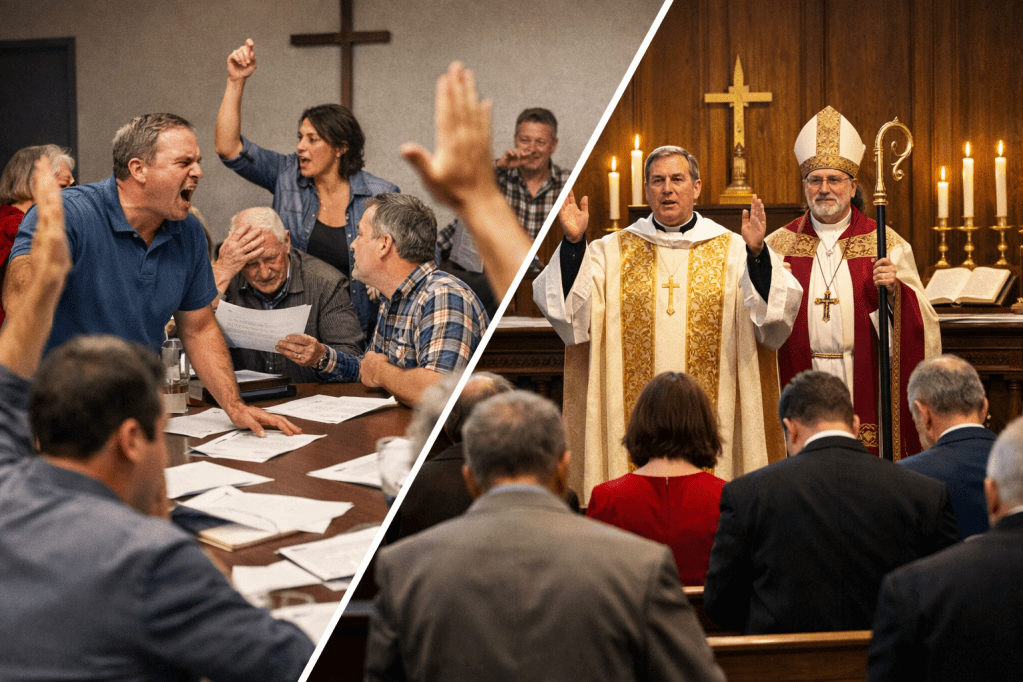
    Unfortunately, some Baptist churches have unintentionally turned their polity into something resembling a town council meeting rather than a biblical congregation.

    But the solution is not to abandon Baptist ecclesiology. The solution is to recover it.


    The Problem: Congregationalism Without Leadership

    Historically, Baptists have affirmed congregational polity. This means that the final earthly authority in the church resides in the congregation itself. Major matters—such as receiving members, appointing leaders, and practicing church discipline—are entrusted to the body.

    This principle was never meant to create constant democracy.

    Yet in many churches today, business meetings can become exercises in parliamentary maneuvering:

    • Members debating minor operational details
    • Committees controlling ministry direction
    • Pastors treated like hired staff
    • Decisions driven by the loudest personalities in the room

    Instead of spiritual discernment, meetings sometimes resemble a civic hearing.

    When that happens, the congregation is no longer exercising biblical authority. It is exercising raw influence.

    And influence often flows not to the wisest voices but to the loudest ones.


    Why Anglicanism Begins to Look Attractive

    Against that backdrop, the ordered structure of Anglicanism can appear refreshing.

    Anglican churches operate with episcopal polity, where bishops oversee clergy and provide hierarchical leadership. Authority flows downward through established offices rather than emerging through congregational deliberation.

    For Baptists exhausted by chaotic governance, this can feel stabilizing.

    Instead of endless debates, there is structure.
    Instead of congregational factions, there is clerical authority.

    To someone who has experienced unhealthy congregationalism, episcopal systems can seem like the obvious answer.

    But the problem was never congregationalism itself.

    The problem was the abandonment of biblical leadership within it.


    What Baptist Ecclesiology Was Meant to Be

    Early Baptists never envisioned congregational life as a perpetual democracy.

    Congregational authority existed to protect the gospel, not to manage the church like a corporation. Pastors were not mere facilitators of meetings. They were shepherds charged with spiritual oversight.

    The New Testament consistently portrays church leaders as those who teach, guide, and govern under Christ’s authority.

    The congregation holds final responsibility, but pastors exercise real leadership.

    When these roles function properly, congregational authority becomes a safeguard, not a substitute for leadership.


    Recovering Pastoral Authority

    Many Baptist churches today need not a new ecclesiology, but a renewed confidence in pastoral leadership.

    Pastors should not function as corporate managers who simply implement whatever the congregation votes. They are called to shepherd, teach, and guide the church.

    Healthy churches recognize this authority without drifting into clericalism.

    The pastor leads.
    The elders shepherd.
    The congregation affirms and guards the faith.

    When that balance is lost, congregational meetings become arenas for power struggles rather than moments of corporate discernment.


    What Member Meetings Are Actually For

    Church meetings should not resemble municipal governance.

    They exist for a few essential purposes:

    • Receiving and restoring members
    • Practicing church discipline
    • Affirming leaders
    • Celebrating what God is doing in the church

    They are not designed to decide carpet colors, debate scheduling decisions, or adjudicate personal preferences.

    When meetings are limited to their proper scope, they become meaningful expressions of the church’s shared responsibility under Christ.


    The Loudest Voices Are Not the Church

    One of the greatest dangers in unhealthy congregationalism is the rise of informal power structures.

    When pastoral authority is weakened, leadership does not disappear. It simply shifts.

    It shifts to:

    • long-tenured members
    • dominant personalities
    • influential families

    In such environments, the church is not governed by Scripture but by social dynamics.

    And ironically, this produces far less accountability than healthy pastoral leadership would.


    The Answer Is Not Elsewhere

    It is understandable why some Baptists look to traditions like Anglicanism for solutions. When congregational life becomes chaotic, ordered hierarchy looks appealing.

    But abandoning congregationalism is not the answer.

    The Baptist vision—when properly practiced—combines pastoral leadership with congregational responsibility. It protects both the authority of shepherds and the accountability of the church.

    Rather than seeking stability elsewhere, Baptists should rediscover the wisdom within their own tradition.

    Congregationalism does not require chaos.
    Pastoral authority does not require hierarchy.
    And church meetings do not need to resemble town halls.

    When pastors lead faithfully and congregations follow wisely, the church reflects the order Christ intended.

    And when that happens, there is far less temptation to look for solutions outside the house.

  • When Salvation was For Sale:

    How the Reformation Exposed the Costly Error of Indulgences and Reclaimed the Gospel of Grace

    In the early 16th century, the church in Western Europe was in crisis—not from outside enemies, but from within. The gospel of Jesus Christ, once proclaimed as the free gift of salvation to all who believe, had become entangled in a system of works, payments, and spiritual debt. The very message that “by grace you have been saved through faith” (Ephesians 2:8–9) had been overshadowed by a practice that suggested forgiveness could be purchased. That practice was the sale of indulgences.

    The Protestant Reformation was not born from political ambition or personal rebellion—it arose because the truth of salvation had been obscured. And if the gospel is obscured, everything is lost.


    The Rise of Indulgences: A Financial Crisis in Rome

    In the early 1500s, the Roman Church faced a massive architectural project: the rebuilding of St. Peter’s Basilica in Rome—one of the largest and grandest churches in the world. The project was expensive, and the church needed funds. The solution devised was to expand the system of indulgences.

    An indulgence was originally framed as a church-declared remission of the temporal punishment due to sin (distinct from forgiveness itself). But in practice, indulgences became something much worse: a spiritual transaction. With the purchase of an indulgence, one could supposedly reduce time spent in purgatory—a place the Church taught was a temporary state of purification before entering heaven.

    And the sale was not just for the living. People were told they could buy indulgences for deceased loved ones—reducing their suffering and hastening their entry into heaven.

    This culminated in the infamous fundraising campaign led by Johan Tetzel, who advertised indulgences with slogans like:

    “As soon as the coin in the coffer rings, the soul from purgatory springs.”

    It was an offer that tugged on fear and affection—what loving child wouldn’t want to ease their parents’ suffering?

    But what Tetzel was selling was not hope—it was a lie.


    The Unbiblical Nature of Purgatory

    The entire indulgence system depends on the existence of purgatory, yet purgatory itself has no foundation in Scripture. The Bible teaches two—and only two—eternal destinies:

    “It is appointed for a man to die once, and after that comes judgment.”
    —Hebrews 9:27

    Jesus told the thief on the cross:

    “Today you will be with me in Paradise.”
    —Luke 23:43

    Not after centuries of cleansing. Not after purification by fire. Today.

    The Bible presents heaven and hell as final and eternal states (Matthew 25:46). There is no middle place. There is no second chance. There is no postmortem purification process.

    And there is no price—no payment, no gift, no offering—that can shorten or avoid judgment.


    Martin Luther and the Spark of Reformation

    When Martin Luther, a German monk and professor, saw indulgences being sold as spiritual escape tickets, he recognized the danger. In 1517, he wrote the 95 Theses and nailed them to the door of the Wittenberg Church—not to start a revolution, but to call for honest debate.

    His central argument was simple:

    Salvation cannot be bought. Forgiveness cannot be sold. Christ alone saves.

    The gospel had been replaced by a marketplace. Grace had been replaced by greed. The Church had entered the business of selling what God offered freely.

    The Reformation was born not because Luther wanted to tear the church apart, but because he wanted to restore the gospel.


    The True Gospel: Salvation by Grace Through Faith

    The Bible declares without hesitation:

    “For by grace you have been saved through faith. And this is not your own doing; it is the gift of God, not a result of works, so that no one may boast.”
    —Ephesians 2:8–9

    Grace is not earned.
    Faith is not purchased.
    Salvation is not for sale.

    Christ paid the full price—once for all—at the cross:

    “It is finished.” (John 19:30)

    There is no leftover debt.
    No remaining punishment.
    No divine invoice waiting for payment.


    When the Gospel Is Sold, Christ Is Diminished

    The sale of indulgences was not just a theological error—it was a denial of the sufficiency of Christ’s sacrifice. To suggest that money could reduce punishment is to say that the blood of Jesus was not enough.

    And that is a lie no Christian can accept.


    The Legacy of the Reformation

    The Reformation recovered five essential truths:

    1. Scripture Alone — The Bible is the final authority.
    2. Christ Alone — Christ is the only mediator.
    3. Grace Alone — Salvation is God’s gift.
    4. Faith Alone — We receive salvation through trusting Christ.
    5. To the Glory of God Alone — Salvation is for God’s praise, not human power or profit.

    These were not new doctrines—they were the original teachings of Christ and the Apostles, rediscovered and reclaimed.


    Conclusion: Salvation Cannot Be Bought

    The gospel is the best news the world has ever heard:

    God saves sinners—not because they earn it, deserve it, or buy it—but because He is gracious.

    Poverty cannot bar someone from heaven.
    Wealth cannot purchase a single moment of salvation.

    Heaven is not a marketplace.
    Grace is not a transaction.
    Christ is not for sale.

    Salvation is the free gift of God, secured by Christ, received by faith, and guaranteed by the promise of God Himself.

  • When Prominence Fades: A Call to Faithful Shepherding in Obscurity

    As we embark on another annual meeting in Dallas, we’re once again surrounded by crowds, big names, and high-profile debates. We see familiar faces on platforms, hear strong voices in microphones, and feel the buzz of influence and prominence. But in the midst of it all, we must be reminded: the health and future of the Southern Baptist Convention does not rest on the most visible leaders—it rests in the quiet, unseen faithfulness of ordinary pastors serving ordinary churches with extraordinary commitment.

    The Southern Baptist Convention (SBC) has seen its fair share of prominent leaders—voices that rose quickly, led boldly, and fell, whether by controversy, conflict, or quiet exit. Some left positions of influence amid media storms. Others quietly stepped down under the weight of internal division or external scrutiny. Consider just a few recent examples:

    • Russell Moore – Once the head of the Ethics & Religious Liberty Commission (ERLC), Moore became a polarizing figure over his criticisms of Donald Trump and his handling of abuse-related issues in the SBC. He eventually left the SBC altogether.
    • Adam Greenway – Former president of Southwestern Baptist Theological Seminary (SWBTS), Greenway resigned amid financial and leadership challenges, leaving questions and controversy in his wake.
    • David Platt – A widely celebrated preacher and former president of the International Mission Board (IMB), Platt later faced tensions within his own church over political and theological differences, leading to members departing and public disputes.
    • Paige Patterson – Once a titan in the Conservative Resurgence and former SWBTS president, Patterson was terminated for mishandling sexual abuse allegations and other leadership failures.
    • Ed Litton – Elected SBC president in 2021, Litton came under fire after revelations that he had used extended portions of sermons from J.D. Greear without clear attribution. The controversy raised questions about pastoral integrity and sermon preparation.
    • J.D. Greear – Also a former SBC president, Greear faced criticism for his language on sexual ethics and perceived doctrinal ambiguity, including how he spoke about homosexuality—sparking concern among many Southern Baptists about clarity and conviction.

    These names remind us that prominence does not equal permanence. Influence in the SBC, or any Christian institution, can be as fleeting as the cultural winds that blow around it. Platforms rise and fall. Conferences fade. Spotlights shift. But the chief calling of a pastor remains unchanged:

    “Shepherd the flock of God that is among you, exercising oversight… not domineering… but being examples to the flock” (1 Peter 5:2–3).

    There is an ever-present temptation in our culture, even among pastors, to long for visibility over faithfulness, platform over pastoring, and acclaim over quiet obedience. Yet the Kingdom advances not through celebrity but through faithful, long-haul shepherds—men who love their church more than their image, who open the Word week after week, visit the sick, pray for the weary, and raise up disciples in their own community, far from the limelight.

    We thank God for leaders who serve well on a denominational level. But we must not confuse the conference stage with the judgment seat of Christ. The applause of men is fleeting; the approval of the Chief Shepherd is eternal.

    So to the Southern Baptist pastor laboring in obscurity: do not grow weary. You may never trend on social media, but your name is written in heaven. You may never lead an entity, but you lead God’s sheep. You may never be invited to speak at the Convention, but you’ve been called to speak God’s Word every week. That is enough.

    Let us pray not for fame, but for faithfulness. Not for platforms, but for perseverance. Not for recognition, but for resurrection reward.

  • Beyond the Conservative Resurgence

    Why Past Movements Were Not Enough—and What the SBC Needs Now

    In the late 20th century, the Conservative Resurgence rescued the Southern Baptist Convention from doctrinal drift. It restored biblical inerrancy in our seminaries, pulpits, and denominational institutions. This was no small feat—it preserved theological faithfulness for a new generation.

    Then came the Great Commission Resurgence, calling us to a renewed focus on evangelism, church planting, and global mission. With declining baptisms and a changing culture, it reminded Southern Baptists that our doctrinal fidelity must also drive missional urgency.

    But as we reflect now, we must ask: did either movement transform the soul of our churches?
    We have right beliefs—and we’ve declared right priorities. But our churches remain divided, disillusioned, and in many places, declining.

    Southern Baptists do not need another branding campaign or strategic slogan. We need a true resurgence—not just of ideas, but of people. A renewal that begins in the pew, not just on the platform.

    Here are six essential resurgences the SBC must embrace to move faithfully into the future.


    1. A Resurgence of Integrity

    The Southern Baptist Convention has weathered doctrinal battles—but now faces a crisis of trust. Many Southern Baptists believe the theological convictions we fought to preserve are being undermined by institutional secrecy, platform protection, and personal ambition. The issue isn’t merely orthodoxy—it’s credibility.

    Why it’s needed:
    In a time when confidence in leadership is eroding, we need leaders and institutions whose lives and practices match the gospel they proclaim. If we lose integrity, we lose the ability to lead.

    What it looks like:

    • Financial transparency in our entities and institutions, with clear accountability to the churches that fund them.
    • Building trust among messengers, not through managed narratives, but through openness, repentance when necessary, and a return to servant-hearted leadership.
    • Leaders who walk humbly, avoiding personal empire-building and resisting the temptation to treat the SBC as a career ladder or political arena.
    • Churches that expect godly character, not just communication skills or charisma, from their pastors and leaders.

    “The integrity of the upright guides them, but the crookedness of the treacherous destroys them.” – Proverbs 11:3


    2. A Resurgence of Discipleship

    Southern Baptists have long measured ministry success by decisions and attendance. But far too often, we’ve made converts without making disciples. The result is spiritual immaturity in our churches and generational drift in our families.

    Why it’s needed:
    We cannot build gospel churches on shallow soil. And we cannot expect the next generation to walk with Christ if we do not teach them how.

    What it looks like:

    • Intentional, relational discipleship—not just programs, but people walking with people in the ways of Christ.
    • Family discipleship, where parents—and especially fathers—are equipped to teach, model, and shepherd their children in the faith (Eph. 6:4).
    • Biblical literacy, with churches prioritizing Scripture memory, meditation, and obedience—not just inspirational content.
    • Training lay leaders, raising up deacons, elders, teachers, and counselors from within the congregation.

    “Teaching them to observe all that I have commanded you…” – Matthew 28:20


    3. A Resurgence of Unity in the Gospel

    We are fragmented. Not just politically or theologically—but relationally. The SBC has become a battlefield of tribes, factions, and personalities, where brothers in Christ are treated as enemies because of differing emphases or affiliations.

    Why it’s needed:
    We cannot fight side by side for the lost when we’re firing shots at each other. Gospel unity is not a luxury—it’s a necessity.

    What it looks like:

    • Refusing tribalism—choosing fellowship with faithful brothers and sisters even when we don’t agree on every strategy or secondary issue.
    • Keeping the main things central—like Christ crucified, the authority of Scripture, and the need for the nations to hear the gospel.
    • Disagreeing with humility, rejecting online scorched-earth tactics, and speaking truth seasoned with grace.

    “There is one body and one Spirit… one Lord, one faith, one baptism, one God and Father of all.” – Ephesians 4:4–6


    4. A Resurgence of Church Health

    You cannot send strong missionaries from sick churches. The SBC has focused heavily on church planting and multiplication—which is essential. But far too many established churches are spiritually stagnant, unbiblically led, or dying.

    Why it’s needed:
    The foundation of the SBC is not its entities or its mission boards. It’s the local church. If our churches are unhealthy, our Convention has no future.

    What it looks like:

    • Qualified pastors and elders, who lead with courage, conviction, and compassion.
    • Meaningful membership, where church rolls reflect regenerate believers in real community.
    • Expository preaching and Christ-centered worship, feeding the sheep, not entertaining the goats.
    • Support for revitalization, encouraging faithful pastors of smaller churches and resisting the idolatry of church size or fame.

    “The church of the living God, a pillar and buttress of the truth.” – 1 Timothy 3:15


    5. A Resurgence of Physical Presence in a World of Followers and Likes

    We live in an age of digital disembodiment—TikToks over tables, threads over truth, clicks over community. The SBC must resist the gravitational pull of the virtual by reasserting the beauty and necessity of the local, visible, gathered church.

    Why it’s needed:
    Online influence has too often replaced in-person shepherding. But the body of Christ was never meant to be a brand—it is a body.

    What it looks like:

    • Churches that prioritize presence: gathering in person, breaking bread, laying hands, weeping and rejoicing together.
    • Pastors who know their people and walk with them, not just broadcast sermons.
    • Disciples who live in proximity, not merely affinity.

    “And the Word became flesh and dwelt among us…” – John 1:14
    “Let us not neglect to meet together…” – Hebrews 10:25


    6. A Resurgence of Clarity and Conviction in a World of Ambiguity

    We are living in a fog of postmodern confusion—about truth, gender, morality, and even salvation itself. Many churches are tempted to trade clarity for complexity, fearing offense more than fearing God.

    Why it’s needed:
    The world is not looking for another vague voice. It needs truth. Spoken with love, yes—but spoken clearly, without compromise.

    What it looks like:

    • Preaching with doctrinal precision, applying God’s Word boldly to cultural lies and spiritual error.
    • Standing firm on God’s design for manhood and womanhood, marriage, and the sanctity of life.
    • Holding fast to salvation by grace alone through faith alone, without theological drift or equivocation.
    • Teaching with theological depth, equipping people to stand firm in a world that is constantly shifting.

    “If the trumpet gives an uncertain sound, who shall prepare himself to the battle?” – 1 Corinthians 14:8 (KJV)


    Final Word: Not a Platform but a People

    The Conservative Resurgence gave us our doctrinal foundation.
    The Great Commission Resurgence gave us a missional framework.
    Now, we need a resurgence that gives us spiritual formation—in the pews, in our homes, and in our pulpits.

    We need leaders of integrity.
    We need churches that make disciples.
    We need a fellowship built on the gospel.
    We need pastors rooted in real communities.
    We need truth spoken in love and without fear.

    This next resurgence must not be top-down, but grassroots.
    Not powered by politics, but prayer.
    Not about reclaiming influence, but reclaiming faithfulness.

    Let it begin not in a task force, but in your local church.
    Let it begin with us.

  • The Trump and Elon Feud and SBC Cooperation

    What Two Billionaires Can Teach Us About the Need for Unity in the Church

    In recent weeks, headlines have spotlighted a public unraveling of the once-curious alliance between Donald Trump and Elon Musk. Once praised by Trump and courted by Musk, the relationship has devolved into social media barbs and personal insults. Trump has labeled Musk “a BS artist,” while Musk has increasingly distanced himself from Trump’s brand of politics. Their high-profile “breakup” is just another example of the culture of fragmentation that defines our age.

    Social media makes it easy to sever ties. A disagreement? Block. A moment of offense? Unfollow. A different worldview? Cancel. Our tools have discipled us in the habits of disunity—removing nuance and patience in favor of fast takes and instant tribalism. This is the air we breathe, and whether we admit it or not, it’s shaping our institutions—including the church.

    The SBC: A Big Tent in a Divided Age

    The Southern Baptist Convention is a diverse body. Theologically, ethnically, generationally, and geographically, we bring a lot of differences to the table. And in recent years, those differences have grown sharper. Social issues, political alignments, leadership conflicts, and theological emphasis have all contributed to rising tensions. Many are tempted to throw up their hands and walk away—to treat the church like social media: if you don’t like what you see, just “block” the whole convention.

    But the SBC isn’t Twitter. It’s not a platform built on clout or algorithms. It’s a people united by a common confession and a Great Commission. What makes the SBC work—at its best—is not uniformity, but cooperation. We voluntarily link arms to plant churches, send missionaries, train pastors, and preach the gospel to a lost and dying world. That mission is too important to walk away from.

    Unity Without Compromise

    Our culture is confused about unity. It either means total agreement or total silence. But biblical unity is something different. It’s grounded in truth and expressed in love. As Paul wrote to the Philippians, we are to be “of one mind, striving side by side for the faith of the gospel” (Phil. 1:27). Not identical minds, but a shared direction.

    We don’t need to agree on everything to cooperate in gospel work. But we do need clarity about what matters most. That’s why our confession of faith matters. That’s why doctrinal integrity must never be sacrificed on the altar of pragmatism or politics. And that’s why we must resist the cultural impulse to divide every time there’s friction. The kingdom is bigger than our tribes, and the gospel is stronger than our algorithms.

    Conclusion: Hold the Line Together

    Trump and Musk may go their separate ways, each with their own platforms and followings. But the church cannot afford to mimic their model of fragmentation. If we become just another reflection of the world’s division, we lose our witness.

    As Southern Baptists head into another convention season, let us remember: we are not bound together by personalities or platforms, but by doctrine and mission. Let the world feud. Let the church be different.