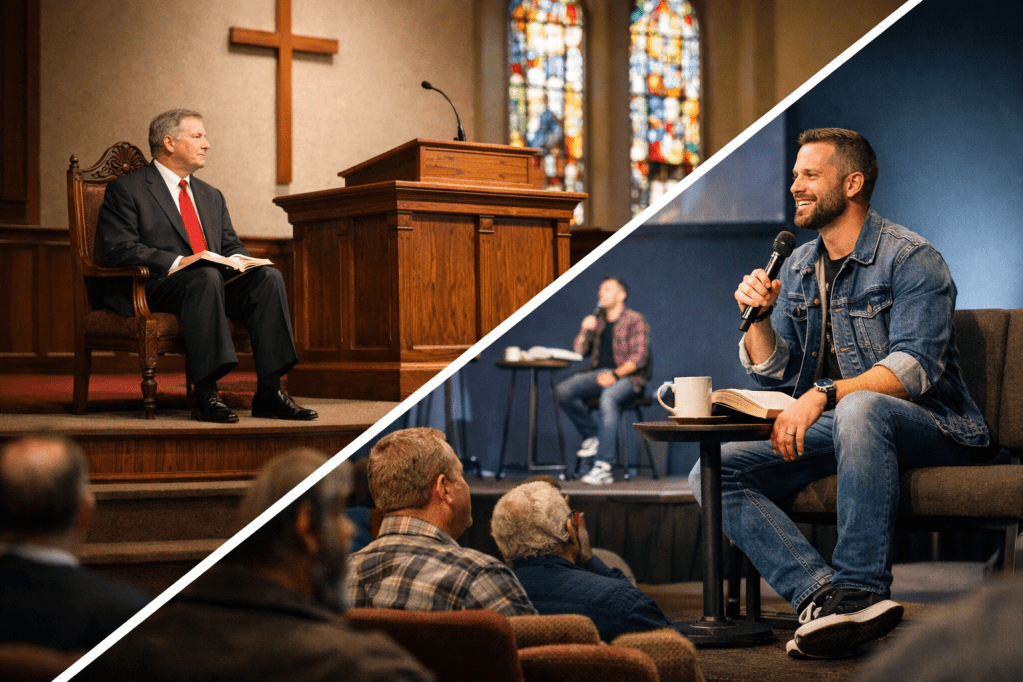
Walk into many historic Protestant churches and you would notice a pattern.
The pastor presided over the service from the platform.
He sat visibly before the congregation.
He stood behind a prominent pulpit to preach.
He wore formal attire—often a suit and tie, sometimes even a robe.
None of these elements were arbitrary. They communicated something about office, authority, and responsibility.
Walk into many churches today and you may notice something different.
The pastor sits among the congregation until it is “his turn.”
The pulpit has been replaced by a small table or music stand.
He may preach from a stool.
His attire might be jeans and sneakers.
Individually, none of these choices are sinful. But collectively, they communicate something. And over time, they have reshaped how many congregations perceive pastoral authority.
When Pastors Presided
Historically, pastors did not simply deliver sermons; they presided over worship. Their visible presence on the platform signaled that Christ governs His church through appointed shepherds.
This was not Roman Catholic sacerdotalism. The Reformers—men like John Calvin and Martin Luther—rejected priestly mediation. But they strongly affirmed pastoral office. The minister was not a spiritual celebrity, but he was a recognized overseer.
His elevated seat on the platform symbolized:
- Accountability before God
- Responsibility for ordering worship
- Authority to preach and guard doctrine
The congregation did not view him as “one voice among many.” He was their shepherd.
Hebrews 13:17 speaks plainly: “Obey your leaders and submit to them, for they are keeping watch over your souls.” That kind of soul-watch requires recognized authority.
The Shift to Sitting Among the Congregation
In recent decades, many pastors have intentionally chosen to sit among the congregation rather than preside visibly.
The motivations are understandable:
- To emphasize humility
- To avoid clerical distance
- To express the priesthood of all believers
Yet something subtle happens when the shepherd is visually indistinguishable from the flock during the service.
The symbolic weight of the office lessens.
The pastor is still ordained. He is still accountable. But the visual cues that reinforced that reality disappear. Worship can begin to feel less ordered by shepherding authority and more facilitated by a rotating group of participants.
Again, this is not about pride. It is about clarity. Scripture maintains a distinction between elders and congregation—not of worth, but of responsibility.
From Pulpit to Table
Alongside the shift in seating has been a shift in preaching posture.
The pulpit once stood at the center because preaching stood at the center. The preacher stood as a herald—announcing divine truth.
The Reformation’s recovery of preaching was architectural as well as theological. The pulpit was theology in wood.
Today, many pulpits are gone. In their place:
- A café-style table
- A music stand
- A handheld microphone
- A stool
The tone often becomes conversational rather than declarative.
There is nothing inherently wrong with clarity, warmth, or accessibility. But posture shapes perception.
Standing behind a pulpit says, “Thus says the Lord.”
Sitting on a stool can feel like, “Here are some thoughts to consider.”
Over time, congregations may begin to treat sermons less as authoritative exposition and more as spiritual TED Talks.
From Suits to Sneakers
Dress also communicates.
Historically, pastors wore formal attire not because Scripture mandated suits, but because their clothing reflected the gravity of their office and the solemnity of worship.
In many modern contexts, pastors now dress like the average attendee—or even more casually.
Again, clothing is not a moral absolute. Scripture does not command a tie.
But attire signals role.
In every sphere of life, uniforms communicate authority and responsibility. Judges wear robes. Police officers wear badges. Military officers wear insignia. Clothing distinguishes office from individual.
When pastors intentionally erase visual distinction, they may communicate approachability—but they may also unintentionally diminish perceived weight.
The cumulative effect of casual seating, casual posture, and casual dress is often a casual perception of authority.
The Podcast Authority Problem
Overlaying all of this is the digital age.
Congregants can now listen weekly to preachers across the globe—figures like John Piper, Alistair Begg, or the late Tim Keller. These men may effectively function as theological authorities in the minds of listeners.
This is a gift in many ways. Faithful preaching is a blessing.
But it creates a danger: the displacement of local authority.
A podcast preacher cannot:
- Exercise church discipline
- Shepherd your family personally
- Order your congregation’s worship
- Give an account for your soul
Your pastor can.
Yet if the visual and symbolic weight of the local office has been steadily diminished—no presiding presence, no pulpit, no visible distinction—the congregation may subconsciously grant more authority to the distant voice than to the shepherd Christ has actually placed over them.
Symbols Shape Souls
We live in a culture that distrusts authority and prizes informality. The church has not been immune to this drift.
In trying to avoid clericalism, we may have flattened shepherding.
In trying to avoid celebrity culture, we may have created a new one—digital and disembodied.
In trying to emphasize humility, we may have blurred office.
None of these shifts—platform seating, pulpit removal, casual dress—automatically destroy authority. But together they catechize congregations. They teach, week after week, what to expect from leadership.
And what is expected eventually becomes what is believed.
Recovering Respect Without Arrogance
The answer is not necessarily a universal return to towering pulpits and three-piece suits. Architecture alone cannot create reverence.
But churches must ask:
- Do our practices communicate that Christ rules His church?
- Do they reflect that pastors will give an account for souls?
- Do they reinforce the seriousness of preaching?
Authority in the church must be humble, accountable, and Christlike.
But it must also be real.
Christ did not give His church content creators.
He gave shepherds.
Whether standing behind a pulpit or sitting on a platform chair, wearing a suit or simple attire, what must not be lost is this: the pastoral office is a divine gift for the good of the flock.
And when the visible symbols of that office disappear, respect for it often fades with them.
The church must not only preach about authority—it must embody it in ways that clearly, wisely, and reverently communicate that Christ truly governs His people through appointed shepherds.
 Doctrine and Mission
Leave a comment