Jesus’ words are familiar enough to lose their edge.
“You are the salt of the earth… You are the light of the world” (Matthew 5:13–14).
We quote them. We affirm them. We even build strategies around them. But somewhere along the way, many of us have quietly redefined what it means to be salt and light—not by Scripture, but by our instincts in an age of outrage.
Ed Stetzer, in Christians in the Age of Outrage (Tyndale House, 2018), observes that we are living in a cultural moment marked by constant outrage, where the loudest voices are rewarded and the sharpest takes spread the fastest. Jamie Dunlop, in Loving the Church… Even When It Hurts (Crossway, 2019), reminds us that many of the people who most test our patience are not “out there,” but sitting right beside us in the pews.
Put those together, and you start to see the problem.
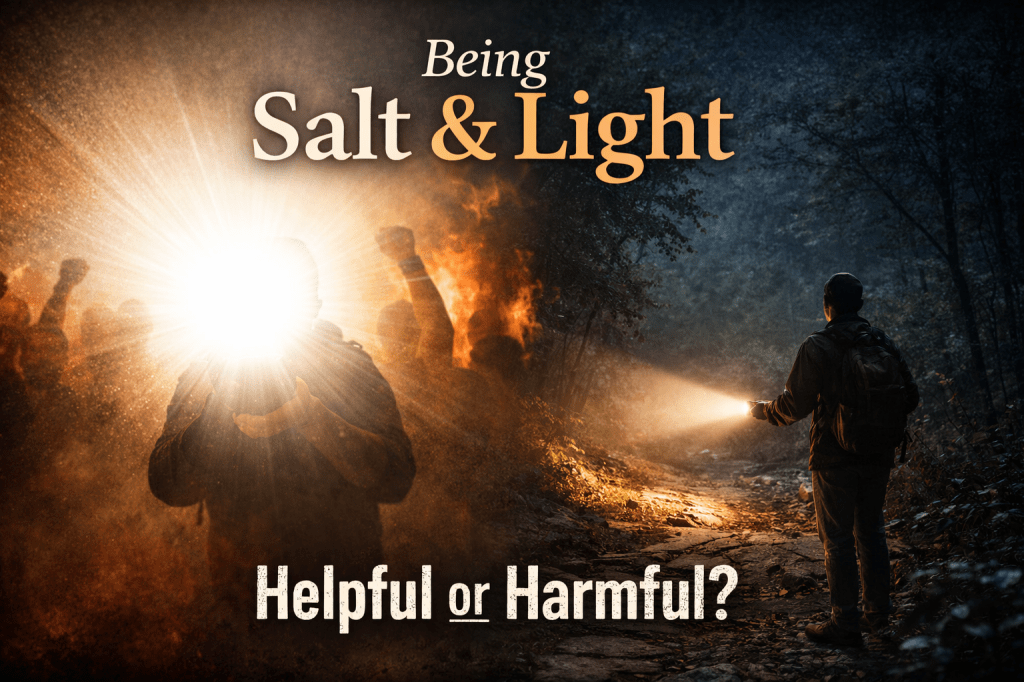
We are trying to be light—but we’ve confused illumination with intensity.
When Light Stops Helping
Light, by its nature, is meant to help people see.
A lamp on a dark path doesn’t blind—it guides. It reveals where to step. It helps you move forward with confidence.
But not all light helps.
A two-million candlepower spotlight aimed straight into someone’s eyes doesn’t illuminate anything. It disorients. It overwhelms. It may be technically “bright,” but it is profoundly unhelpful.
And if we’re honest, much of what passes for Christian “light” today feels less like a lamp for the path and more like a blinding floodlight.
We win arguments but lose people.
We speak truth but without proportion.
We react quickly but rarely with patience.
We are bright—but not helpful.
Salt That Preserves, Not Burns
The same is true of salt.
Salt preserves. It enhances. It brings out what is good. In the ancient world, it slowed decay and made food usable.
But salt, used carelessly, ruins a meal.
No one sits down to eat a spoonful of it. No one enjoys food that has been overwhelmed by it. Salt is meant to be present, but not overpowering.
Yet many of us have adopted a posture where being “salty” means being sharp, biting, and unfiltered—something Stetzer warns can easily mirror the outrage-driven tone of the culture rather than the character of Christ. We justify harshness as faithfulness, as if conviction requires abrasion.
But biblical salt doesn’t destroy—it preserves.
If our presence consistently corrodes relationships, inflames conflict, and drives people away, we should at least ask whether we’ve confused zeal with wisdom.
The Outrage Temptation
In an age of outrage, it is incredibly easy to drift into this—precisely the concern Stetzer raises as he calls Christians to resist becoming “outrage addicts.”
Outrage feels like righteousness.
Sharpness feels like clarity.
Volume feels like courage.
But Scripture consistently calls us to something deeper and more difficult:
- “Let your speech always be gracious, seasoned with salt…” (Colossians 4:6)
- “The anger of man does not produce the righteousness of God” (James 1:20)
- “Speaking the truth in love…” (Ephesians 4:15)
Notice the balance. Not truth instead of love. Not love instead of truth.
Both. Always both.
Loving the Ones Who Test Us
Jamie Dunlop presses this even further. In Loving the Church… Even When It Hurts, he argues that the real test of our maturity is not how we engage our ideological opponents online, but how we love the brother or sister who frustrates us, misunderstands us, or sees things differently.
It’s easy to shine a harsh light at a distance. It’s much harder to patiently walk alongside someone in the dark.
It’s easy to be “right.” It’s harder to be edifying.
In the church, especially, our calling is not merely to expose error, but to build up the body (Ephesians 4:12). That requires more than brightness. It requires wisdom, restraint, and a genuine commitment to the good of others—especially those we find difficult.
A Better Kind of Light
Jesus did not call us to be the loudest people in the room.
He called us to be light.
The kind of light that:
- Helps people see clearly
- Guides rather than overwhelms
- Draws attention not to itself, but to what it reveals
And He called us to be salt:
- Preserving what is good
- Slowing decay
- Making the world more “tasteable,” not less
That kind of presence is often quieter. More patient. Less reactive—precisely the kind of countercultural witness both Stetzer and Dunlop are urging in different ways.
But it is far more powerful.
A Needed Question
Before we speak, post, or respond, we might ask:
Is this helping someone see—or just proving that I can shine?
Is this preserving—or just burning?
Is this building up—or simply venting in religious language?
Being salt and light is not about intensity.
It’s about usefulness in the hands of God.
 Doctrine and Mission
Leave a comment