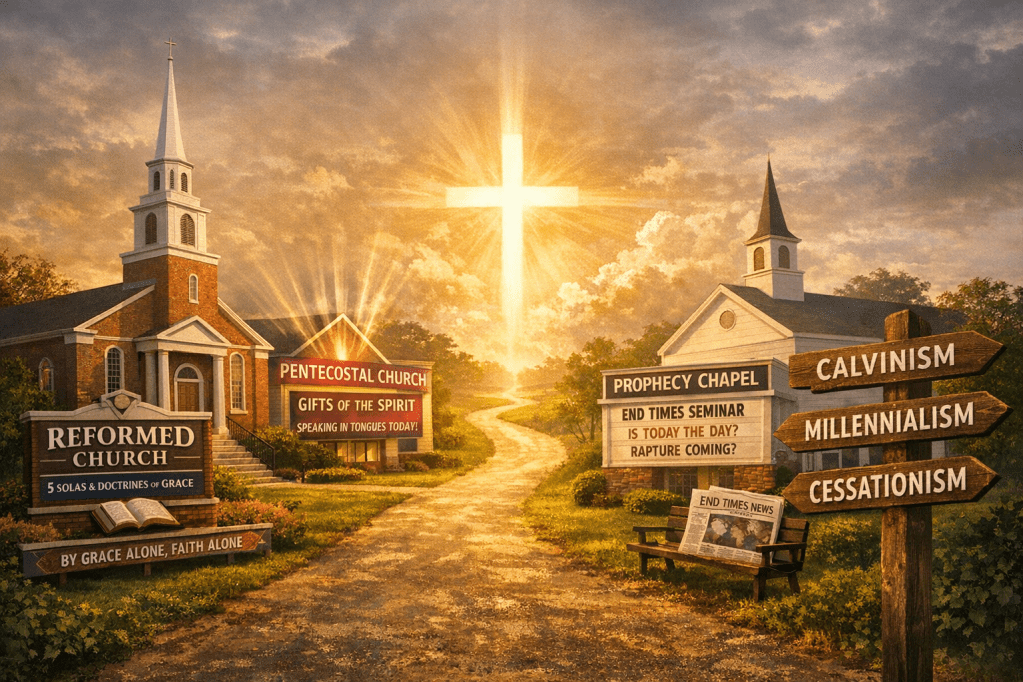
Walk down the main street of almost any town, and you’ll see it: a row of churches, each claiming to follow Christ—but each telling a very different story about what that means. One proudly declares itself Reformed, emphasizing the Five Solas and doctrines of grace, preaching a careful, methodical theology of God’s sovereignty. Next door, another brims with energy, speaking in tongues, emphasizing the gifts of the Spirit, and calling the congregation to expect miracles and prophecy in every service. A few blocks away, yet another church is consumed with the end times, pouring over dates, headlines, and signs in the sky, warning believers to be prepared for the coming tribulation.
On the surface, it may look like diversity—variety in worship styles, theology, and emphasis. But underneath, the reality is often far less beautiful: suspicion, judgment, and competition. The differences that should enrich the body of Christ instead become dividing walls.
Into this fractured landscape, Paul’s words in Ephesians 2 speak with timeless power: the dividing wall between Jew and Gentile has been broken down. Former enemies are now reconciled, not by compromise, but by the finished work of Christ on the cross. Our unity is grounded in something far deeper than personal preferences or theological nuances.
And yet, unity requires effort. In Ephesians 4, Paul calls the church to “make every effort to maintain the unity of the Spirit in the bond of peace,” anchored in “one faith, one Lord, one baptism.” Differences in gifts, personality, and approach are real, but they must never overshadow the gospel that makes us one.
The Modern Challenge
In today’s fractured church landscape, it’s easy to forget what binds us together. Churches that emphasize different doctrines or worship styles often speak past one another, inadvertently elevating secondary debates above the primary mission of the gospel. One church meticulously studies God’s sovereignty, another exuberantly exercises spiritual gifts, while a third dissects headlines for end-times signs. Individually, each pursuit has value—but collectively, when these emphases overshadow the gospel itself, the witness of the church suffers.
Paul’s letters repeatedly show a remarkable clarity on what is of first importance. In 1 Corinthians 15, for example, he insists that the resurrection is non-negotiable: if Christ has not been raised, our faith is futile. Likewise, even in letters filled with detailed teaching on conduct, doctrine, and church life, Paul consistently points his readers back to the central truths of the gospel. The resurrection, justification by faith, and the reconciliation brought by Christ’s death and resurrection are the essentials—everything else, while important, is subordinate.
Pursuing Unity Today
So, how can churches pursue unity in this environment without surrendering doctrinal conviction? The pathway is both simple in principle and challenging in practice: focus on the essentials, honor differences, and prioritize the mission.
- Anchor in the Gospel – Like the Jew and Gentile reconciled in Ephesians 2, the church today must root its unity in Christ’s finished work. Salvation, the resurrection, and the lordship of Christ form the foundation of our fellowship. Differences in secondary doctrines or worship style must never overshadow this anchor.
- Celebrate Differences in Gifts – Paul reminds us in Ephesians 4 that the Spirit gives diverse gifts to build up the body. Unity does not require uniformity. The Reformed preacher, the charismatic teacher, and the eschatology enthusiast all contribute to the body’s maturity—if we focus on the gifts rather than the differences.
- Prioritize the Mission – The ultimate test of unity is not doctrinal agreement on every point, but faithful obedience to Christ’s command: make disciples of all nations, teaching them to observe all that He has commanded(Matthew 28:19–20). Churches that measure success by spiritual fruit—lives transformed, souls won, disciples trained—naturally gravitate toward what matters most.
- Practice Humility and Peace – Maintaining unity requires intentional humility. We must enter conversations ready to listen, willing to defer on secondary matters, and slow to judge. Paul calls this “making every effort to maintain the unity of the Spirit in the bond of peace” (Ephesians 4:3). It is a daily discipline, not a one-time declaration.
- Focus on “First Things First” – Like Paul, we must constantly remind ourselves of what is essential. Doctrinal instruction, governance, and worship style have their place, but they serve the gospel, not the other way around. Churches that keep first things first are best positioned to live out both unity and mission.
Conclusion: Living Out the Unity Christ Bought
Unity in the church is not about erasing differences or pretending disagreements don’t exist. It is about letting the gospel define our relationships, so that even amid differences in gifts, doctrine, and style, the church can reflect the reconciling work of Christ.
If the churches in that small town—the Reformed, the charismatic, the eschatology-focused—could place the gospel at the center of their lives and ministries, they would model what Paul describes: diverse, yet one; different, yet united; passionate about Christ, yet humble toward one another.
Christ died to make us one. Our task is to pursue that unity with diligence, focus on what is of first importance, and channel our energy toward winning souls and making disciples. When we do, our differences enrich the body rather than divide it, and the world sees the power of Christ’s love lived out in a fractured but reconciling church.
 Doctrine and Mission
Leave a comment