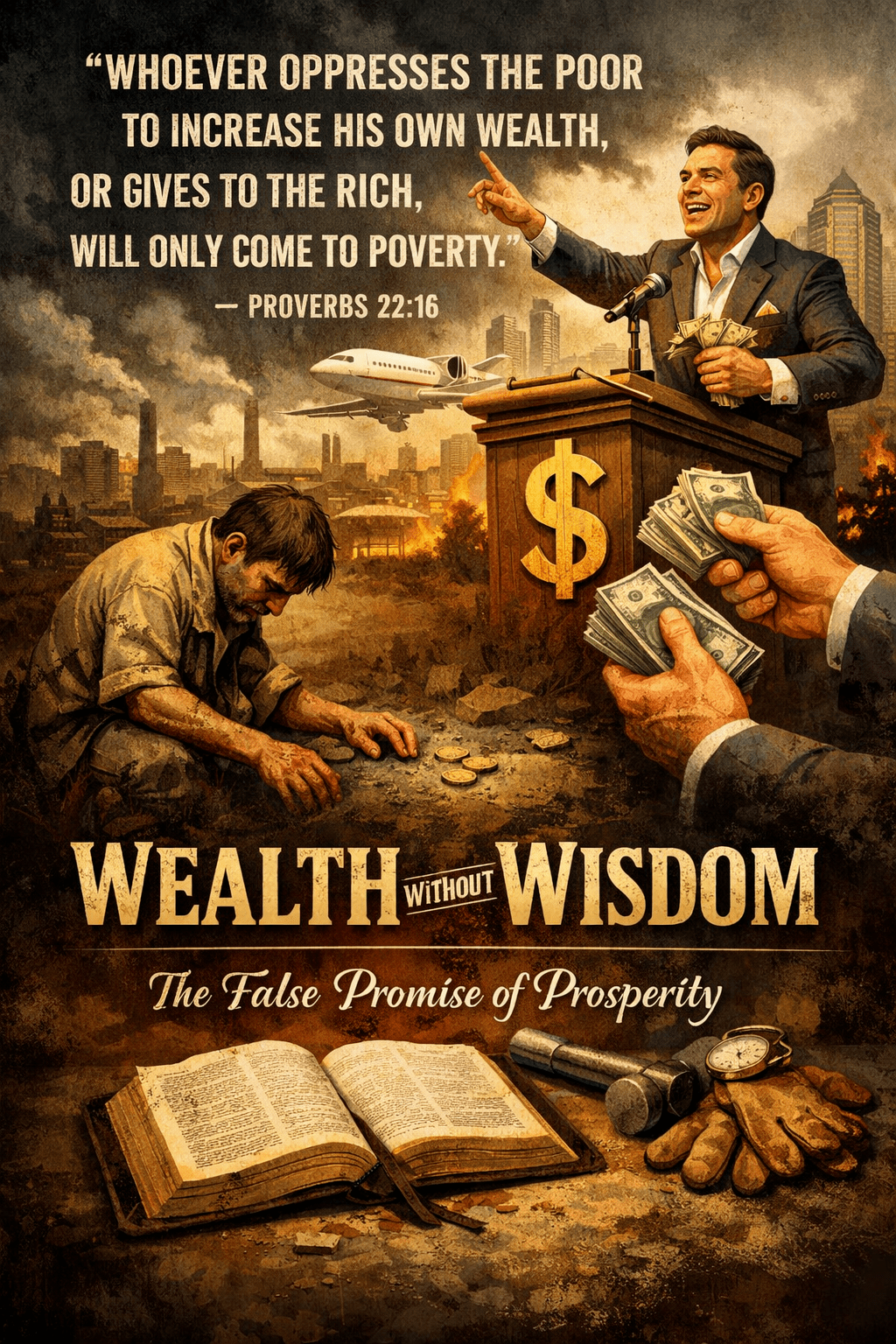
“Whoever oppresses the poor to increase his own wealth, or gives to the rich, will only come to poverty.” — Proverbs 22:16
The Prosperity Promise—and the Proverb That Exposes It
The prosperity gospel offers a simple formula: give, believe, and God will make you wealthy. It turns faith into a mechanism for financial gain and generosity into a strategy for return on investment.
But Proverbs 22:16 quietly dismantles that vision.
Rather than presenting wealth as the automatic result of spiritual activity, this proverb exposes how wealth is often pursued wrongly—and how those pursuits end not in blessing, but in loss.
Oppressing the Poor: When Religion Exploits the Vulnerable
“Whoever oppresses the poor to increase his own wealth…”
This is more than ancient injustice; it is a timeless warning. The poor are not to be used as a means of gain.
Yet the prosperity gospel can mirror this pattern when it pressures those with the least to give the most—promising financial breakthrough if they sow sacrificially. In doing so, it risks turning the suffering of the poor into a revenue stream.
Proverbs calls that what it is: oppression, even when dressed in spiritual language.
Giving to the Rich: The Illusion of Strategic Generosity
“…or gives to the rich, will only come to poverty.”
This exposes another subtle error—giving not out of love, but out of ambition. It is generosity aimed upward, hoping to gain favor, access, or reflected blessing.
In prosperity thinking, this often becomes “sowing into” already wealthy leaders or ministries in hopes of sharing in their success. Giving becomes transactional, almost superstitious.
But Proverbs warns: this path does not lead to increase. It leads to emptiness.
The Missing Piece: How Proverbs Actually Says Wealth Comes
If the prosperity gospel is wrong, what does Proverbs say instead?
Over and over again, Proverbs gives a consistent, grounded answer: wealth—when it comes at all—comes through diligence, patience, and ordinary work.
- “A slack hand causes poverty, but the hand of the diligent makes rich.” (Proverbs 10:4)
- “The plans of the diligent lead surely to abundance, but everyone who is hasty comes only to poverty.” (Proverbs 21:5)
- “Whoever works his land will have plenty of bread, but he who follows worthless pursuits lacks sense.” (Proverbs 12:11)
- “The soul of the sluggard craves and gets nothing, while the soul of the diligent is richly supplied.” (Proverbs 13:4)
There is no hint here of financial return through giving formulas or faith declarations. The path is slower, less glamorous, and far more grounded:
Work. Plan. Be diligent. Avoid shortcuts.
This doesn’t guarantee riches—but it does reflect God’s ordinary design for provision.
The Danger of Shortcuts
The prosperity gospel thrives on immediacy. Sow today, reap tomorrow. Give now, receive a hundredfold.
But Proverbs repeatedly warns against that mindset:
- “Wealth gained hastily will dwindle, but whoever gathers little by little will increase it.” (Proverbs 13:11)
This is perhaps one of the clearest contradictions of prosperity teaching in the entire Bible.
True increase, when it comes, is gradual, not explosive. It is built, not declared. It grows “little by little,” not through spiritualized shortcuts.
A Different Definition of Blessing
At its core, the prosperity gospel misdefines blessing.
Proverbs redefines it:
- Better to be righteous than rich (Proverbs 16:8)
- Better to have little with the fear of the Lord (Proverbs 15:16)
- A good name is greater than great riches (Proverbs 22:1)
Blessing is not measured by accumulation, but by character, wisdom, and the fear of the Lord.
The Ironic End: Poverty
Proverbs 22:16 closes with a sobering irony: those who chase wealth through exploitation or manipulation will end in poverty.
This includes:
- Those who take advantage of the poor
- Those who give for self-advancement
- And, by extension, those who try to bypass God’s design for provision
The prosperity gospel promises abundance, but it often produces disillusionment—if not financial poverty, then certainly spiritual poverty.
Conclusion
Proverbs offers a far more realistic—and far more faithful—vision of life:
- Wealth is not the measure of God’s favor
- Giving is not a strategy for personal gain
- And provision ordinarily comes through diligence, not declarations
Proverbs 22:16 calls us to reject every system that exploits, manipulates, or shortcuts God’s design.
Instead, it invites us into a wiser path—one marked by integrity, steady labor, contentment, and trust in the Lord.
Not flashy. Not immediate. But true.
 Doctrine and Mission
Leave a comment