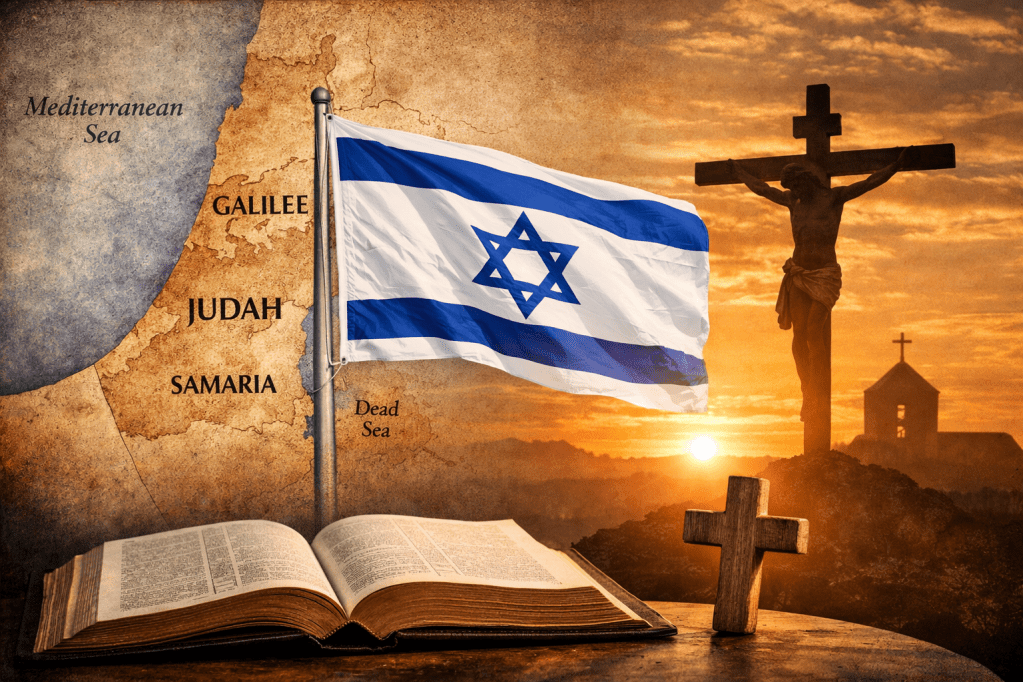
Few questions generate more debate among Christians today than this one: Does the modern nation of Israel have a unique covenant relationship with God? Many believers assume that because Israel was God’s chosen nation in the Old Testament, the present-day political state of Israel must still occupy that same status. But when we examine the full storyline of Scripture—from Abraham to Christ and the church—the answer becomes clearer.
The modern nation of Israel does not possess a unique covenant relationship with God in the way Old Testament Israel once did. That role has reached its fulfillment in Jesus Christ and the people united to Him by faith.
Israel Was God’s Chosen Nation in the Old Testament
The story begins with God’s covenant with Abraham.
In Genesis 12:1–3, God promised Abraham three things:
- Descendants – Abraham would become a great nation.
- Land – His offspring would inherit the land of Canaan.
- Blessing – Through him all nations of the earth would be blessed.
From Abraham came Isaac, then Jacob, and Jacob’s descendants became the nation of Israel. When famine struck the land, the family of Jacob migrated to Egypt where they eventually multiplied into a great people.
Centuries later, God raised up Moses to deliver them from slavery. Through mighty acts of judgment against Egypt, God brought Israel out in the Exodus, forming them into His covenant people at Mount Sinai.
Under Moses they left Egypt, and under Joshua they entered the Promised Land. Israel was uniquely chosen among the nations. As Deuteronomy 7:6 says:
“For you are a people holy to the Lord your God. The Lord your God has chosen you to be a people for his treasured possession.”
Israel had a real and unique covenant relationship with God in the Old Testament. They received the law, the prophets, the temple, the priesthood, and the promises.
But their election was not an end in itself.
Israel’s Purpose Was to Bring Forth the Messiah
The Old Testament makes clear that Israel’s calling was ultimately messianic. God chose Israel in order to bring the Savior into the world.
The promises to Abraham already hinted at this:
“In you all the families of the earth shall be blessed.” (Genesis 12:3)
The apostle Paul later explains that this promise pointed ultimately to Christ (Galatians 3:16).
Israel was the channel through which God would send the Redeemer. Their history, kings, sacrifices, prophets, and covenants all prepared the world for the coming Messiah.
And when Jesus arrived, the New Testament reveals something profound: Jesus Himself is the true Israel.
Jesus Is the True Israel
In the Old Testament, Israel was repeatedly called God’s son.
For example, Hosea 11:1 says:
“Out of Egypt I called my son.”
Originally this referred to the nation of Israel coming out of Egypt in the Exodus. But the Gospel of Matthew applies this same passage directly to Jesus (Matthew 2:15) when He returns from Egypt as a child.
This is not a mistake. It is a theological claim.
Jesus recapitulates the story of Israel.
Consider the parallels:
- Israel went into Egypt → Jesus went into Egypt.
- Israel came out of Egypt → Jesus came out of Egypt.
- Israel passed through the Red Sea → Jesus passed through baptism.
- Israel wandered 40 years in the wilderness → Jesus fasted 40 days in the wilderness.
- Israel was tested and failed → Jesus was tested and obeyed perfectly.
Where Israel failed, Jesus succeeded.
He embodies in Himself everything Israel was meant to be: the faithful Son of God.
This means that the promises given to Israel ultimately converge on Christ.
The Church Is the People of God in Christ
If Jesus is the true Israel, then the people united to Him become the true people of God.
The New Testament repeatedly teaches that membership in God’s people is no longer defined by ethnicity but by faith in Christ.
Paul writes in Romans 9:6–8:
“Not all who are descended from Israel belong to Israel… it is not the children of the flesh who are the children of God, but the children of the promise.”
Likewise in Galatians 3:7:
“Know then that it is those of faith who are the sons of Abraham.”
And again:
“If you are Christ’s, then you are Abraham’s offspring, heirs according to promise.” (Galatians 3:29)
The true heirs of Abraham are not defined by Jewish ancestry but by faith in the Messiah.
Paul even uses striking language in Galatians 6:16, referring to believers as “the Israel of God.”
The church—made up of Jews and Gentiles united in Christ—has inherited the promises that once belonged to Israel as a nation.
What This Means for the Modern Nation of Israel
The modern state of Israel is a real political nation like any other country. Its people should be treated with dignity and justice, just like every nation.
But Scripture does not teach that the modern nation-state has a unique covenant relationship with God.
Why?
Because the covenant role of Israel has already reached its fulfillment.
- The promises pointed to Christ.
- The mission of Israel was completed in the coming of the Messiah.
- The people of God are now defined by union with Christ, not national identity.
Under the new covenant, the dividing wall between Jew and Gentile has been removed. As Paul writes in Ephesians 2:14–16, Christ has made both groups into one new humanity.
In other words, the center of God’s redemptive plan is no longer a geopolitical nation but a global people gathered from every tribe, language, and nation.
A Better Promise
Ironically, the New Testament vision is not smaller than the Old Testament promise—it is much larger.
The promise to Abraham was never merely about one strip of land in the Middle East. It was about blessing all nations.
In Christ, that promise is now being fulfilled as the gospel spreads throughout the world and people from every nation become children of Abraham by faith.
The focus of God’s redemptive plan is therefore not a modern nation-state, but Jesus Christ and His church.
So does the modern nation of Israel have a special covenant relationship with God today?
According to the New Testament, the answer is no.
Israel’s unique role in redemptive history was real and vital—but it reached its goal in the coming of the Messiah. Now the people of God are those who belong to Christ, whether Jew or Gentile, forming the true Israel of God under the new covenant.
 Doctrine and Mission
Leave a comment