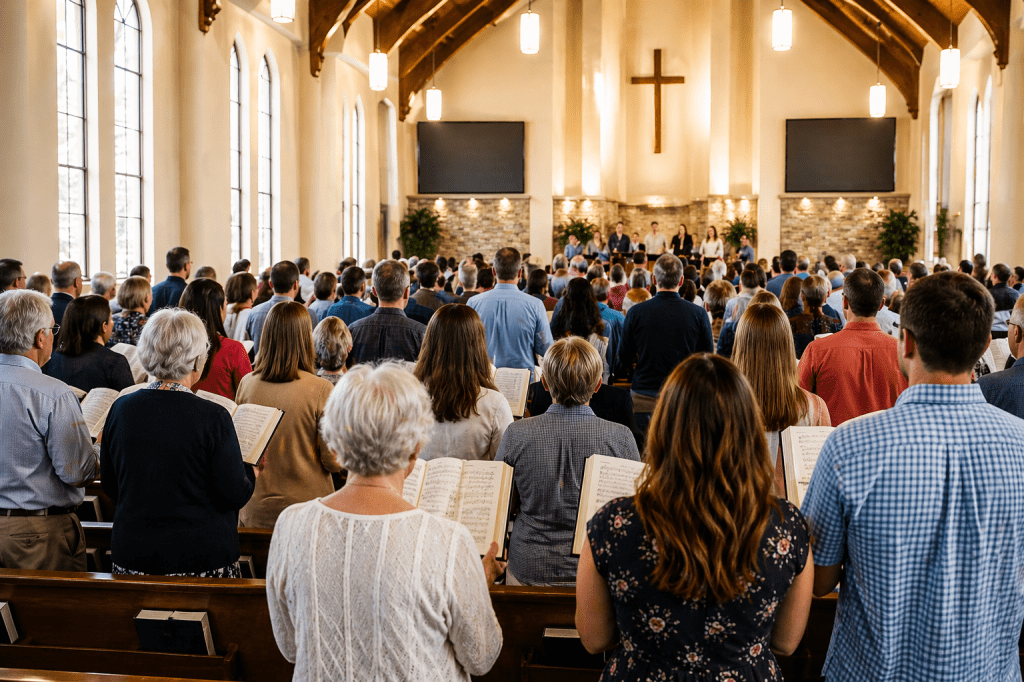
Walk into many churches today, and one thing becomes immediately clear: you can hear the band—but you can’t hear the people.
This is not a small issue. It is not a stylistic preference. It is a theological problem.
Because in Scripture, the primary sound of worship is not a performance—it is the collective voice of the people of God.
Worship in Scripture Is Always Corporate
When we turn to the Psalms, we are not reading private devotionals set to music. We are reading the inspired hymnbook of the gathered people of God.
Take Psalm 96:
“Sing to the Lord…”
That command is not singular—it is plural. It is addressed to a people. The assumption is that God’s people gather and lift their voices together.
This pattern continues into the New Testament.
In Ephesians 5:19:
“…addressing one another in psalms and hymns and spiritual songs…”
And even more explicitly in Colossians 3:16:
“Let the word of Christ dwell in you richly, teaching and admonishing one another in all wisdom, singing psalms and hymns and spiritual songs…”
Notice what Paul is saying: when the church sings, it is teaching and admonishing.
That means congregational singing is not just expressive—it is formative.
It is how the Word of Christ takes root in the body.
It is how believers correct, encourage, and strengthen one another.
You cannot “admonish one another” if you cannot hear one another.
You cannot teach one another if only a few voices are carrying the sound.
This means something unavoidable:
The congregation is the worship team.
When the Church Stops Singing, Something Is Broken
If the gathered church is meant to be the primary instrument of worship, then we must ask an uncomfortable question:
What happens when the band is loud—and the people are silent?
We have unintentionally trained congregations to become spectators. The stage carries the sound. The people consume the experience.
But biblical worship does not function that way.
The gathered church is not an audience. It is a choir.
And more than that—it is a mutual ministry of the Word through song.
The Role of the Worship Team
This does not mean there is no place for musicians. Scripture clearly affirms instrumental accompaniment. But their role must be rightly ordered.
The worship team exists to support, not supplant, the congregation.
That means:
- They should be loud enough to lead, but not so loud that they dominate.
- Their role is to carry the melody, not replace the voices.
- They are successful not when they sound impressive, but when the church sings loudly.
If the congregation cannot be heard, then the very means God designed for teaching and admonishing through song is being diminished.
What Should We Hear on Sunday Morning?
The most powerful sound in corporate worship is not a polished vocal performance.
It is the unified, imperfect, wholehearted singing of the saints.
Different ages. Different abilities. Some on pitch, some not. All lifting their voices together.
That is the sound of:
- Truth being declared
- Hearts being shaped
- Believers admonishing one another
- The Word of Christ dwelling richly among God’s people
Choosing Songs for the People, Not the Platform
This has major implications for song selection.
Not every song that sounds good on a recording works for a congregation.
A song may be easy for a trained vocalist—but difficult for a room full of ordinary people.
Congregational songs should have:
- Singable melodies (not overly complex or jumpy)
- Manageable range (not too high or too low)
- Clear rhythm (not confusing or constantly shifting)
- Predictable structure (so people can learn it quickly)
In other words, songs should be chosen not for how they showcase musicians—but for how they serve the church’s ability to teach and admonish one another through singing.
A good test is simple:
Can a first-time visitor sing this by the second or third verse?
If not, it may not be suitable for congregational worship.
Recovering the Voice of the Church
If we want to recover biblical worship, we don’t need something new—we need something older.
We need to recover the sound of God’s people singing.
Pastors and leaders can begin by:
- Lowering stage volume where needed
- Intentionally teaching on congregational singing
- Choosing songs that are accessible
- Encouraging the church to sing boldly
- Modeling participation from the front
Because when the church sings, something happens:
- The Word is taught
- The body is admonished
- Truth takes root
- Unity is formed
- God is glorified
A Final Word
The goal of worship is not excellence in performance.
It is participation in ministry.
Not a few voices amplified—but many voices united.
The church does not need a better show.
It needs its voice back.

