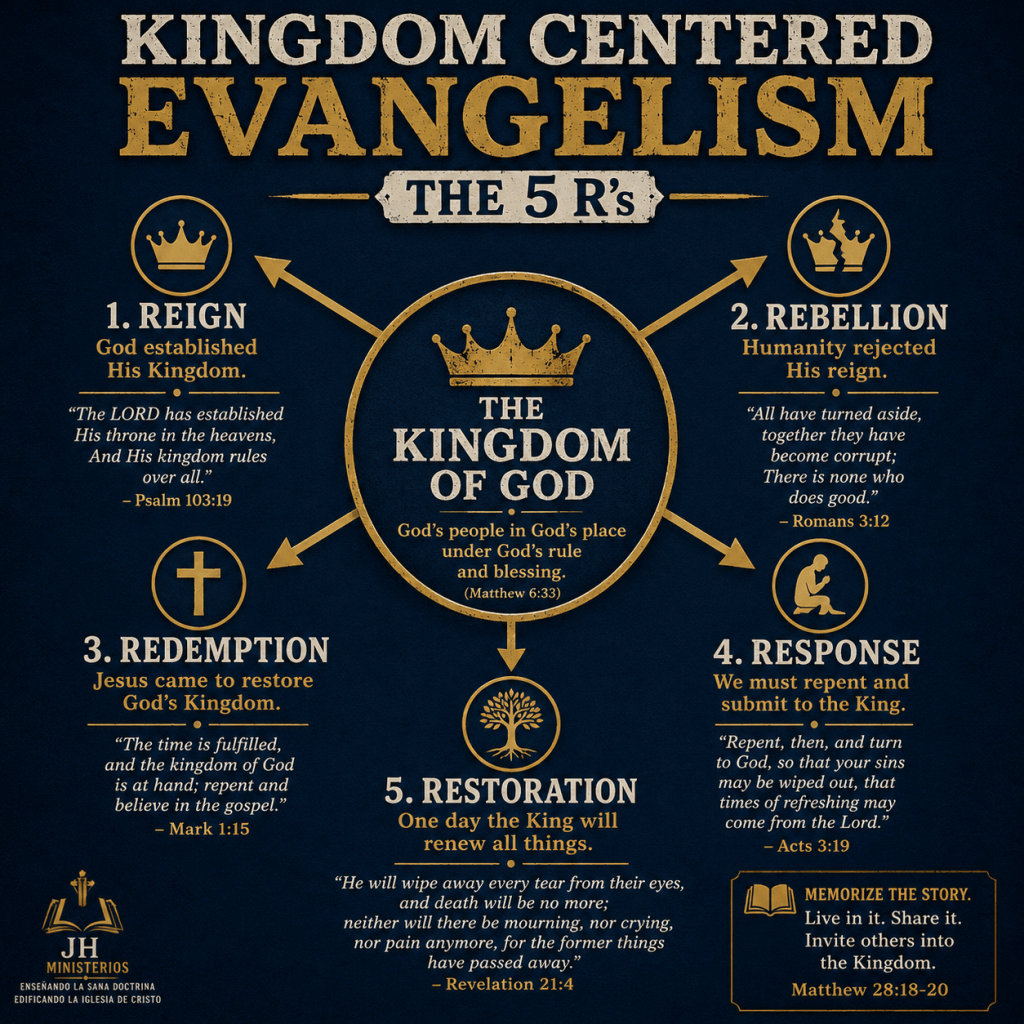
For generations, the church has faithfully proclaimed the good news of Jesus Christ through various evangelism methods and gospel presentations. Many of these tools have helped people understand sin, grace, forgiveness, the cross, and the promise of eternal life. These truths are essential, biblical, and necessary.
The concern is not that traditional gospel presentations are inaccurate. The concern is that many presentations can sometimes be incomplete in their emphasis. They often begin with the individual’s greatest need—guilt, forgiveness, fear of judgment, or the hope of heaven—without placing those realities within the larger biblical story of God’s Kingdom.
The gospel is not less than forgiveness. It is not less than salvation from judgment. It is not less than the hope of eternal life.
But it is more.
The gospel is the announcement that God’s rightful King has come, that His Kingdom has arrived, that rebels can be reconciled to Him, and that all people are called to submit to the reign of King Jesus.
Jesus and the Gospel of the Kingdom
A Kingdom-centered approach to evangelism begins with the message Jesus Himself proclaimed.
When Jesus began His public ministry, He announced:
“The time is fulfilled, and the kingdom of God is at hand; repent and believe in the gospel.”
Mark 1:15
Notice the connection Jesus makes:
The Kingdom has arrived. Therefore, repent and believe.
The gospel response is not simply acknowledging personal need; it is responding to the arrival of God’s reign.
Matthew summarizes Jesus’ ministry this way:
“And he went throughout all Galilee, teaching in their synagogues and proclaiming the gospel of the kingdom and healing every disease and every affliction among the people.”
Matthew 4:23
Jesus’ ministry was centered on the Kingdom:
- He taught the truth of the Kingdom.
- He proclaimed the good news of the Kingdom.
- He demonstrated the power of the Kingdom.
The Kingdom was not a secondary theme of Jesus’ ministry. It was the framework through which He announced salvation.
Jesus even described His mission in these terms:
“I must preach the good news of the kingdom of God to the other towns as well; for I was sent for this purpose.”
Luke 4:43
After His resurrection, Jesus continued teaching His disciples about the Kingdom:
“He presented himself alive to them after his suffering by many proofs, appearing to them during forty days and speaking about the kingdom of God.”
Acts 1:3
The early church continued this same message. Philip preached “the good news about the kingdom of God and the name of Jesus Christ” (Acts 8:12), and Paul spent his final days “proclaiming the kingdom of God and teaching about the Lord Jesus Christ” (Acts 28:31).
The gospel of the Kingdom is not a new emphasis added to the gospel. It is the gospel framework proclaimed by Jesus and continued by His apostles.
The Need for a Kingdom-Centered Gospel
Many evangelism presentations rightly explain that humanity is separated from God because of sin and that Jesus provides forgiveness through His death and resurrection.
But sometimes the gospel can be reduced to a transaction:
“I have my sins forgiven, so I can go to heaven.”
While forgiveness is glorious and essential, Scripture presents salvation as something larger. Salvation is not only rescue from punishment; it is restoration to our rightful place under the loving rule of God.
The problem of humanity is not merely that we have broken God’s laws. The deeper problem is that we have rejected God’s rule.
Sin is rebellion against the King.
Therefore, the solution is not merely receiving a benefit from Jesus. The solution is reconciliation with the King.
The gospel invitation is not simply:
“Accept Jesus as Savior.”
It is:
“Submit to Jesus as King.”
Christ is Savior because He is King. He saves rebels by bringing them back into His Kingdom.
The Five R’s of Kingdom Evangelism
A Kingdom-centered evangelism approach follows the biblical storyline from creation to new creation.
1. Reign — The King Creates His Kingdom
The story begins with God’s authority.
God created all things and established His reign over creation. Humanity was created in God’s image to represent Him, worship Him, and live under His good and gracious rule.
Before humanity had a problem, humanity had a purpose:
To live under the reign of the King.
The first question of the gospel is not, “How can God improve my life?”
The first question is:
Who is the rightful King?
2. Rebellion — Humanity Rejects the King
Genesis 3 reveals humanity’s rejection of God’s authority.
Sin is more than moral failure. It is rebellion against the rightful King.
Humanity chose self-rule over God’s rule, independence over submission, and rebellion over worship.
Every person has participated in this rebellion.
The human problem is not merely that we need improvement. We need reconciliation with the King.
3. Redemption — The King Comes to Rescue Rebels
God did not abandon His Kingdom or His people.
He promised a coming King.
Jesus Christ arrived announcing the Kingdom, demonstrating Kingdom authority, defeating sin and death, and accomplishing redemption through His cross and resurrection.
The cross is not only the payment for sin; it is the victory of the King over His enemies.
Through Christ, rebels can become citizens.
4. Response — Rebels Submit to the King
The proper response to the gospel is repentance and faith.
Repentance is turning away from rebellion against God.
Faith is trusting Christ, receiving His grace, and submitting to Him as Lord and King.
The gospel calls people not merely to receive forgiveness but to enter the Kingdom and live under the authority of Christ.
Conversion is not simply a decision for Christ.
It is allegiance to Christ.
5. Restoration — The King Will Restore All Things
The gospel does not end with individual salvation. It ends with restoration.
King Jesus will return.
He will judge evil, raise His people, renew creation, and establish His Kingdom forever.
Christians live between the arrival of the King and the return of the King.
We are citizens of a Kingdom that has already begun and will one day be fully revealed.
From Evangelism to Discipleship
A Kingdom-centered gospel naturally leads to Kingdom-centered discipleship.
If evangelism is only about receiving forgiveness, discipleship can appear to be an optional next step.
But if evangelism is a call to submit to the King, then discipleship is the lifelong process of learning to live faithfully under His reign.
The goal is not merely forgiven people waiting for heaven.
The goal is faithful citizens who joyfully live under the rule of Christ.
Discipleship asks:
- What does the King command?
- How does the King want His people to live?
- How do we bring every area of life under His authority?
The Mission of the Church
A Kingdom-centered understanding of evangelism leads to a Kingdom-centered understanding of the church:
The mission of the church is to proclaim the Kingdom of God, call rebels to submit to King Jesus, and form faithful citizens who joyfully live under His reign until He returns to restore all things.
The church exists to announce the reign of the King, display the culture of His Kingdom, form His citizens, and await His return.
The gospel is not merely the message that we can be forgiven.
The gospel is the announcement that the King has come.
He calls rebels home.
He forgives sinners.
He forms citizens.
He restores creation.
And until He returns, the church faithfully proclaims:
The King reigns. The Kingdom has come. Submit to King Jesus.

