Tag: deacons

  • Does Your Church Really Need Committees, Ministry Directors, and Church Programs?

    Does Your Church Really Need Committees, Ministry Directors, and Church Programs?

    Or Have We Replaced the Biblical Model of Elders and Deacons?

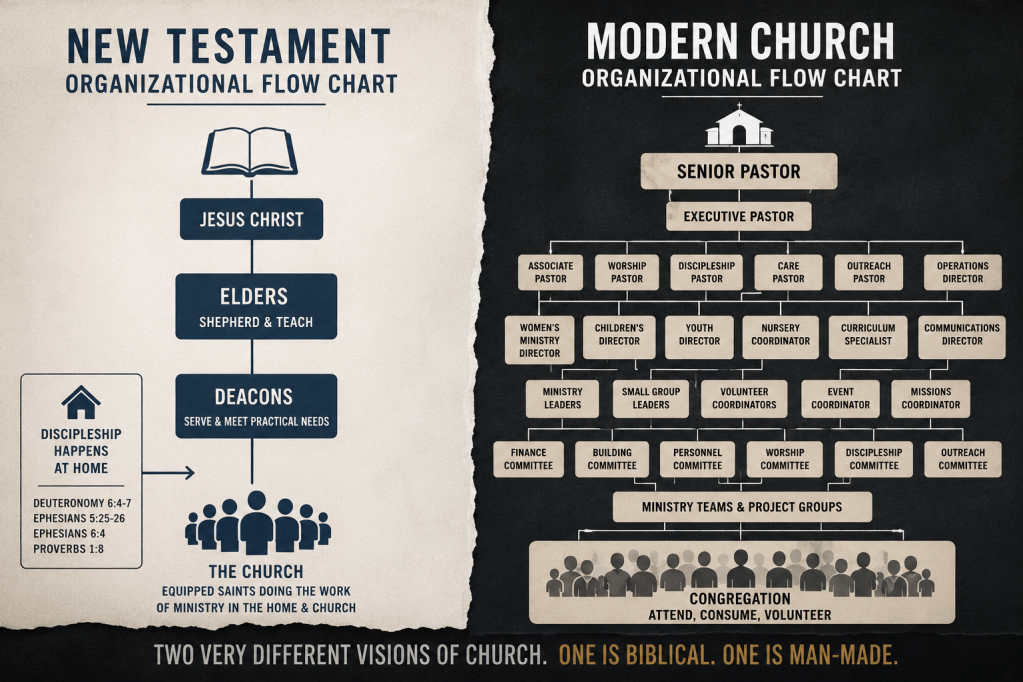
    Modern churches are filled with ministry structures the New Testament never describes.

    Finance committees.
    Women’s ministry directors.
    Children’s ministry pastors.
    Family ministry coordinators.
    Discipleship directors.
    Program directors.
    Ministry teams overseeing ministry teams.

    And yet when we open the New Testament, the structure of the church appears remarkably simple.

    The apostles consistently describe two ordinary offices within the local church:

    • Elders
    • Deacons

    That simplicity should force us to ask an uncomfortable question:

    Have we complicated the church beyond the pattern Scripture gives us?

    The New Testament Pattern Is Surprisingly Simple

    When Paul writes to Timothy about church leadership in 1 Timothy 3, he gives qualifications for two offices:

    • Overseers/Elders
    • Deacons

    Likewise, in Philippians 1:1, Paul addresses:

    “All the saints in Christ Jesus who are at Philippi, with the overseers and deacons.”

    That is the structure.

    Not committees.
    Not boards.
    Not ministry departments.
    Not layers of specialized directors.

    The church in the New Testament was not organizationally complex. It was spiritually serious.

    We often assume effectiveness requires increasing specialization and administrative expansion. But the apostolic churches spread throughout the Roman Empire without the vast institutional machinery many modern churches consider essential.

    The question is not whether organizational tools can sometimes be useful. The question is whether we have slowly replaced the biblical simplicity of the church with corporate models borrowed from the business world.

    What Are Elders Supposed to Do?

    In the New Testament, elders are responsible for the spiritual oversight of the church.

    They teach sound doctrine.
    They guard the flock from error.
    They shepherd souls.
    They equip the saints for ministry.
    They pray.
    They lead.

    Paul tells the Ephesian elders in Acts 20:

    “Pay careful attention to yourselves and to all the flock, in which the Holy Spirit has made you overseers.”

    Peter writes:

    “Shepherd the flock of God that is among you, exercising oversight” (1 Peter 5:2).

    The responsibility of elders is fundamentally spiritual.

    This includes overseeing the teaching ministry of the church.

    In many modern churches, however, teaching has become fragmented into independent ministry silos. Women’s ministries create their own teaching structures. Children’s ministries operate almost autonomously. Small group systems function disconnected from elder oversight.

    But biblically faithful elders cannot delegate away doctrinal oversight.

    If teaching occurs within the church, elders are responsible for ensuring it is sound.

    The church does not need a corporate hierarchy of ministry directors to accomplish this. It needs faithful elders who know the flock and guard the teaching ministry carefully.

    What Are Deacons Supposed to Do?

    Deacons serve the practical needs of the church.

    Their role is not primarily doctrinal oversight but practical service that supports and protects the ministry of the Word.

    Acts 6 gives us the prototype.

    The apostles refused to abandon prayer and the ministry of the Word in order to manage food distribution. Instead, qualified servants were appointed to handle practical matters.

    This allowed the apostles to remain focused on spiritual oversight.

    That pattern remains profoundly important.

    The church has real practical needs:

    • Caring for widows
    • Organizing meals
    • Maintaining facilities
    • Coordinating nursery service
    • Helping members in crisis
    • Managing logistics
    • Supporting mercy ministry

    These are good and necessary works.

    But Scripture assigns such practical service to deaconal ministry, not endless layers of bureaucracy.

    Many churches today function like mid-sized corporations because every ministry becomes its own department requiring directors, committees, meetings, branding, and organizational infrastructure.

    But the New Testament vision is far simpler:

    Elders oversee spiritual matters.
    Deacons oversee practical service.

    The Committee Culture Problem

    Many churches are governed less by elders and more by committees.

    Budget committees.
    Personnel committees.
    Building committees.
    Program committees.

    Sometimes these structures emerge from good intentions. Churches want accountability and shared wisdom.

    But often committees become substitutes for biblical leadership.

    In many churches, elders function more like ceremonial Bible teachers while committees actually govern the church.

    That is not the New Testament pattern.

    Biblically qualified elders are called to lead, shepherd, and oversee the church.

    Likewise, deacons are called to serve practical needs faithfully.

    The church should not need endless layers of governance when spiritually mature elders and faithful deacons are functioning properly.

    We Have Professionalized the Church

    One of the great temptations of modern evangelicalism is the professionalization of ministry.

    Every need becomes a specialized office.
    Every ministry requires a director.
    Every problem demands another program.

    But the New Testament repeatedly pushes responsibility downward into the congregation and especially into the household.

    Parents disciple children.
    Husbands disciple wives.
    Members serve one another.
    Older women teach younger women.
    The body ministers to itself.

    Meanwhile, elders equip and oversee.
    Deacons facilitate and serve.

    This model is far less institutional, but far more relational.

    It also protects the church from becoming dependent upon paid professionals to accomplish ordinary Christian responsibilities.

    Simplicity Is Not Weakness

    Some hear this vision and assume it sounds primitive or inefficient.

    But biblical simplicity is not weakness.

    In fact, complexity often hides spiritual weakness.

    When churches require massive organizational systems to sustain basic discipleship, it may reveal that ordinary Christian life within the congregation has become unhealthy.

    The New Testament church was not built around ministry professionals managing segmented demographics.

    It was built around:

    • Faithful preaching
    • Qualified elders
    • Faithful deacons
    • Ordinary members serving one another
    • Families discipling within the home
    • The body building itself up in love

    The church is not a corporation.

    It is a spiritual family.

    And families do not flourish primarily through bureaucracy.

    They flourish through faithful relationships, godly leadership, and ordinary obedience.

    Recovering the Biblical Pattern

    A biblically healthy church does not need endless organizational complexity.

    It needs:

    • Faithful elders devoted to prayer, teaching, and shepherding.
    • Faithful deacons serving practical needs wisely.
    • Fathers discipling their children.
    • Husbands washing their wives with the Word.
    • Mature members serving one another.
    • The ordinary means of grace functioning faithfully.

    The New Testament pattern is not flashy.

    It will not impress corporate leadership experts.

    But it produces something far more valuable:

    Healthy churches built upon spiritually mature households, qualified elders, faithful servants, and the sufficient wisdom of God’s Word.

  • From Acts to Timothy: How the Church Matures

    It started, as it often does, with a meeting that ran too long at Redemption Hill Church.

    What was supposed to be a straightforward discussion about next year’s budget had slowly turned into something else. The room wasn’t loud, but it was heavy—the kind of silence where everyone knows more is being said beneath the surface than on it.

    Pastor Daniel sat at the end of the table, hands folded, trying to keep the conversation moving. Across from him was Mark Ellison, a longtime member whose family had been at Redemption Hill for over twenty years. Mark didn’t raise his voice—he didn’t have to.

    “I just think,” Mark said, leaning back in his chair, “we need to be wise about where we’re putting resources. We’ve always prioritized ministries that actually bear fruit.”

    Everyone in the room knew what he meant.

    Jared, one of the younger members who had only been at the church a few years, shifted forward. “But who decides what counts as fruit?” he asked. “It feels like some of these decisions are already made before we even get in this room.”

    A few heads turned. No one spoke.

    Finally, one of the elders, Tom, cleared his throat. “Jared, I think we need to be careful here. There’s a reason God appoints leaders. Not every decision needs to be… debated at length.”

    Jared nodded slowly, but the tension didn’t ease. “I’m not asking for control,” he said. “Just clarity.”

    From the corner, Lisa—who oversaw one of the ministries that had recently lost funding—spoke up quietly. “It would just be helpful to know why some things are being cut and others aren’t.”

    Mark sighed, not irritated, just settled. “Not everything can be a priority,” he said. “That’s just reality.”

    But by then, the meeting had already shifted. This wasn’t about numbers anymore. It was about trust. About influence. About who actually shaped the direction of the church.

    And everyone felt it.


    In the weeks that followed, the real conversations didn’t happen in meetings.

    They happened in parking lots after Sunday service.

    In living rooms over late-night conversations.

    In group texts that started with, “I don’t want to stir anything up, but…”

    Jared met with a few others from the church. “I’m not trying to divide anything,” he said, “but it feels like there are two churches here—one that makes decisions and one that just lives with them.”

    Across town, Mark sat at his kitchen table with a couple of longtime members. “We’ve seen this before,” he said. “You get a few people who want to change everything overnight. That’s how churches lose their footing.”

    Lisa, meanwhile, quietly stepped back from her ministry. No announcement. No conflict. Just… absence.

    By the next members’ meeting, the tension was no longer subtle.

    Someone finally said the word no one had wanted to say out loud:

    “Are we heading toward a split?”

    The room went still.

    Pastor Daniel leaned forward, his voice careful. “I hope not,” he said. “But we need to be honest about where we are.”

    And then, from the back of the room, a voice broke in—earnest, almost pleading:

    “This is exactly why the church needs to get back to the simplicity of Acts 2.”

    A few people nodded.

    “No politics. No power struggles. Just the Word, prayer, fellowship… caring for each other. That’s what the church is supposed to be.”

    It sounded right.

    It sounded spiritual.

    It sounded like the answer.

    But it also raised a question that no one in the room was asking yet:

    Was Acts 2 ever meant to carry the full weight of a church over time?

    Or are we longing for a moment in Scripture that was never designed to stand alone?


    Acts Is a Beginning, Not a Mature Model

    Acts 2 describes a newly formed community in the immediate aftermath of Pentecost. The Spirit has been poured out. Thousands have been converted. The apostles are physically present. The church is unified, energized, and—at least in that moment—uncomplicated.

    But it doesn’t stay that way.

    Very quickly, cracks begin to show:

    • In Acts 5, hypocrisy enters through Ananias and Sapphira.
    • In Acts 6, conflict arises over the neglect of widows.
    • In Acts 15, doctrinal controversy threatens the unity of the church.

    The “simplicity” of Acts 2 doesn’t disappear because something went wrong—it disappears because real people are involved. Sinners saved by grace still bring sin into the life of the church. Growth introduces complexity. Diversity introduces tension. Time introduces drift.

    And what does the church do?

    It doesn’t try to recreate Acts 2. It begins to organize, appoint, clarify, and guard.


    The Reality Check: The Churches of the New Testament

    If Acts shows us the birth of the church, the Epistles show us its adolescence—and it’s not pretty.

    Take Corinth, for example. This is not a church lacking spiritual gifts or enthusiasm. And yet:

    • Members are suing one another in secular courts (1 Cor. 6).
    • Sexual immorality is being tolerated—even celebrated (1 Cor. 5).
    • The Lord’s Supper is being abused, turning a sacred meal into division and selfishness (1 Cor. 11).
    • Worship gatherings are marked by chaos rather than edification (1 Cor. 14).

    This isn’t a church that just needs to “get back to Acts 2.” This is a church that needs correction, structure, and clear apostolic authority.

    Or consider Galatia:

    Paul doesn’t commend them—he confronts them. Strongly.

    • False teachers have infiltrated the church.
    • The gospel itself is being distorted.
    • Believers are being led away from grace into legalism.

    Paul’s response is not to simplify things. It is to draw hard doctrinal lines: “If anyone preaches another gospel…let him be accursed” (Gal. 1:8).

    Then there’s Ephesus:

    Even in a relatively healthy church, unity is fragile.

    • Jew and Gentile tensions threaten to divide the body (Eph. 2).
    • Maturity is not assumed—it must be cultivated (Eph. 4).
    • The church must be equipped so it is not “tossed to and fro by every wind of doctrine.”

    Across the New Testament, a pattern emerges: churches are not drifting because they’ve become too structured—they are struggling because they are made up of sinners who need clarity, leadership, and formation.


    The New Testament Moves Toward Structure, Not Away From It

    By the time we reach the Pastoral Epistles—1 Timothy and Titus—we’re no longer looking at a brand-new movement. We’re looking at churches that have existed long enough to face serious challenges:

    • False teachers are distorting the gospel (1 Tim. 1:3–7; Titus 1:10–11).
    • Leadership is necessary and must be qualified (1 Tim. 3; Titus 1).
    • Widows need structured, ongoing care (1 Tim. 5).
    • Church order is not optional—it is essential.

    Paul doesn’t tell Timothy and Titus to “get back to the simplicity of Acts 2.” He tells them to establish elders, appoint deacons, rebuke false teaching, and bring order to the household of God.

    In other words, the church doesn’t become less structured as it matures—it becomes more so.


    Guardrails Are Not the Enemy of the Spirit

    There is often an assumption behind the “back to Acts 2” mindset: structure stifles the Spirit, while simplicity invites Him.

    But the New Testament presents a different picture.

    The same Spirit who was poured out at Pentecost is the one who:

    • Inspires the qualifications for elders and deacons
    • Commands the guarding of sound doctrine
    • Establishes patterns for discipline, care, and leadership

    Structure in the church is not a retreat from spiritual vitality—it is the means by which spiritual vitality is preserved.

    Guardrails are not opposed to life; they protect it.


    The Church Is Not an Event—It’s a Household

    Acts 2 feels like a moment. The Pastoral Epistles describe a household.

    Paul explicitly calls the church “the household of God” (1 Tim. 3:15). Households require order. They require leadership. They require care for the vulnerable. They require instruction, correction, and stability over time.

    You can’t run a household on a perpetual “Pentecost moment.” It requires ongoing faithfulness.


    The Real Danger of Romanticizing Acts 2

    When we idealize Acts 2 as the model to return to, we can unintentionally:

    • Downplay the necessity of qualified leadership
    • Resist accountability and doctrinal clarity
    • Neglect long-term care structures (like widows and the needy)
    • Confuse emotional vibrancy with spiritual health

    Worse, we can begin to see the very instructions God gives in the Pastoral Epistles as less spiritual than the early days of Acts.

    But that’s exactly backward.


    Don’t Rewind—Mature

    The goal isn’t to go back to Acts 2. The goal is to become a church that is:

    • Rooted in apostolic doctrine
    • Led by qualified, godly elders
    • Served by faithful deacons
    • Committed to sound teaching
    • Structured to care for its people
    • Equipped to guard the gospel over time

    Acts 2 shows us what the Spirit begins.
    1 Timothy and Titus show us what the Spirit sustains.


    A Better Vision

    Yes, we should long for the devotion, generosity, and gospel power of Acts 2.

    But we should also embrace the wisdom, order, and durability of the Pastoral Epistles.

    Because the same God who poured out His Spirit in Acts 2 is the God who, through Paul, told the church how to endure.

    Not as a moment.

    But as a faithful, ordered, truth-guarding people—generation after generation.
  • Called to Shepherd, Not to Apply: Rethinking How We Raise Up Pastors

    Jake loved his church.

    He wasn’t on staff. He didn’t have a title. But he was there when people needed him. He taught faithfully. He discipled younger men. He showed up in hospital rooms and living rooms and hard conversations.

    People began to notice.

    “I think Jake might be called to ministry.”

    Eventually, Jake believed it too.

    So he did what everyone told him to do.

    He left.

    He went to seminary. He sat under professors who didn’t know his life, didn’t know his church, and didn’t know the people he had already begun to shepherd. He learned, he studied, he graduated.

    Then he built a résumé.

    He sent it out to churches he had never visited—churches that had never seen him handle conflict, never watched him disciple a struggling believer, never observed his life over time.

    One of them called.

    After a series of interviews, they offered him the position of pastor.

    Jake accepted.

    At first, things went well. He preached faithfully. He worked hard. He cast vision. But slowly, something began to feel off.

    Every decision seemed to run through a group of deacons who functioned less like servants and more like a board of directors. Budgets, priorities, even aspects of ministry direction were filtered through them.

    Jake wasn’t leading as an elder—he was reporting as an employee.

    When tensions arose, they weren’t handled as shepherding issues within a body. They felt like workplace conflicts. Evaluations happened. Concerns were raised. Expectations were clarified.

    And eventually, the relationship fractured.

    Jake resigned.

    Within months, he was updating his résumé again—searching for the next opportunity, the next church, the next “fit.”

    And the church?

    They began the process all over again.

    And no one thought this was strange.

    When the Church Becomes a Corporation

    We’ve created a system that would have been foreign to the New Testament.

    A man senses a call, leaves his church to be trained elsewhere, and then enters a kind of ministry marketplace—applying, interviewing, negotiating—until he is hired by a church that barely knows him.

    Once there, he often functions not as a recognized elder among a known people, but as a professional brought in to perform a role.

    And in many cases, the structure reinforces it.

    Deacons—who in Scripture are called to serve—can drift into functioning like a governing board. The pastor—who is called to shepherd and oversee—can be subtly recast as a kind of employee accountable to that board.

    It’s not always explicit. No one says it out loud.

    But it shows up in how decisions are made, how authority is structured, and how easily a pastor can be replaced.

    The Assumption We Never Question

    Underneath all of this is an assumption we rarely examine:

    That a “call to ministry” is a call to become the senior pastor somewhere else.

    But that category doesn’t come from Scripture.

    The New Testament speaks of elders—plural—who shepherd a local church together (Acts 14:23, Titus 1:5). It does not present a lone “senior pastor” as the goal of a man’s calling.

    So what if Jake’s calling was not to leave?

    What if his calling was to shepherd the flock of God among him?

    What if the recognition of his gifting by his church was not the first step away from that body—but deeper intoresponsibility within it?

    One of the most overlooked paths in our current system is this:

    A man is called… and he stays.

    He is raised up as an elder in the very church where his life is already known. He shepherds the people who have seen his character. He leads alongside other elders, not above them. He doesn’t need a new platform—he embraces a present responsibility.

    But in many of our contexts, that option is barely visible.

    We’ve unintentionally trained men to think that faithfulness means leaving.

    Shepherds Don’t Job Hop

    If a pastor is functionally an employee, then leaving for another church can feel no different than taking a new position somewhere else.

    But shepherding isn’t a career ladder.

    It’s a calling to people.

    Peter says, “shepherd the flock of God that is among you” (1 Peter 5:2).

    Not the one hundreds of miles away.

    Not the one you interviewed for.

    The one among you—people who know your life, who have seen your faithfulness, who can affirm your calling because they’ve witnessed it over time.

    The Root Problem: Disconnected Formation

    We have separated the raising up of pastors from the life of the local church.

    Instead of being trained, tested, and affirmed within a body, men are often formed at a distance and then inserted into a church as outsiders.

    That creates a fragile foundation from the start.

    The church doesn’t truly know the man.

    The man doesn’t truly know the church.

    And when pressure comes—and it always does—there is not enough relational depth to hold things together.

    A Better Pattern: Raised Up and Sent Out

    The New Testament offers a better way.

    A man senses a call and brings it to his elders. They test it. They observe his life. They give him opportunities to teach, to lead, to shepherd.

    Over time, he is not just educated—he is known.

    And then one of two things happens:

    He is recognized as an elder in that church, continuing to shepherd the very people among whom he was formed.

    Or—

    He is sent out by that church to plant, revitalize, or strengthen another work.

    In Acts 13, the church at Antioch sets apart Paul and Barnabas and sends them out. They go not as independent ministers seeking opportunity, but as men recognized and commissioned by a local body.

    Not hired.

    Sent.

    Restoring the Right Roles

    Recovering this vision also restores clarity to the offices of the church.

    Elders lead, shepherd, and oversee.

    Deacons serve, support, and meet tangible needs.

    When those roles are blurred, the church suffers. When they are restored, the church flourishes.

    Pastors are no longer treated like entry-level employees trying to prove themselves to a board.

    They are recognized as shepherds—among a people, alongside other elders, under Christ.

    The Way Forward

    Recovering this will require a shift in how we think about calling.

    Not every called man needs to go somewhere else.

    Some need to stay.

    Some need to shepherd the flock already among them.

    And some need to be sent—but sent by a church that knows them, affirms them, and remains connected to them.

    That means slowing down. Investing deeply. Raising up men instead of importing them.

    It means resisting the instinct to turn pastors into employees and churches into hiring organizations.

    Because the goal is not to fill positions.

    It is to faithfully shepherd the flock of God.

    Not far away.

    But among you.