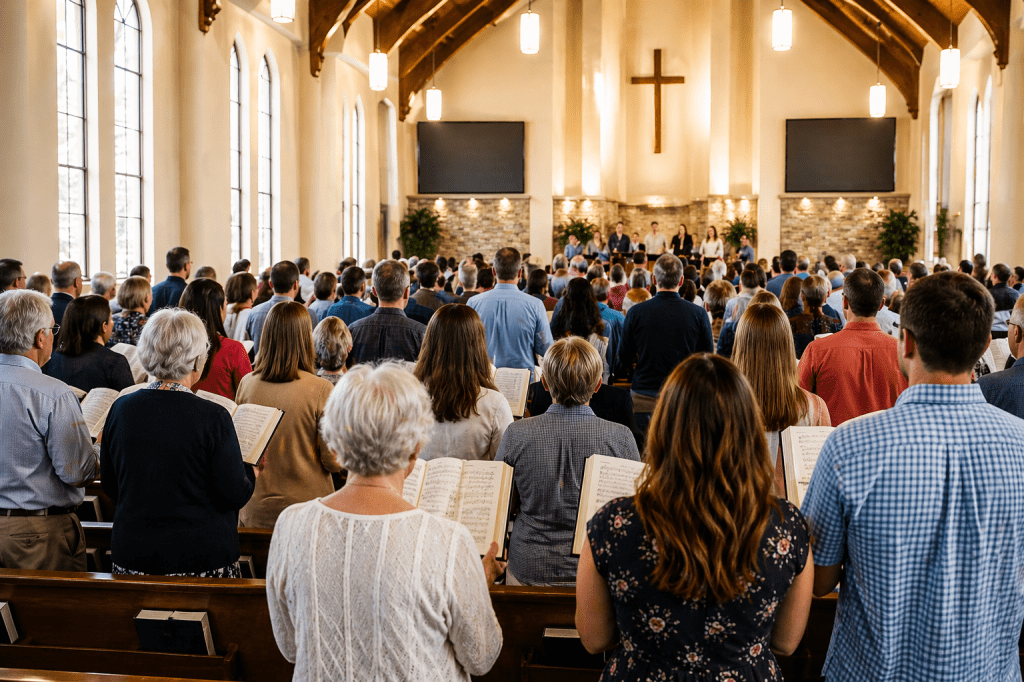
Tag: corporate worship

  • The Lost Sound of Worship: Why Congregational Singing must be Recovered

    The Lost Sound of Worship: Why Congregational Singing must be Recovered

    Walk into many churches today, and one thing becomes immediately clear: you can hear the band—but you can’t hear the people.

    This is not a small issue. It is not a stylistic preference. It is a theological problem.

    Because in Scripture, the primary sound of worship is not a performance—it is the collective voice of the people of God.

    Worship in Scripture Is Always Corporate

    When we turn to the Psalms, we are not reading private devotionals set to music. We are reading the inspired hymnbook of the gathered people of God.

    Take Psalm 96:

    “Sing to the Lord…”

    That command is not singular—it is plural. It is addressed to a people. The assumption is that God’s people gather and lift their voices together.

    This pattern continues into the New Testament.

    In Ephesians 5:19:

    “…addressing one another in psalms and hymns and spiritual songs…”

    And even more explicitly in Colossians 3:16:

    “Let the word of Christ dwell in you richly, teaching and admonishing one another in all wisdom, singing psalms and hymns and spiritual songs…”

    Notice what Paul is saying: when the church sings, it is teaching and admonishing.

    That means congregational singing is not just expressive—it is formative.

    It is how the Word of Christ takes root in the body.

    It is how believers correct, encourage, and strengthen one another.

    You cannot “admonish one another” if you cannot hear one another.

    You cannot teach one another if only a few voices are carrying the sound.

    This means something unavoidable:

    The congregation is the worship team.

    When the Church Stops Singing, Something Is Broken

    If the gathered church is meant to be the primary instrument of worship, then we must ask an uncomfortable question:

    What happens when the band is loud—and the people are silent?

    We have unintentionally trained congregations to become spectators. The stage carries the sound. The people consume the experience.

    But biblical worship does not function that way.

    The gathered church is not an audience. It is a choir.

    And more than that—it is a mutual ministry of the Word through song.

    The Role of the Worship Team

    This does not mean there is no place for musicians. Scripture clearly affirms instrumental accompaniment. But their role must be rightly ordered.

    The worship team exists to support, not supplant, the congregation.

    That means:

    • They should be loud enough to lead, but not so loud that they dominate.
    • Their role is to carry the melody, not replace the voices.
    • They are successful not when they sound impressive, but when the church sings loudly.

    If the congregation cannot be heard, then the very means God designed for teaching and admonishing through song is being diminished.

    What Should We Hear on Sunday Morning?

    The most powerful sound in corporate worship is not a polished vocal performance.

    It is the unified, imperfect, wholehearted singing of the saints.

    Different ages. Different abilities. Some on pitch, some not. All lifting their voices together.

    That is the sound of:

    • Truth being declared
    • Hearts being shaped
    • Believers admonishing one another
    • The Word of Christ dwelling richly among God’s people

    Choosing Songs for the People, Not the Platform

    This has major implications for song selection.

    Not every song that sounds good on a recording works for a congregation.

    A song may be easy for a trained vocalist—but difficult for a room full of ordinary people.

    Congregational songs should have:

    • Singable melodies (not overly complex or jumpy)
    • Manageable range (not too high or too low)
    • Clear rhythm (not confusing or constantly shifting)
    • Predictable structure (so people can learn it quickly)

    In other words, songs should be chosen not for how they showcase musicians—but for how they serve the church’s ability to teach and admonish one another through singing.

    A good test is simple:

    Can a first-time visitor sing this by the second or third verse?

    If not, it may not be suitable for congregational worship.

    Recovering the Voice of the Church

    If we want to recover biblical worship, we don’t need something new—we need something older.

    We need to recover the sound of God’s people singing.

    Pastors and leaders can begin by:

    • Lowering stage volume where needed
    • Intentionally teaching on congregational singing
    • Choosing songs that are accessible
    • Encouraging the church to sing boldly
    • Modeling participation from the front

    Because when the church sings, something happens:

    • The Word is taught
    • The body is admonished
    • Truth takes root
    • Unity is formed
    • God is glorified

    A Final Word

    The goal of worship is not excellence in performance.

    It is participation in ministry.

    Not a few voices amplified—but many voices united.

    The church does not need a better show.

    It needs its voice back.

  • Singable Worship: Why Corporate Songs Must Belong to the Congregation

    “Addressing one another in psalms and hymns and spiritual songs…” — Ephesians 5:19

    Walk into many churches today and you’ll notice something subtle but significant:

    The music is excellent.
    The band is tight.
    The vocals are powerful.

    And yet… the congregation is quiet.

    Not silent—but hesitant. Watching more than participating. Listening more than singing.

    That’s not just a stylistic issue. It’s a theological one.

    Because Scripture does not present worship as a performance to observe—but as a shared act of singing to one another.

    Which raises a critical question:

    Are our songs actually singable for the people we’re asking to sing them?


    Worship Is Corporate, Not Platform-Centered

    When Paul describes gathered worship in Ephesians 5:19 and Colossians 3:16, the direction is unmistakable:

    We are singing to one another.

    That means the primary instrument in corporate worship is not the guitar, the piano, or even the band.

    It’s the voice of the congregation.

    The platform exists to support that—not replace it.

    But when songs are chosen that only a trained vocalist can navigate, the result is predictable:

    The congregation disengages.
    Worship becomes something done for them rather than by them.

    And slowly, almost without noticing, the church shifts from a singing people to a listening audience.


    What Makes a Song Singable?

    Singability isn’t about taste—it’s about accessibility.

    A song may sound incredible in the hands of skilled musicians and still be nearly impossible for the average person to sing.

    Here are a few elements that determine whether a song truly belongs to the congregation:

    1. A Reasonable Vocal Range

    Most untrained singers are comfortable within about an octave (roughly middle C to the next C).

    But many modern worship songs stretch far beyond that—requiring:

    • High sustained notes
    • Sudden jumps in pitch
    • Keys that sit too high or too low

    What feels powerful for a lead vocalist often feels unreachable for a congregation.

    A singable song sits in a range where:

    • Men and women can both participate
    • Voices don’t strain
    • The melody feels natural, not athletic

    If people have to stop singing to listen and recalibrate, the song is doing too much.


    2. Memorable, Predictable Melodies

    A congregation hears most songs only a handful of times.

    That means melodies must be:

    • Intuitive (they “go where you expect”)
    • Repetitive enough to learn quickly
    • Structured clearly (verse, chorus, etc.)

    If a melody feels unpredictable or overly complex, people won’t sing—they’ll spectate.

    The goal is not musical impressiveness.
    The goal is immediate participation.


    3. Rhythmic Simplicity

    Highly syncopated or rhythmically complex songs can be engaging to listen to—but difficult to join.

    Congregational singing thrives on:

    • Clear, steady rhythms
    • Strong downbeats
    • Phrases that are easy to follow

    If the average person can’t tell when to come in, they won’t.


    4. Clear, Lingering Phrasing

    People need time to:

    • Read the words
    • Process the meaning
    • Physically sing the line

    Songs that rush lyrics, cram syllables, or move too quickly unintentionally exclude the congregation.

    A singable song gives space to breathe—both musically and spiritually.


    The Difference Between a Good Song and a Church Song

    Not every good Christian song is a good corporate worship song.

    That’s an important distinction.

    Some songs are:

    • Better suited for personal listening
    • Built around a specific artist’s vocal style
    • Designed for performance rather than participation

    And that’s okay.

    But the gathered church has a different aim.

    We’re not curating a playlist—we’re cultivating a singing people.

    So the question isn’t:
    “Is this song powerful?”

    It’s:
    “Can our people actually sing this together?”


    When Music Outpaces the Congregation

    One of the unintended effects of modern worship culture—shaped in part by groups like Hillsong Worship, Bethel Music, and Elevation Worship—is that songs are often written and recorded in contexts where:

    • The musicians are highly skilled
    • The vocalists are exceptional
    • The arrangements are layered and dynamic

    Those songs can be beautiful.

    But when imported directly into the local church without adaptation, they can unintentionally sideline the congregation.

    What works in a recording or conference setting doesn’t always translate to a room full of ordinary people.

    And that matters—because the local church is not a concert venue.


    The Sound That Should Define the Church

    The most important sound in corporate worship is not the band.

    It’s the collective voice of God’s people singing truth together.

    There’s something uniquely powerful about that:

    • Imperfect voices
    • Different ages
    • Different levels of ability

    All united in one shared song.

    That’s not a limitation to work around—it’s the very design of corporate worship.


    Leading for Participation, Not Performance

    This places a responsibility on those who plan and lead music in the church.

    We should aim for:

    • Keys that fit the congregation, not just the vocalist
    • Arrangements that support, not overpower
    • Song choices that prioritize clarity over complexity

    Sometimes that means:

    • Lowering a key
    • Simplifying a melody
    • Choosing an older or simpler song over a newer, trendier one

    That’s not a step backward.

    It’s a step toward faithfulness.


    A Simple Test

    Here’s a practical question:

    If the instruments dropped out, could the congregation carry the song?

    If the answer is no, the song may not truly belong to them.

    But if the room continues—strong, confident, unified—then you’re hearing what corporate worship is meant to be.


    Give the Song Back to the People

    The goal of church music is not to showcase talent.

    It’s to equip the saints to sing.

    To teach and admonish.
    To declare truth.
    To let the Word dwell richly—not just in the band, but in the body.

    So let’s choose songs that people can actually sing.

    Songs that invite participation.
    Songs that unite voices.
    Songs that carry truth on melodies accessible enough for everyone.

    Because when the whole church sings, something beautiful happens:

    The platform fades,
    The congregation rises,
    And the sound of worship becomes what it was always meant to be—

    the voice of the people of God, lifting truth together.