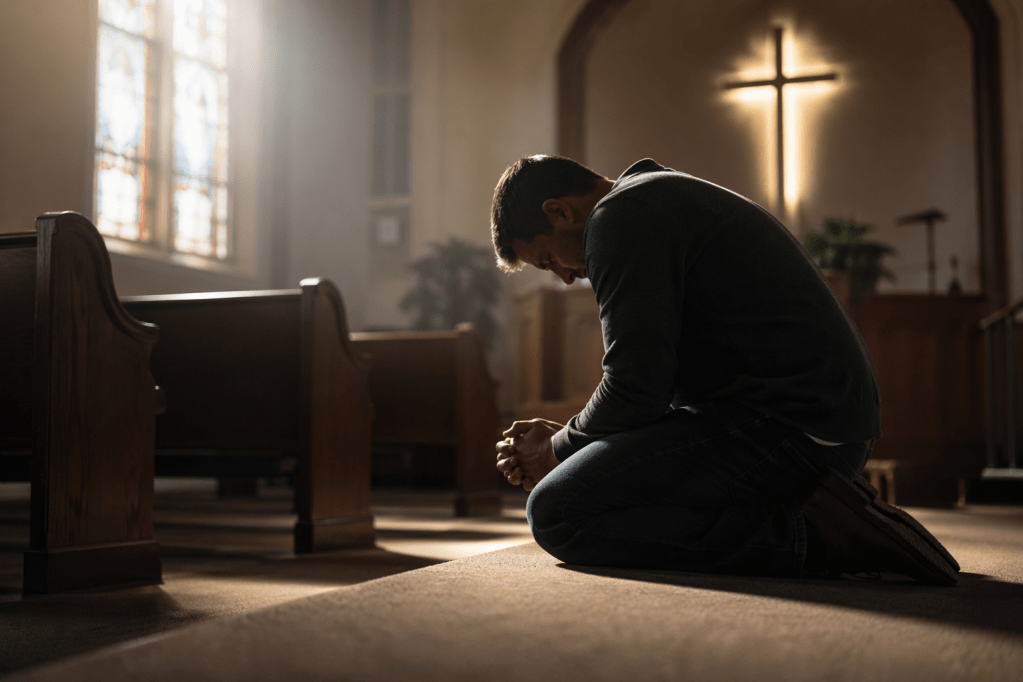
The difficult balance of pastoral integrity and honest confession
There is a quiet tension built into pastoral ministry—one that every faithful shepherd eventually feels but few articulate well. On the one hand, Scripture calls pastors to be “above reproach” (see 1 Timothy 3:2). On the other, they are called to be examples to the flock (1 Peter 5:3).
Too often, those two callings are misunderstood as being at odds. If a pastor must be above reproach, does that mean he must appear flawless? If he is to be an example, what exactly is he modeling—moral perfection, or something deeper?
The answer is not found in choosing one over the other, but in holding them together rightly.
Above Reproach Does Not Mean Sinless
The phrase “above reproach” has sometimes been flattened into an unrealistic expectation: a pastor must never stumble, never struggle, never fail in any visible way. But that is not what Paul is describing.
“Above reproach” does not mean sinless—it means blameless in reputation. A pastor’s life should not be marked by patterns of disqualifying sin, hypocrisy, or scandal. His character should be consistent, his conduct credible, and his life free from legitimate accusation.
But Scripture never presents pastors as men who have arrived. In fact, the same apostle who wrote the qualifications in 1 Timothy openly confessed his ongoing battle with sin (see Romans 7). The qualification is not perfection—it is integrity.
A man can be above reproach and still be deeply aware of his own remaining sin.
The Danger of Confusing Integrity with Image
When “above reproach” is misunderstood as “never visibly failing,” pastors can begin to curate an image rather than cultivate holiness.
They learn to hide weakness instead of confessing it.
They manage perception instead of pursuing repentance.
They fear exposure more than they fear sin itself.
This is not only spiritually dangerous for the pastor—it is spiritually damaging for the church.
A congregation that only sees polished strength will assume that mature Christianity means suppressing weakness. Sin goes underground. Confession becomes rare. Grace feels theoretical.
In trying to protect the standard, we can actually undermine the gospel.
What Does It Mean to Be an Example?
When Peter exhorts elders to be “examples to the flock” (1 Peter 5:3), he is not calling them to perform perfection. He is calling them to model Christian maturity.
And Christian maturity is not the absence of sin—it is the presence of repentance.
An exemplary pastor shows his people:
- How to respond when he sins
- How to confess quickly and honestly
- How to seek forgiveness humbly
- How to rest in the grace of Christ rather than his own righteousness
In other words, he models what it looks like to live as a sinner saved by grace.
This is why Paul could say, “Be imitators of me, as I am of Christ” (1 Corinthians 11:1). Paul was not claiming perfection—he was pointing to a pattern of life shaped by continual dependence on Christ.
The Power of Pastoral Confession
There is a unique power when a pastor confesses sin appropriately and wisely.
It reminds the church that:
- The ground is level at the foot of the cross
- The pastor is not the savior—Christ is
- Grace is not just preached; it is needed
This kind of transparency, when handled with discernment, does not weaken authority—it deepens trust.
Of course, not every struggle should be shared publicly in detail. Wisdom is required. The goal is not unfiltered vulnerability, but faithful modeling. Yet a pastor who never confesses, never admits fault, never asks forgiveness, is not protecting his ministry—he is distorting it.
Walking the Line: Integrity with Humility
So how does a pastor live in this tension?
He refuses both extremes:
1. The illusion of perfection
He does not pretend to be beyond sin. He does not hide behind his office. He does not confuse spiritual leadership with spiritual arrival.
2. The erosion of credibility
At the same time, he takes sin seriously. He fights it. He does not excuse patterns that would disqualify him. He understands that being above reproach matters for the sake of the gospel’s witness.
Instead, he walks the narrow path:
- A life marked by consistency, yet not sinlessness
- A reputation of integrity, yet a heart quick to repent
- Authority that is real, yet clearly derived—not inherent
The Kind of Example the Church Needs
The church does not need pastors who appear untouchable.
It needs pastors who are believable.
Men whose lives demonstrate that:
- Holiness is real
- Sin is serious
- Repentance is normal
- Grace is sufficient
A pastor who never seems to need grace cannot effectively preach grace. But a pastor who lives in ongoing repentance becomes a living testimony to the gospel he proclaims.
Conclusion
To be “above reproach” is to live with integrity before a watching world.
To be an “example” is to show the flock how to follow Christ in the real world.
Those callings meet, not in perfection, but in repentance.
The faithful pastor is not the one who never stumbles—but the one who, when he does, turns quickly, humbly, and visibly back to Christ.
And in doing so, he leads his people not just by instruction, but by example.
 Doctrine and Mission