Tag: biblical worship

  • Singable Worship: Why Corporate Songs Must Belong to the Congregation

    “Addressing one another in psalms and hymns and spiritual songs…” — Ephesians 5:19

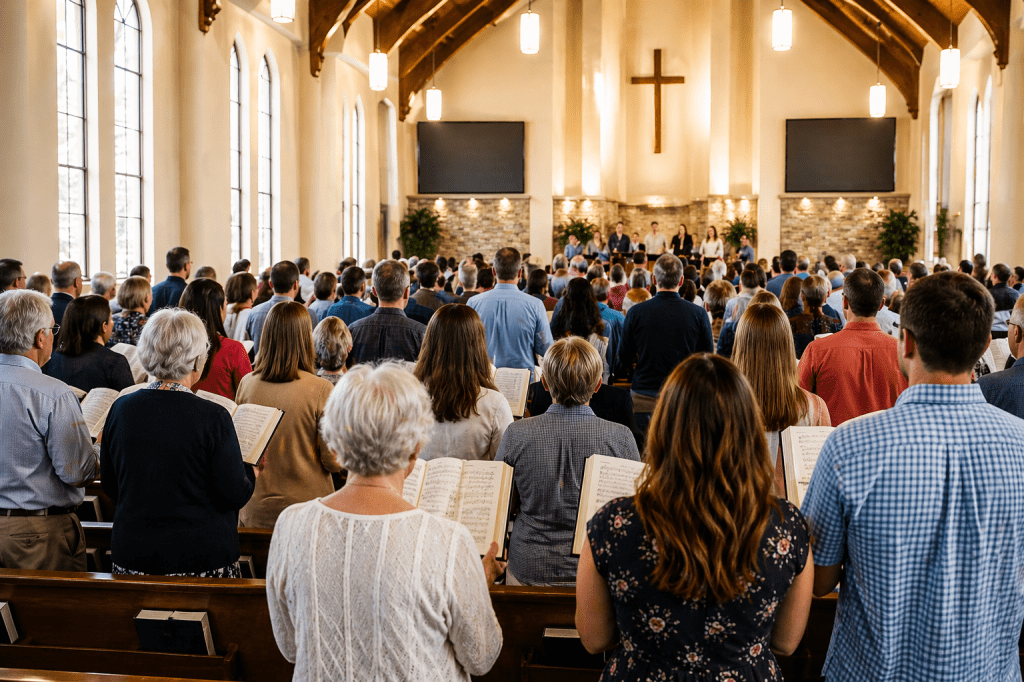
    Walk into many churches today and you’ll notice something subtle but significant:

    The music is excellent.
    The band is tight.
    The vocals are powerful.

    And yet… the congregation is quiet.

    Not silent—but hesitant. Watching more than participating. Listening more than singing.

    That’s not just a stylistic issue. It’s a theological one.

    Because Scripture does not present worship as a performance to observe—but as a shared act of singing to one another.

    Which raises a critical question:

    Are our songs actually singable for the people we’re asking to sing them?


    Worship Is Corporate, Not Platform-Centered

    When Paul describes gathered worship in Ephesians 5:19 and Colossians 3:16, the direction is unmistakable:

    We are singing to one another.

    That means the primary instrument in corporate worship is not the guitar, the piano, or even the band.

    It’s the voice of the congregation.

    The platform exists to support that—not replace it.

    But when songs are chosen that only a trained vocalist can navigate, the result is predictable:

    The congregation disengages.
    Worship becomes something done for them rather than by them.

    And slowly, almost without noticing, the church shifts from a singing people to a listening audience.


    What Makes a Song Singable?

    Singability isn’t about taste—it’s about accessibility.

    A song may sound incredible in the hands of skilled musicians and still be nearly impossible for the average person to sing.

    Here are a few elements that determine whether a song truly belongs to the congregation:

    1. A Reasonable Vocal Range

    Most untrained singers are comfortable within about an octave (roughly middle C to the next C).

    But many modern worship songs stretch far beyond that—requiring:

    • High sustained notes
    • Sudden jumps in pitch
    • Keys that sit too high or too low

    What feels powerful for a lead vocalist often feels unreachable for a congregation.

    A singable song sits in a range where:

    • Men and women can both participate
    • Voices don’t strain
    • The melody feels natural, not athletic

    If people have to stop singing to listen and recalibrate, the song is doing too much.


    2. Memorable, Predictable Melodies

    A congregation hears most songs only a handful of times.

    That means melodies must be:

    • Intuitive (they “go where you expect”)
    • Repetitive enough to learn quickly
    • Structured clearly (verse, chorus, etc.)

    If a melody feels unpredictable or overly complex, people won’t sing—they’ll spectate.

    The goal is not musical impressiveness.
    The goal is immediate participation.


    3. Rhythmic Simplicity

    Highly syncopated or rhythmically complex songs can be engaging to listen to—but difficult to join.

    Congregational singing thrives on:

    • Clear, steady rhythms
    • Strong downbeats
    • Phrases that are easy to follow

    If the average person can’t tell when to come in, they won’t.


    4. Clear, Lingering Phrasing

    People need time to:

    • Read the words
    • Process the meaning
    • Physically sing the line

    Songs that rush lyrics, cram syllables, or move too quickly unintentionally exclude the congregation.

    A singable song gives space to breathe—both musically and spiritually.


    The Difference Between a Good Song and a Church Song

    Not every good Christian song is a good corporate worship song.

    That’s an important distinction.

    Some songs are:

    • Better suited for personal listening
    • Built around a specific artist’s vocal style
    • Designed for performance rather than participation

    And that’s okay.

    But the gathered church has a different aim.

    We’re not curating a playlist—we’re cultivating a singing people.

    So the question isn’t:
    “Is this song powerful?”

    It’s:
    “Can our people actually sing this together?”


    When Music Outpaces the Congregation

    One of the unintended effects of modern worship culture—shaped in part by groups like Hillsong Worship, Bethel Music, and Elevation Worship—is that songs are often written and recorded in contexts where:

    • The musicians are highly skilled
    • The vocalists are exceptional
    • The arrangements are layered and dynamic

    Those songs can be beautiful.

    But when imported directly into the local church without adaptation, they can unintentionally sideline the congregation.

    What works in a recording or conference setting doesn’t always translate to a room full of ordinary people.

    And that matters—because the local church is not a concert venue.


    The Sound That Should Define the Church

    The most important sound in corporate worship is not the band.

    It’s the collective voice of God’s people singing truth together.

    There’s something uniquely powerful about that:

    • Imperfect voices
    • Different ages
    • Different levels of ability

    All united in one shared song.

    That’s not a limitation to work around—it’s the very design of corporate worship.


    Leading for Participation, Not Performance

    This places a responsibility on those who plan and lead music in the church.

    We should aim for:

    • Keys that fit the congregation, not just the vocalist
    • Arrangements that support, not overpower
    • Song choices that prioritize clarity over complexity

    Sometimes that means:

    • Lowering a key
    • Simplifying a melody
    • Choosing an older or simpler song over a newer, trendier one

    That’s not a step backward.

    It’s a step toward faithfulness.


    A Simple Test

    Here’s a practical question:

    If the instruments dropped out, could the congregation carry the song?

    If the answer is no, the song may not truly belong to them.

    But if the room continues—strong, confident, unified—then you’re hearing what corporate worship is meant to be.


    Give the Song Back to the People

    The goal of church music is not to showcase talent.

    It’s to equip the saints to sing.

    To teach and admonish.
    To declare truth.
    To let the Word dwell richly—not just in the band, but in the body.

    So let’s choose songs that people can actually sing.

    Songs that invite participation.
    Songs that unite voices.
    Songs that carry truth on melodies accessible enough for everyone.

    Because when the whole church sings, something beautiful happens:

    The platform fades,
    The congregation rises,
    And the sound of worship becomes what it was always meant to be—

    the voice of the people of God, lifting truth together.

  • Singing What We Believe: Why the Source of Our Worship Songs Matters

    Singing What We Believe: Why the Source of Our Worship Songs Matters

    The pulpit is central. The Bible is open. Week after week, the church is fed with careful, expositional preaching—words explained in context, doctrine drawn out with precision, application pressed into the heart.

    The congregation expects this. They’ve come to trust it. They know their pastors take Scripture seriously.

    But then the music begins.

    The lights dim. The band starts. And suddenly, the theological clarity of the pulpit gives way to something else—songs sourced from ministries the church itself would never recommend, lyrics that are thin at best and confusing at worst, and a steady diet of worship that doesn’t reflect the same doctrinal care.

    No one says it out loud, but the disconnect is there.

    Why are we so careful about what we preach, but far less careful about what we sing?

    Because Scripture doesn’t treat singing as a filler between “real” parts of the service. It treats it as one of the primary ways truth is taught and applied in the life of the church.

    In Colossians 3:16, Paul writes:

    “Let the word of Christ dwell in you richly, teaching and admonishing one another in all wisdom, singing psalms and hymns and spiritual songs…”

    Singing is not just expression—it is instruction. It is not just vertical—it is formational. When the church sings, the church is being taught.

    And that means the disconnect between pulpit and platform is not a small issue. It is a discipleship issue.


    Songs Are Not Neutral—They Teach

    If singing teaches, then every song carries theological weight.

    Lyrics are not just poetic—they are doctrinal. Over time, they shape how a church understands:

    • Who God is
    • What the gospel is
    • What the Christian life looks like
    • How we think about suffering, repentance, and holiness

    This is why Paul pairs singing with “teaching and admonishing.” When the church sings, it is doing theology together.

    So the question is not merely:

    • Is this song moving?
    • Do people like it?

    But:

    • What is this song teaching our people?

    The Inconsistency We Tolerate

    Now the tension sharpens.

    Most churches are rightly cautious about who they allow to teach. They would not platform or promote the preaching of movements like Elevation Church, Bethel Church, or Hillsong Church because of real theological concerns.

    They would not quote their pastors.
    They would not recommend their conferences.
    They would not commend their doctrine.

    And yet—they will sing their songs.

    That’s not a small inconsistency. It reveals that we may not fully believe what Scripture says about singing.

    If songs teach, then platforming songs is functionally the same as platforming teachers.

    We would never say, “We disagree with their theology, but we’ll let them preach occasionally because parts of their sermons are good.”

    But that is often exactly what we are doing—just set to music.


    The Source Shapes the Substance

    A common response is: “We only sing the good songs. We filter out the bad.”

    But theology is not just found in isolated lines—it is embedded in emphasis, tone, and trajectory.

    Every movement has instincts:

    • What they highlight about God
    • How they frame the Christian life
    • How they speak about the Holy Spirit
    • How they describe faith, blessing, suffering, and obedience

    Those instincts inevitably show up in their music.

    A song might not contain outright error, but it can still:

    • Minimize God’s holiness
    • Center man’s experience
    • Blur categories of truth
    • Promote a shallow or imbalanced spirituality

    And beyond content, there is the issue of endorsement.

    When a church consistently sings songs from a particular ministry, it sends a message—whether intended or not:

    “This is a voice you can trust.”

    That shapes how people listen outside of Sunday morning. It lowers discernment. It builds credibility for the very teaching the church may otherwise warn against.


    Worship Is Shepherding, Not Just Singing

    Worship leaders are not merely musicians. They are shepherds of the church’s theology through song.

    Every setlist is a form of discipleship.

    Every lyric is a form of instruction.

    Every source is a form of endorsement.

    This is why Scripture repeatedly calls for discernment:

    • “Test everything; hold fast what is good” (1 Thess. 5:21)
    • “Keep a close watch on yourself and on the teaching” (1 Tim. 4:16)

    That responsibility does not stop at the sermon—it extends to the songs.


    A Better Way Forward

    This is not a call for fear or cynicism. It is a call for consistency and conviction.

    If we believe in sound doctrine in the pulpit, we should pursue it on the platform.

    A few practical steps:

    Align Songs with Doctrine

    If a church would not recommend a ministry’s teaching, it should carefully reconsider using their music.

    Prioritize Theological Depth

    There is no shortage of rich, doctrinally faithful songs—both old and new. The issue is not availability, but intentionality.

    Evaluate Entire Songs

    Don’t settle for a strong chorus with weak verses. Evaluate the full message being sung.

    Shepherd with Clarity

    Help the congregation understand why song choices matter. This builds a culture that values truth, not just experience.


    Let the Word Dwell Richly

    At the heart of this issue is not preference—it is obedience.

    Paul’s command is clear:

    “Let the word of Christ dwell in you richly.”

    That happens not only through preaching, but through singing.

    The goal of worship is not merely engagement—it is formation. Not just emotion—but truth. Not just expression—but saturation in the Word.

    So we must ask:

    • Are our songs helping the Word dwell richly?
    • Are they reinforcing the doctrine we preach?
    • Are they forming our people in truth?

    Because in the end, the church will believe what it repeatedly sings.

    And if that’s true, then the source of our songs is not a secondary issue.

    It is a shepherding issue.